
Introduction
In the rapidly shifting landscape of digital marketing, the distinction between a standard Email Service Provider (ESP) and a Customer Data Platform (CDP) has become the defining line for scalability and success. For Marketing Managers at small-to-medium businesses (SMBs), the era of blasting generic newsletters to a static list is effectively over. The modern consumer expects hyper-personalization, seamless omnichannel experiences, and real-time responsiveness. This shift has propelled platforms like ExpertSender S.A. into the spotlight, promising a unification of siloed data streams into actionable marketing intelligence.
Streamline your software evaluation process
As businesses outgrow entry-level tools, the need for robust data orchestration becomes critical. You are likely facing the challenge of managing disparate customer touchpoints—web behavior, purchase history, and mobile app interactions—without a central brain to process them. This is where the search for a customer data platform for marketing managers begins. ExpertSender S.A. positions itself as that central brain, offering a high-throughput infrastructure paired with advanced CDP capabilities. However, with the market flooded with agile competitors, determining if this specific enterprise-grade solution is the right fit for your budget and technical resources is a complex decision.
This comprehensive overview will dissect ExpertSender pricing and features, technical limitations, and implementation realities. We will also rigorously compare it against eight top-tier alternatives to ensure your migration strategy aligns with your growth metrics.
Key Takeaways
ExpertSender S.A. stands out in 2026 as a powerhouse Customer Data Platform (CDP) and omnichannel marketing automation solution, tailored specifically for high-volume senders and enterprise data orchestration. If you need hyper-personalized messaging driven by complex data, it is a top-tier choice.
Here is a quick summary of what you need to know before investing:
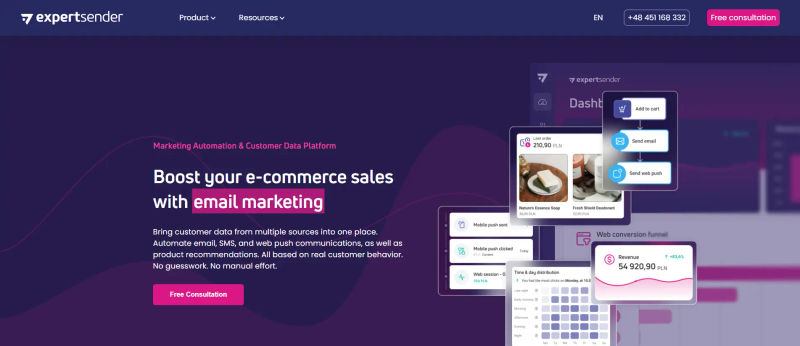
Built for sophisticated marketing: ExpertSender goes beyond basic email campaigns with CDP capabilities, advanced segmentation, and behavioral data.
Strong omnichannel capabilities: Teams can coordinate email, SMS, web, and push notifications within connected customer journeys.
Deep personalization: Detailed customer data enables marketers to create highly targeted campaigns based on individual behavior and preferences.
Useful predictive tools: AI-powered analytics can support churn prediction, purchase forecasting, and send-time optimization.
Well suited to high-volume operations: Deliverability tools, dedicated IP options, and scalable infrastructure make it suitable for larger campaigns.
Implementation requires effort: Its advanced capabilities can mean a steeper learning curve and greater technical involvement than simpler email marketing platforms.
ExpertSender S.A. Review — Advanced Data-Driven Email Automation
What Works Well
Powerful CDP capabilities: ExpertSender can bring together customer data from ecommerce platforms, CRMs, and other sources to create detailed customer profiles.
Advanced segmentation: Relational data tables and detailed customer information allow marketers to build highly specific audience segments.
Omnichannel automation: Email, SMS, web, and push messaging can be incorporated into connected customer journeys.
Strong deliverability infrastructure: Dedicated IPs, custom sending configurations, and deliverability support are valuable for high-volume senders.
Predictive analytics: AI-driven capabilities can identify churn risk, predict purchase timing, and optimize send times.
Robust API capabilities: Developer-friendly APIs support integrations with ecommerce platforms, CRMs, and custom applications.
Personalized customer journeys: Real-time data can be used to trigger highly relevant messages based on customer behavior.
Where It Falls Short
Steep learning curve: Its feature-dense interface can be intimidating for marketers accustomed to simpler email platforms.
Technical expertise may be required: Businesses using advanced CDP and data synchronization features may need developer support.
Complex implementation: Connecting multiple data sources and building sophisticated workflows can require significant setup.
Potential additional costs: High-volume businesses may need to account for onboarding, storage, or API-related expenses.
More than many SMBs need: Businesses with straightforward email campaigns may find its extensive data capabilities unnecessary.
Verdict: ExpertSender S.A. is a powerful choice for businesses that need advanced customer data management, high-volume messaging, and sophisticated omnichannel automation.
Best For: High-volume marketers, ecommerce businesses, and data-driven teams with complex customer journeys and the technical resources to manage them.
Software covered in this article
To help you evaluate Expertsender S.A. in the right context, this article compares it against a carefully curated set of competitors:


What is ExpertSender S.A.? (Core Value Proposition & CDP Capabilities)
The ExpertSender company (sometimes misspelled as expersender) is a global marketing automation provider. Founded in 2009 as a high-volume email delivery engine, ExpertSender has evolved its core value proposition. By 2026, it operates as a multichannel messaging hub built on a robust Customer Data Platform (CDP).
Unlike traditional ESPs storing basic contact info, ExpertSender’s architecture maintains a "Golden Record" for every customer. It aggregates zero-party and first-party data from every available source—eCommerce platforms, CRMs, and POS systems—to create a dynamic, 360-degree consumer view.
The "Golden Record" in Action: A Use Case
To understand the power of this architecture, consider a subscription box service for pet owners. A standard ESP might know that "Customer A" bought a dog box last month. ExpertSender’s CDP creates a Golden Record that links:
Shopify Data: Customer A subscribes to the "Large Dog" tier but skipped the last month.
Zendesk Data: Customer A has an open ticket regarding a shipping delay.
Web Behavior: Customer A visited the "Cat Toys" category page three times in the last 24 hours.
If you are evaluating how to orchestrate campaigns for pet owners using this granular data, the process relies on ExpertSender's visual omnichannel workflows. You orchestrate the journey by setting conditional logic nodes that query the Golden Record in real time. Using this unified profile, ExpertSender can automatically suppress the standard "Re-subscribe" email (due to the open ticket) and instead trigger a cross-sell SMS for cat toys with a "Sorry for the wait" discount. This level of logic requires a backend capable of processing massive API throughput without latency, a core competency of the ExpertSender infrastructure.
Furthermore, ExpertSender S.A. emphasizes its "Data-First" approach. In a cookieless world, their reliance on server-side tracking and persistent identifiers helps marketers bypass the limitations of browser-based tracking restrictions. This ensures that your attribution models remain accurate and your segmentation remains precise, regardless of privacy updates from major tech giants.
Key Features Breakdown
To understand the ROI potential of ExpertSender, we must look beyond the dashboard and into the technical engines that drive the platform.
1. Advanced CDP Capabilities and Data Orchestration
At the heart of the system is the Data Table management feature. Unlike rigid list-based systems, ExpertSender allows for relational data tables. You can store purchase history, loyalty points, and support ticket status in separate tables and link them to a unique subscriber identifier. This allows for SQL-like segmentation power without needing a data scientist on hand. The platform supports real-time data ingestion via API, ensuring that your marketing messages always reflect the customer's current state, not their state from 24 hours ago.
2. Omnichannel Automation: SMS, Web, and Social Integration
ExpertSender S.A. facilitates true omnichannel orchestration. The workflow builder mixes channels within a single journey; if an email remains unopened for 48 hours, the system automatically routes the message via SMS or push notification. The platform also supports web overlays synchronized with email behavior, dynamically rendering banners based on previous clicks.
Additionally, ExpertSender integrates directly with the best price comparison software for omnichannel strategies. By ingesting data from the top price comparison software for omnichannel retail, marketers can automatically trigger cross-channel SMS or social alerts whenever product prices drop below competitors.
3. Deliverability and Professional Services
One of the platform's strongest selling points is its approach to infrastructure. ExpertSender offers dedicated IPs and custom subnet ranges for high-volume senders. This is crucial for maintaining domain reputation. They utilize advanced throttling algorithms that adjust sending speeds based on ISP feedback loops in real-time, mitigating the risk of soft bounces turning into hard blocks. For SMBs moving up from shared IP pools (common in cheaper tools), this is a significant upgrade in ensuring inbox placement.
4. AI-Driven Predictive Modeling vs. Generative AI
The 2026 iteration of ExpertSender includes enhanced predictive analytics. It is important to distinguish this from Generative AI (like ChatGPT). ExpertSender's AI focuses on backend logistics using machine learning to calculate:
Churn Probability: Identifying users likely to unsubscribe before they do.
Predicted Next Purchase Date: Timing emails to land exactly when a replenishable product runs out.
Send Time Optimization (STO): Delivering messages when a specific user is historically most active.
These aren't just static metrics; they are dynamic fields that can be used to trigger automated retention campaigns before a customer even realizes they are disengaging.
ExpertSender Pricing and Features: A 2026 Detailed Breakdown
If you are wondering if the platform is free (est ce que c'est gratuit?), it is not. ExpertSender does not offer a free tier.
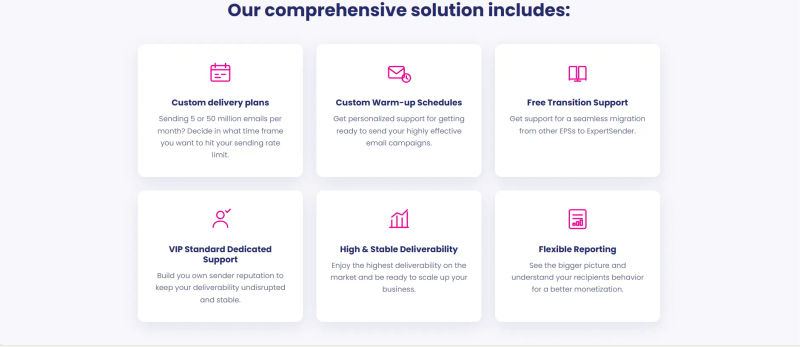
ExpertSender pricing operates on a custom, volume-based model. For 2026, they use structured tiers based on active subscriber count and monthly email volume to give growing SMBs predictability. While exact costs require a sales quote, higher tiers bundle dedicated IPs and deliverability consulting. Below is a breakdown of their standardized plans.
Plan | Price | Best For | Features |
Growth | Custom Pricing | SMBs scaling up from basic ESPs | 1. Up to 50k Contacts |
Professional | Custom Pricing | Mid-sized teams needing deep data | 1. Up to 150k Contacts |
Enterprise | Custom Pricing | High-volume senders & complex stacks | 1. Unlimited Contacts (Tiered) |
The Hidden Costs of Enterprise CDPs
While the base pricing seems straightforward, Marketing Managers must be aware of potential hidden costs associated with platforms like ExpertSender. Unlike plug-and-play tools, enterprise-grade solutions often carry:
Onboarding Fees: A one-time setup fee ranging from $2,000 to $5,000 is common for dedicated IP warming and data migration assistance.
Data Storage Overages: If you store massive amounts of historical event data (e.g., every web click for 5 years), you may hit storage caps that trigger additional monthly fees.
API Call Limits: High-frequency businesses (like daily deal sites) may exceed standard API rate limits, requiring the purchase of "throughput boosters."
Find Perfect Software For Your Business
Top 8 ExpertSender Alternatives to Consider
While ExpertSender is powerful, the 2026 market offers several robust alternatives that might align better with specific use cases, budgets, or technical capabilities. Here is a detailed look at the top contenders.
1. Moosend: The User-Friendly Contender
Moosend remains a favorite for SMBs that want automation without the headache. Unlike ExpertSender's industrial-strength interface, Moosend offers a highly intuitive UI that democratizes marketing automation.
Comparison: Moosend is significantly more affordable and easier to set up. It offers robust automation workflows and AI-driven product recommendations but lacks the deep, relational database capabilities of ExpertSender. If your data needs are straightforward—e.g., tracking purchases and clicks—Moosend is sufficient. If you need to map complex custom objects, ExpertSender wins.
Best For: SMBs looking for a balance of power and usability without a steep learning curve.
Migration Ease Rating: 9/10. Moosend has excellent import tools for standard CSVs and direct integrations with major platforms, making switching very low-friction.
2. Drip: Best for E-commerce Personalization
Drip has doubled down on being the "Ecommerce Revenue Engine." It is purpose-built for DTC (Direct-to-Consumer) brands running on platforms like Shopify, Magento, or WooCommerce.
Comparison: Drip’s visual builder is superior for creating aesthetically pleasing emails quickly. Its integration with Shopify is deeper out-of-the-box compared to ExpertSender’s generic API approach. Drip focuses heavily on visual revenue attribution, showing you exactly how much money each email made. ExpertSender offers this too but requires more configuration. However, Drip can get expensive quickly as list sizes grow, whereas ExpertSender’s volume pricing might be more efficient for massive lists.
Best For: Online retailers who want plug-and-play revenue automation.
Migration Ease Rating: 8/10. If you are on Shopify, Drip connects in minutes. Moving historical data from a custom CDP like ExpertSender to Drip is harder, as Drip has a more rigid data structure.
3. Sender: High-Volume Efficiency
Sender is a rising star known for its incredible price-to-performance ratio. It focuses on high deliverability and speed, much like ExpertSender, but with a stripped-down feature set focused on essentials.
Comparison: Sender is ideal if your primary goal is sending emails and SMS efficiently without complex CDP requirements. It lacks the predictive modeling and advanced SQL-like segmentation of ExpertSender. However, for a Marketing Manager operating on a lean budget who still needs high throughput and reliable inbox placement, Sender is a formidable alternative.
Best For: Startups and SMBs prioritizing budget and deliverability over complex data orchestration.
Migration Ease Rating: 9/10. Extremely simple interface and import process. You can be up and running in an afternoon.
4. Customer.io: Best for Data-Triggered Messaging
Customer.io is perhaps the closest direct competitor regarding data flexibility. It is built for SaaS and tech-forward companies that want to trigger messages based on complex event data. Because of its robust data routing capabilities, Customer.io frequently anchors a CIO's digital transformation initiatives by unifying disparate data streams into a single, actionable messaging pipeline.
Comparison: Customer.io’s "Data Pipelines" feature rivals ExpertSender’s CDP. It allows for incredible flexibility in how you use data to trigger logic. The UI is cleaner and more modern than ExpertSender’s. However, Customer.io requires a bit of technical know-how (Liquid code) to unlock its full potential. While ExpertSender leans towards enterprise stability, Customer.io feels more agile and developer-friendly.
Best For: SaaS companies and tech-savvy marketing teams who love logic-based automation.
Migration Ease Rating: 6/10. Because Customer.io is so flexible, mapping your data correctly requires planning. It is not a 1-click install; it requires a data strategy.
5. Kartra: The All-in-One Marketing Suite
Kartra is not just an email tool; it is an entire business operating system. It includes landing pages, video hosting, checkouts, and membership sites.
Comparison: If ExpertSender is a specialized surgeon, Kartra is a general practitioner. Kartra replaces your landing page builder, video host, and shopping cart. However, its email automation and deliverability controls are not as granular as ExpertSender’s. You cannot manage dedicated IPs or complex throttling in Kartra. If you need a full funnel in a box, choose Kartra. If you need best-in-class email deliverability and data management, stick with ExpertSender.
Best For: Solopreneurs and small teams wanting to consolidate their entire tech stack.
Migration Ease Rating: 4/10. Moving to Kartra often means moving your entire business (pages, checkout, etc.), which is a massive undertaking.
6. Omnisend Ltd: Best for Omnichannel Retail
Omnisend is specifically designed to help eCommerce stores drive sales through multiple channels, including Email, SMS, and Web Push. Based on our Omnisend customer data platform (CDP) features review, it also functions as a highly effective, lightweight retail CDP.
CDP Features & Comparison: Omnisend automatically aggregates purchase history, browsing behavior, and campaign engagement into unified customer profiles. It excels in pre-built workflows using this centralized data. You can set up a "Cart Abandonment" series involving email and SMS in minutes, whereas ExpertSender requires you to build this logic from scratch. Omnisend’s integration with platforms like Shopify Plus is seamless. While ExpertSender offers deeper CDP customization for complex, non-retail data structures, Omnisend is the superior choice for pure-play retail businesses that want industry-standard automations ready to go on day one.
Best For: Retailers who want to seamlessly combine SMS and Email marketing using out-of-the-box customer data platform capabilities.
Migration Ease Rating: 8/10. Very high for eCommerce stores; lower if you have a custom-built backend.
7. iContact: Reliable Legacy Solutions
iContact has been a staple in the industry for years, known for its reliability and excellent customer support.
Comparison: iContact is a "steady eddy." It doesn't have the advanced AI or CDP capabilities of ExpertSender. It is a traditional ESP focused on newsletters and basic autoresponders. For a business that simply needs to communicate with a list without complex behavioral targeting, iContact is far easier to use and cheaper. However, it will severely limit a 2026 marketing strategy focused on hyper-personalization.
Best For: Traditional businesses with simple newsletter needs and a desire for phone support.
Migration Ease Rating: 10/10. One of the simplest platforms to adopt. Upload your list and start sending.
8. Campaigner: Best for Advanced Workflows
Campaigner positions itself for the sophisticated marketer, offering features like "Experiments" (multivariate testing) and complex workflow automation.
Comparison: Campaigner is a strong middle ground. It offers more advanced features than iContact or Moosend but is less infrastructure-heavy than ExpertSender. Its workflow builder is powerful, allowing for complex branching logic. However, its CDP capabilities are not as deep as ExpertSender’s "Golden Record" architecture. Campaigner is excellent for marketers who want to run complex A/B tests on automation flows.
Pricing: While standard plans are tiered by contact volume, Campaigner 360 pricing uses a custom, quote-based model. This enterprise tier is tailored for high-volume senders requiring dedicated account management and advanced deliverability tools.
Best For: Marketers focused on conversion rate optimization (CRO) through rigorous testing.
Migration Ease Rating: 7/10. Requires some setup for advanced workflows, but the interface is logical for experienced marketers.
Implementation & Support: What to Expect
Choosing a platform like ExpertSender is not just a software purchase; it is an infrastructure project. Unlike signing up for a freemium tool, the implementation timeline for ExpertSender typically runs between 4 to 8 weeks depending on the complexity of your data integration. This period includes IP warming (gradually increasing email volume to establish reputation), API connection testing, and data mapping.
Support is a critical differentiator. ExpertSender typically provides dedicated account management for their Professional and Enterprise tiers. This means you have a human point of contact who understands your specific business logic, rather than a generic chat bot. However, SMBs should verify the support hours—ensure that your account manager operates in your time zone, as critical deliverability issues often require immediate attention.
The 2026 Migration Readiness Checklist
Before you decide to migrate to a CDP like ExpertSender, use this checklist to ensure your organization is ready. Moving to a CDP without a strategy is a recipe for expensive shelfware.
Data Source Audit: Have you identified every source of customer data (POS, Website, App, CRM, Helpdesk)? Do you have API access to these tools?
Identifier Strategy: How will you link users across devices? Do you have a consistent unique identifier (e.g., User ID or Email) across all your systems?
Content Velocity: A CDP allows for hyper-segmentation, which means you need more content. Do you have the creative resources to produce unique copy and assets for 10 different segments, or will you just send the same generic email to everyone anyway?
Technical Bandwidth: Do you have access to a developer for the initial setup? If not, do you have the budget to pay for ExpertSender’s implementation services?
Compliance Check: Is your data collection compliant with 2026 privacy standards (GDPR, CCPA, etc.)? A CDP centralizes liability as much as it centralizes data.
Final Verdict: Is ExpertSender S.A. Right for Your Marketing Stack?
Deciding on ExpertSender S.A. comes down to your data maturity. If your business is sitting on a goldmine of customer data—transaction logs, website activity, app usage—and you are currently unable to leverage that data for marketing due to tool limitations, ExpertSender is a worthy investment. Its ability to unify this data into a single, actionable CDP makes it a powerhouse for increasing Customer Lifetime Value (CLV).
However, if your primary need is simply to send attractive newsletters or run basic abandoned cart sequences for a Shopify store, ExpertSender might be overkill. The complexity of the setup and the cost of the platform are justified only if you are using the advanced segmentation and omnichannel orchestration features. For many SMBs, agile alternatives like Customer.io (for data) or Drip (for retail) might offer a faster time-to-value.
In 2026, the cost of switching platforms is high, not just in dollars but in data migration headaches. It is imperative to validate your specific use cases—such as API call limits, storage overages, and integration readiness—before signing a contract.
Try AuthenCIO
Move to faster, smarter software evaluation with AI
Conclusion
ExpertSender S.A. stands as a formidable solution in the 2026 marketplace, bridging the gap between high-volume email sending and sophisticated customer data management. It offers the infrastructure of an enterprise powerhouse with the agility required for modern omnichannel strategies. While it demands a higher level of technical competence and budget than entry-level ESPs, the payoff in data granularity and deliverability can be substantial for the right organization.
As you evaluate your marketing stack for the coming year, focus on your data strategy first. If centralization and complex orchestration are your goals, ExpertSender is a top-tier candidate. If speed and simplicity are paramount, exploring the alternatives listed above is your best course of action. Whichever path you choose, ensure your decision is backed by data and direct comparison.