
Introduction
This 2026 Omnisend review evaluates whether the platform remains the top email automation software for small to medium-sized eCommerce businesses. While U.S. eCommerce order volume recently grew by 147% year-over-year, many Marketing Managers still struggle to maximize Customer Lifetime Value (CLV) using fragmented tools. Omnisend addresses this by combining email, SMS, and push notifications into unified, hyper-personalized workflows.
Streamline your software evaluation process
Many SMBs find themselves trapped by exorbitant fees for enterprise features they rarely use, or limited by generalist tools lacking specific eCommerce triggers. Omnisend positions itself as a purpose-built, omnichannel alternative. By weaving SMS and push notifications directly into traditional email workflows, it helps brands efficiently capture the 27% of revenue typically generated by automated messages.
With the market crowded with capable customer lifecycle management software, you need to know if Omnisend is the most capital-efficient choice for your tech stack. This comprehensive review dissects Omnisend's capabilities, pricing, and integrations to help you make an informed decision for your 2026 eCommerce strategy.
Key Takeaways
Best for E-commerce: Omnisend remains a top-tier marketing automation platform in 2026, specifically engineered for e-commerce brands using Shopify, WooCommerce, and BigCommerce.
Omnichannel Automation: Its standout capability is seamlessly blending email, SMS, and web push notifications into single, automated customer lifecycle workflows.
Transparent Pricing: The platform offers a generous Free tier (up to 250 contacts). Paid plans scale predictably based on list size, with the Standard plan starting at $16/month and the Pro plan (which includes free SMS credits) starting at $59/month.
Data-Driven Segmentation: Users get access to robust, out-of-the-box segmentation based on real-time shopping behavior, campaign engagement, and predictive analytics, making personalization effortless.
The Pros and Cons of Choosing Omnisend
When evaluating Omnisend pros cons 2026, you must weigh its deep e-commerce automation benefits against the technical limitations of its steeper learning curve.
Pros
eCommerce-First DNA: The platform is purpose-built for online stores, meaning integrations with Shopify, WooCommerce, and BigCommerce are native and deep, utilizing data mapping that generalist tools often miss.
Ease of Use: The visual drag-and-drop editor and pre-built workflow templates (e.g., Product Abandonment, Cross-Sell) allow for rapid deployment without developer assistance.
SMS Compliance: Omnisend handles much of the heavy lifting regarding TCPA and GDPR compliance for SMS marketing, reducing legal anxiety for SMBs.
Deliverability Infrastructure: Omnisend maintains rigorous IP warming protocols and provides feedback on sender reputation, ensuring emails land in the Primary tab rather than Promotions or Spam.
Cons
Limited CRM Capabilities: While excellent for marketing, it lacks the deep CRM functionality of tools like Salesforce or HubSpot. It is not designed to manage complex B2B sales cycles.
Design Flexibility: While functional, the email designer can feel rigid compared to design-centric competitors like Campaign Monitor by Marigold.
Support Tiers: Dedicated account management is gated behind higher spending thresholds ($400/mo+), leaving smaller merchants to rely on chat support which, while responsive, may lack strategic depth.
Best for: Global brands seeking multi‑channel marketing and easy platform migration.
Verdict: Omnisend offers a flexible automation suite for marketers needing scalable email and SMS tools with strong international support.

Software covered in this article
To help you evaluate Omnisend in the right context, this article compares it against a carefully curated set of competitors:


What is Omnisend Ltd? Core Features and Capabilities
Omnisend is an eCommerce-first marketing automation platform. If you evaluate the marketing automation company Omnisend on customer data platform capabilities, it functions as a lightweight CDP, unifying real-time shopper behavior into actionable profiles without requiring enterprise data warehousing.
Core Omnisend features include omnichannel workflows, segmentation, and dynamic recommendations. Regarding Omnisend features pricing 2026, all tools—including SMS and reporting—are unlocked on the free tier, meaning costs scale strictly by contact volume rather than gated functionality.
1. Advanced Segmentation and Customer Lifecycle Management
When conducting an Omnisend email personalization features review, the platform's ability to drive customer lifecycle management immediately stands out. At the heart of Omnisend’s 2026 infrastructure is its dynamic segmentation engine. For SMBs, the ability to personalize emails by segmenting not just by demographics but by real-time transactional behavior is critical. Omnisend allows users to layer multiple filters—such as "purchased product X," "viewed category Y," and "has not engaged in 30 days"—to create highly granular audiences. This ensures that every automated email dynamically adapts its product recommendations and messaging to fit the user's exact lifecycle stage.
More importantly, the 2026 update introduces enhanced AI-driven predictive analytics that directly power these email personalization features. The platform now assigns "likely to buy" scores to individual profiles based on browsing frequency and historical data. This allows marketers to create preemptive retention segments, targeting at-risk customers with personalized win-back email offers before they churn, or serving VIP exclusives to those with the highest propensity to purchase. This shift from reactive segmentation to proactive, lifecycle-driven personalization is a key driver for increasing Customer Lifetime Value (CLV).
2. Omnichannel Workflows: Combining Email, SMS, and Push
True to its name, Omnisend’s standout feature is the unified workflow builder. Unlike competitors that treat SMS as a bolt-on feature with separate reporting, Omnisend integrates text messaging directly into the automation sequence using a single visual interface.
When evaluating the Omnisend abandoned cart email conversion rate benchmark, merchants typically see standard email-only sequences converting at the industry average of around 34%. However, utilizing a multi-channel approach significantly improves these baseline metrics.
A typical 2026 workflow designed to beat these benchmarks might look like this:
Trigger: Customer abandons cart (Value > $100).
Action: Wait 1 hour -> Send Email 1 (Dynamic Product Block).
Condition: If Email 1 is not opened in 12 hours -> Send SMS (Short, urgent copy).
Action: If purchase is made -> Send Push Notification with shipping update.
This synergy ensures that brands reach customers on their preferred channel without bombarding them. By utilizing "smart sending" rules, Omnisend prevents message fatigue, maintaining a high sender** reputation** and reducing unsubscribe rates.
3. Reporting and Analytics: Tracking ROI and Attribution
Marketing attribution remains a pain point for many SMBs. Omnisend resolves this with a robust reporting dashboard that tracks sales directly attributed to specific campaigns and workflows. In 2026, the platform has enhanced its visualization tools, allowing managers to see a clear breakdown of revenue by channel (Email vs. SMS).
With email marketing continuing to generate an average $36-$40 ROI per dollar spent, having visibility into which specific automated flows (e.g., Welcome Series vs. Post-Purchase) are driving that return is invaluable for budget allocation. The platform uses customizable attribution windows, allowing you to define whether a sale should be credited to an email opened 24 hours ago or 7 days ago.
4. Ease of Use & Team Onboarding
One of the primary concerns for Marketing Managers is the learning curve for junior staff. Omnisend addresses this with a user interface that prioritizes visual logic over code.
When evaluating Omnisend on ecommerce list growth and lead capture, the platform provides highly accessible, built-in form builders. Teams can launch customizable popups, exit-intent overlays, and embedded signup forms without developer assistance. These capture tools feed directly into Omnisend's segmentation, automatically routing new leads into targeted welcome workflows.
For campaign creation, the drag-and-drop builder supports "saved content blocks" for global template updates. Onboarding is further streamlined by the "Product Picker" feature. When connected to a store, users pull product images, descriptions, and prices directly into emails without manual copy-pasting. This reduces technical overhead, enabling lean teams to manage both list growth and complex campaigns in minutes.
Omnisend Integrations: Building a 2026 Tech Stack
No marketing tool exists in a vacuum. For a 2026 eCommerce operation, the ability to sync data across the entire tech stack is non-negotiable. Omnisend excels here due to its native, deep integrations with major platforms like Shopify, BigCommerce, and WooCommerce.
Beyond the cart, Omnisend integrates with critical ecosystem apps:
Customer Support (Gorgias, Zendesk): Omnisend data pushes to helpdesks, allowing support agents to see a customer's VIP status or recent email engagement before responding to a ticket.
Reviews (Yotpo, Stamped.io): Review requests can be triggered via Omnisend workflows, and positive reviews can segment customers into "Brand Advocate" lists.
Subscriptions (ReCharge): Essential for DTC brands, this integration allows for specific churn-prevention flows targeting subscribers who have paused or cancelled their recurring orders.
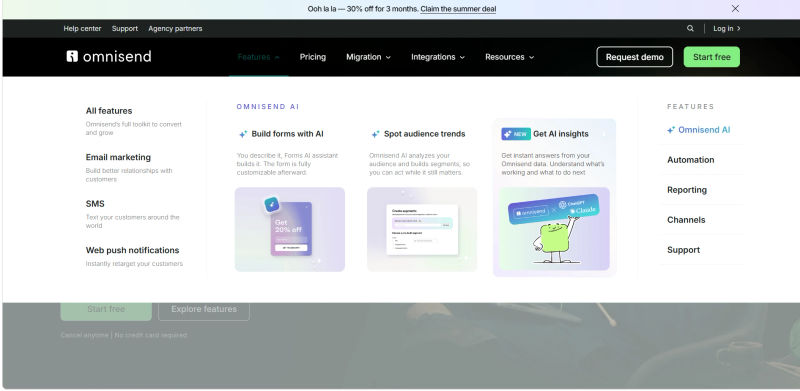
This interconnectivity ensures that data mapping is accurate, preventing the dreaded "siloed data" issues that plague scaling businesses.
Find Perfect Software for Your Business
Omnisend Pricing Plans 2026: Is It Worth the Investment?
When evaluating omnisend pricing 2026, the platform uses a transparent, subscriber-based model. The omnisend pricing official 2026 structure features three tiers: Free, Standard, and Pro. While costs scale with growth—a "success tax" seen in similar platforms—Omnisend includes core automation on all tiers.
Understanding omnisend free plan limits 2026 is crucial: it covers 250 contacts, 500 emails/month, and 60 SMS messages. For growing brands, the paid omnisend pricing plans 2026 include:
Standard (from $16/mo): 6,000 emails/month and unlimited web push.
Pro (from $59/mo): Unlimited emails, advanced reporting, and included SMS credits.
Recent omnisend pricing features reviews 2026 show that omnisend pricing features for small businesses 2026 align perfectly with e-commerce needs. Analyzing omnisend pricing features 2026, users get robust segmentation without paywalls. While extra SMS credits cost separately, general omnisend pricing features reviews confirm that overall omnisend pricing delivers strong ROI.
Plan | Price | Best For | Features |
Free | $0 /mo | New merchants starting out | • 500 emails/mo |
Standard | $16 /mo | Growing businesses focused on email | • 6,000 emails/mo |
Pro | $59 /mo | High-volume senders needing SMS power | • Unlimited emails |
*Note: All prices shown reflect typical monthly billing. Vendors often offer lower pricing for annual commitments, but those discounts are excluded here for easier comparison. Actual costs may vary depending on your requirements, usage volumes, and negotiated terms.

Real-World Cost Scenario
To visualize Omnisend pricing for small businesses 2026, consider a US-based brand with 10,000 subscribers.
Standard Plan: Approx. $115/month for email marketing.
SMS Add-on: Sending 2 SMS campaigns monthly to 5,000 mobile subscribers (10,000 SMS total) adds ~$150/month (at ~$0.015/SMS).
Total Monthly Cost: ~$265/month.
For Omnisend pricing 2026 small business budgets, this setup offers competitive value compared to enterprise tools costing $400+. To lower costs, look for a standard Omnisend deal: they typically offer up to 15% off for annual billing and run seasonal Q4 promotions for new merchants.
Ready to compare Omnisend Ltd with other leading email marketing platforms? Try AuthenCIO for free!
Top 8 Omnisend Alternatives 2026
If Omnisend does not fit your budget or technical requirements, several strong Omnisend alternatives exist in the 2026 email automation market. To help you compare options, we evaluated the top competitors and categorized them by design focus, SMB value, and enterprise capabilities.
1. Design & Experience Focused Alternatives
Campaign Monitor by Marigold vs. Omnisend
Campaign Monitor by Marigold is renowned for its impeccable design standards and template quality. Where Omnisend focuses on the logic of automation and data, Campaign Monitor focuses on the aesthetics of the inbox experience.
Best For: Brands where visual identity, typography, and design precision are paramount (e.g., luxury fashion, high-end media, lifestyle brands).
Why Switch: If your creative team struggles to create pixel-perfect emails in Omnisend’s editor, Campaign Monitor’s drag-and-drop builder is often cited as superior for creative freedom. It offers more control over mobile responsiveness and custom code injection, making it the preferred choice for brands that treat every email as a piece of art.
2. Value-Driven Alternatives for SMBs
Moosend** vs. Omnisend**
When evaluating moosend vs omnisend, Moosend aggressively positions itself as the value leader in 2026. It offers robust email automation features that rival Omnisend but at a significantly lower price point.
Best For: Budget-conscious SMBs who need powerful automation triggers without the high monthly retainer.
Why Switch: If the "success tax" of Omnisend’s pricing is eating into your margins, Moosend provides a similar feature set (including landing pages and automation) for a fraction of the cost. In a direct moosend vs omnisend comparison, Omnisend wins on deep native SMS and push integration, but Moosend’s email automation logic is surprisingly deep for the price.
Sender vs. Omnisend
Sender is another challenger focused on high affordability and high deliverability. It markets itself on a "what you see is what you pay" promise, avoiding hidden costs and complex tier structures.
Best For: Startups and small eCommerce stores that need a generous free tier and low-cost scaling options.
Why Switch: Sender’s interface is incredibly streamlined. If Omnisend feels too "heavy" or feature-bloated for your current needs, Sender offers a lightweight, fast alternative that still supports essential SMS functions. It is ideal for teams that want to set up simple abandoned cart flows and newsletters without navigating a complex dashboard.
AWeber Communications vs. Omnisend
AWeber Communications is a veteran in the industry, known for reliability and simplicity. While it has modernized with automation features, it remains a "list-centric" tool rather than the "customer-centric" database structure of Omnisend.
Best For: Content creators, publishers, and businesses with simple affiliate marketing models alongside their store.
Why Switch: AWeber offers a flatter learning curve for non-technical users who find Omnisend’s behavioral triggers overwhelming. It is a stable, no-nonsense choice for straightforward newsletters and basic autoresponders, backed by 24/7 support that is accessible to all plan levels.
3. Enterprise & Complex Workflow Alternatives
iContact** vs. Omnisend**
iContact has carved a niche by offering strong integration with Salesforce, making it a bridge between SMB simplicity and enterprise CRM needs.
Best For: Businesses that are scaling up and require their email marketing data to sync deeply with a Salesforce CRM environment.
Why Switch: Omnisend’s CRM features are light; if your sales team needs visibility into email engagement within their CRM to close B2B deals or manage wholesale accounts, iContact’s native integration is a decisive factor. It bridges the gap between marketing blasts and one-to-one sales follow-ups.
Campaigner vs. Omnisend
Campaigner is built for the power user who demands complex workflows. It supports highly intricate automation trees that can handle sophisticated logic beyond standard eCommerce triggers (e.g., if X happens AND Y doesn't happen within Z days).
Best For: Mid-market companies with complex customer journeys involving multiple touchpoints and conditional logic.
Why Switch: If you find Omnisend’s workflow builder limiting for your specific multi-step, multi-condition nurture tracks, Campaigner offers the granular control required for complex automation strategies. It allows for advanced API triggers that can handle custom events from proprietary apps.
GetResponse vs. Omnisend
GetResponse has evolved into an "all-in-one" marketing platform. Beyond email and SMS, it includes webinar hosting, conversion funnels, and website building capabilities.
Best For: Marketing teams that want to consolidate their tech stack (Email + Webinars + Landing Pages) into a single subscription.
Why Switch: Omnisend is specialized for eCommerce messaging. If your marketing strategy relies heavily on lead generation through webinars, content funnels, or educational courses, GetResponse offers a broader toolkit. It allows you to manage the entire funnel from lead magnet to sale within one ecosystem.
ExpertSender S.A. vs. Omnisend
ExpertSender S.A. targets the high-volume, enterprise segment of the market. It is engineered for maximum deliverability and scalability, often handling millions of messages per hour.
Best For: Large eCommerce enterprises where deliverability optimization, dedicated IPs, and custom infrastructure are critical.
Why Switch: For businesses sending millions of emails monthly, Omnisend’s shared infrastructure may struggle or become cost-prohibitive. ExpertSender provides the dedicated IP support and deliverability consulting necessary for high-volume senders who cannot afford a 1% drop in inbox placement.
Implementation Strategy: Integrating Omnisend into Your Tech Stack
Switching marketing platforms is a significant undertaking. To ensure a smooth transition without losing data or revenue, a structured approach is required.
The 30-Day Migration Blueprint
Week 1: Audit and Clean (Days 1-7): Before exporting data from your current provider (e.g., Mailchimp or Klaviyo), run a list cleaning service to remove hard bounces and inactive users. This protects your sender reputation on the new IP.
Week 2: Data Mapping & Integration (Days 8-14): Connect Omnisend to your eCommerce store. Map your custom fields (e.g., "Birthday," "Skin Type") to Omnisend properties. Ensure historical purchase data syncs correctly to enable "likely to buy" segmentation.
Week 3: IP Warming (Days 15-21): Do not send to your entire list immediately. Start by sending to your most engaged segment (opened in last 30 days). Gradually increase volume day by day to establish trust with ISPs (Gmail, Outlook).
Week 4: Workflow Activation (Days 22-30): Recreate your core automations (Welcome, Abandoned Cart) in Omnisend. Test the logic, activate them, and then turn off the corresponding flows in your old provider to avoid double-sending.
Try AuthenCIO
Move to faster, smarter software evaluation with AI
Final Verdict: Should You Switch to Omnisend in 2026?
To conclude this Omnisend review 2026, the platform remains a top-tier choice for eCommerce merchants, particularly small businesses on Shopify looking to combine SMS and email in a single, unified view. If you are searching for an Omnisend review for small businesses 2025 2026, the verdict is clear: its ability to drive revenue through automated, behavior-based workflows is proven. The reporting tools provide the transparency needed to justify marketing spend, while predictive analytics and deeper integrations make it a future-proof choice for growing SMBs.
However, it is not a one-size-fits-all solution. For brands prioritizing pure design, Campaign Monitor by Marigold may be the better artist's tool. For those strictly managing budget, Moosend or Sender offer compelling value. And for those with complex CRM needs or massive sending volumes, looking toward iContact or ExpertSender S.A. is advisable.
Ultimately, the decision rests on your specific growth stage and channel strategy. If your goal is to automate 30% of your revenue through a mix of text and email with minimal technical headache, Omnisend is a leading candidate in the email automation software market.