

Introduction
In the high-stakes environment of marketing operations and customer support, the most expensive resource isn't budget—it's engineering time. You identify a critical leak in your lead qualification or support funnel, design a logic-based solution to plug it, and then face the reality of a three-sprint backlog before a developer can touch the form fields. By 2026, this latency is no longer acceptable. The cost of inaction—measured in qualified leads lost and degraded user experiences—has driven the massive adoption of conversational tools that empower operations teams to own the infrastructure.
Streamline your software evaluation process
If you are analyzing Landbot reviews to evaluate its fit for your tech stack, this comprehensive Landbot review explores how the platform has evolved from a simple chatbot builder into a sophisticated data orchestration and customer support layer. For Operations Managers at tech companies, the objective is clear: automate lead qualification, streamline support routing, enforce rigorous data hygiene before CRM entry, and accelerate pipeline velocity without writing code.
Landbot positions itself as a leader in this space, promising a visual interface that handles complex boolean logic as intuitively as a whiteboard sketch. But does it truly eliminate the need for technical intervention? How does it handle the nuances of enterprise security, API rate limits, and global localization? And how does it stack up against customer support and messaging competitors like Freshchat, Tidio, respond.io, and heavyweights like Drift?
This deep dive provides a transparent, technical analysis of Landbot’s capabilities, pricing, and limitations, specifically tailored for the Ops professional responsible for the tech stack.
Key Takeaways
Ideal for Marketing Ops: Landbot excels as a no-code, hybrid AI solution for marketing teams needing agile lead qualification and routing without heavy developer reliance.
Built for conversion: Landbot turns website conversations into qualified leads rather than simply answering FAQs.
Automation without engineering: Marketing teams can build, test, and update complex workflows independently.
Data is a major strength: It combines conversational experiences with structured data collection and CRM integration.
Best when complexity matters: It is particularly valuable when basic chatbot tools aren't enough for sophisticated qualification workflows.
The Pros and Cons of Scaling with Landbot
Every platform introduces technical debt. For senior IT and marketing leaders managing 250 to 10,000 employees, weighing the pros and cons of using Landbot chatbots comes down to autonomy versus ultimate control.
Landbot empowers you to build advanced, multilingual automation independently, bypassing developer bottlenecks to reduce operating costs, improve conversion rates, and provide 24/7 support. However, scaling can expose pain points like debugging complex automations, tool overload, AI hallucinations, and strict customization limits that risk vendor lock-in.
The Pros: Agility and Data Granularity
Speed of Iteration: You can clone a flow, tweak the copy, and deploy a new version in minutes. This is essential for A/B testing value propositions without engineering tickets.
Unstructured to Structured Data: Landbot is exceptional at turning conversation into database rows. The ability to validate email formats, phone numbers, and dates within the chat ensures high data hygiene entering your CRM.
Omnichannel Deployment: You can deploy the same bot logic as a full-page landing page, a website widget, a popup, or even via WhatsApp. This ensures a consistent qualification framework across channels.
The Cons: Customization and Reporting Limits
CSS Constraints: While you can customize colors and fonts, deep CSS overrides to match a strictly governed design system can be tricky. It is a "low-code" platform, but the visual container has fixed behaviors.
Analytics Granularity: While Landbot provides flow analytics (drop-off rates per block), it often lacks the deep attribution modeling found in dedicated BI tools. You will likely need to export data or use Google Analytics events to truly understand the impact on the full funnel.
API Rate Limits: For extremely high-volume enterprises, relying solely on Landbot’s native API handling can sometimes hit rate limits. If you are processing 10,000 concurrent leads, you may need to introduce a middleware buffer.
Verdict: A powerful no-code chatbot platform for businesses that need sophisticated lead qualification and conversational experiences.
Best For: B2B tech companies and Marketing Ops teams that want to automate lead qualification while maintaining clean, structured CRM data.
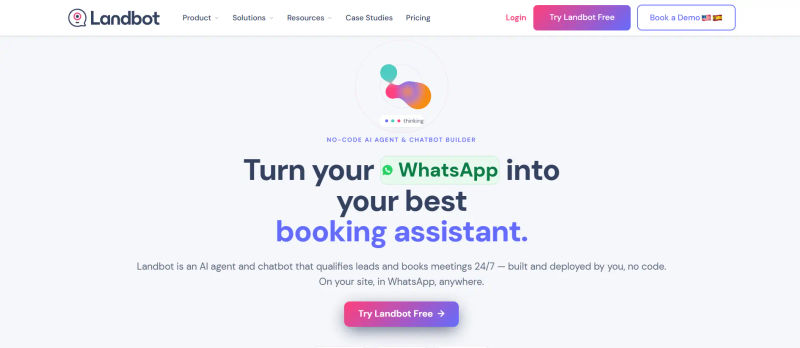
Landbot & Leading Customer Support Alternatives
While this guide focuses on Landbot, it’s helpful to compare it against the most recognized Customer Support solutions.







Why Landbot Remains a Top Contender for Marketing Operations in 2026
The primary value driver for Landbot in a modern tech stack is operational agility. When you evaluate the chatbots company Landbot on SaaS chatbots and use-case positioning, its core strength lies in replacing static lead capture with interactive conversational flows. While traditional forms suffer from high abandonment rates, conversational interfaces increase lead generation completion rates by up to 40%. The challenge for Marketing Ops has never been the why, but the how.
If you are wondering exactly how Landbot chatbots work for SaaS companies, the answer lies in its deep CRM integration and logic mapping. Most enterprise-grade solutions historically required heavy developer lifting to configure API endpoints, manage state, or customize CSS. Landbot bridges this gap by offering a no-code chatbot builder for lead qualification that does not sacrifice logical depth for usability. It allows Marketing Ops Managers to build sophisticated scoring models that branch based on company size, budget, and technical requirements, mapping those variables directly to Salesforce or HubSpot fields without middleware.
Furthermore, the 2026 iteration of Landbot has matured beyond simple decision trees. It now incorporates a hybrid AI architecture. This approach addresses a critical pain point in the generative AI era: purely AI-driven bots often hallucinate or fail to capture the structured data required for marketing automation (e.g., standardized job titles or specific budget ranges). Landbot’s hybrid model allows you to use Large Language Models (LLMs) for conversational fluidity while enforcing strict rule-based logic for data capture, ensuring your CRM receives clean lead_score integers rather than vague text strings.
Key Features: Mastering the Visual Flow Builder without Code
At the core of the Landbot no-code chatbot platform is its visual builder. How does the visual builder work, and can non-technical marketers build complex flows without help from development? Yes. Unlike linear editors, Landbot uses a drag-and-drop spatial canvas where users connect logic "blocks." When you evaluate the chatbots company Landbot on chatbot creation & workflows, this visual approach is superior for auditing the customer journey and managing 50+ node operations entirely independently.
1. Advanced Lead Qualification and Scoring Logic
When evaluating the chatbots company Landbot on lead generation chatbots, its standout capability is replacing static contact forms with interactive, high-converting conversational flows. For B2B tech companies, a binary "contact us" form is insufficient. You need to qualify leads based on BANT (Budget, Authority, Need, Timeline) criteria before routing them to sales.
Landbot handles this lead qualification through robust conditional logic and variable management. In 2026, the logic engine supports nested conditions and complex arrays. For example, if a prospect meets high-value criteria (e.g., company_size > 200 AND budget > $10k), you can build a lead gen flow that books meetings directly in your team's calendar. This is entirely possible without writing any custom code, utilizing Landbot's native calendar routing blocks.
Furthermore, Landbot integrates with HubSpot natively. Qualified data, including custom variables, syncs directly to your CRM without relying on third-party connectors.
Crucially, Landbot allows for mathematical operations within the flow. You can initialize a hidden lead_score variable at 0 and modify it based on user inputs:
Input: User selects "Enterprise Plan"
Operation:
lead_score=lead_score+ 20Input: User selects "Student/Education"
Operation:
lead_score=lead_score- 100
This calculated metric passes to HubSpot in real-time for immediate prioritization. This granular control is often missing in simpler alternatives like Tidio, which are optimized more for support deflection than rigorous data operations.
2. The Hybrid AI Model: Structured Data from Unstructured Conversation
How does Landbot's AI agent actually qualify a lead compared to a traditional chatbot? Traditional bots rely on rigid, button-based decision trees. When we evaluate the chatbots company Landbot on lead generation AI agents, the meaningful difference for a marketing ops team is the ability to extract clean, structured CRM data directly from unstructured, natural conversations.
The Use Case: Instead of forcing users through five different qualification buttons, you can ask an open-ended question: "Tell us about your project requirements."
The Technical Execution:
User Input: "We need 50 seats for email marketing, budget is $5k/month."
Landbot AI Parsing: The AI agent processes this text against your defined schema.
Output Variables:
@seats= 50 (Number)@use_case= "Email Marketing" (String)@budget= 5000 (Number)
When you evaluate the chatbots company Landbot on (test) best no-code AI agent prompts, the visual builder's testing environment stands out. Ops teams can rapidly test and refine system prompts to ensure accurate entity extraction without hallucinations, maintaining the strict database schemas required by your tech stack while delivering a conversational UX.
3. Human-in-the-Loop: Managing Hot Lead Handoffs
Automation should not replace high-touch sales; it should enable it. Landbot’s "Human Takeover" capabilities are essential for preventing high-value leads from cooling off.
You can configure a logic block that triggers immediately when a lead scores above a certain threshold (e.g., lead_score > 80). This can fire a Slack notification to a specific SDR channel with the lead's details and a direct link to the chat conversation. Simultaneously, the bot can pause automation and assign the chat to a live agent via the Landbot inbox or integrations with Salesforce/Zendesk. This "Human-in-the-Loop" protocol ensures that your automation handles the chaff while your humans handle the wheat.
4. Global Operations: Multi-language and Localization Management
For tech companies operating in EMEA or APAC, duplicating flows for every language is a maintenance nightmare. Landbot handles this through dynamic translation management.
Rather than cloning a flow for French, German, and Spanish, you can use a single master flow. The platform detects the user's browser language (or allows manual selection) and dynamically swaps the text strings based on a translation table. This significantly reduces technical debt; when you need to update a logic condition regarding pricing, you do it once in the master flow, and it propagates across all localized versions instantly.

Seamless Tech Stack Integration: Webhooks and Native APIs
A chatbot in a silo is useless. Landbot integrations with CRM and marketing tools (like Salesforce, HubSpot, and Mailchimp) are handled natively. What's the setup process for connecting Landbot to Salesforce? It requires a straightforward OAuth connection directly within the visual builder. Marketing teams can independently map bot variables to Salesforce fields (e.g., mapping @email to the Lead object) without technical support for standard data syncing.
What's the difference between Landbot's no-code builder and using their API and SDK for more custom implementations? The no-code builder is designed for rapid deployment and standard CRM routing. The API and SDK are necessary when you need to embed the bot into a custom app interface, trigger proactive messages based on proprietary backend events, or build bespoke chat UIs outside of Landbot's default widget.
For custom tech stacks, the Webhook block sends and receives JSON payloads to any third-party endpoint.
Technical Workflow:
Request: POST
emailtohttps://api.yourcompany.com/v1/check-userResponse: JSON payload
{ "status": "active", "plan": "free_tier" }Logic: Save response as
@user_status. If "active", route to Support. Else, route to Sales.
Error Handling: The "Fail" path is critical for Ops. If an API endpoint returns a 404 or 500 error, Landbot triggers a fallback path, ensuring the user experience never breaks due to backend latency.
Find Perfect Software For Your Business
Landbot Pricing Breakdown: 2026 Plans and Value Analysis
When evaluating Landbot pricing 2026, the model remains tiered based on active "chats" and user seats. Recent Landbot features pricing reviews 2026 highlight that calculating Total Cost of Ownership (TCO) requires matching tier limits directly to your customer support and marketing ops needs.
Important Definition: In Landbot terms, a "Chat" is a unique conversation session, not a single message bubble. This favors long, complex qualification flows, but accurate traffic forecasting is critical to avoid overage charges or service pauses.
Here is the 2026 tier breakdown:
Free ($0/month): 100 chats/month, 1 seat. Best for basic testing.
Starter (~$45/month): 500 chats/month and basic integrations. It lacks the Webhook and API capabilities required for a serious operations stack.
Pro (~$110/month): 2,500 chats/month, dynamic data, webhooks, and advanced integrations (Zendesk, Salesforce). This is the standard entry point for mid-market teams.
Business (Custom): Custom chat volume, priority support, advanced routing, and a dedicated success manager.
Plan | Price | Best For | Features |
Free | $0 /mo | Solo experimentation & testing | • 100 Chats/mo |
Starter | $45 /mo | Small startups & solopreneurs | • 500 Chats/mo |
Pro | $110 /mo | Growth-stage tech companies | • 2,500 Chats/mo |
Business | Custom | Mid-market Marketing Ops teams | • Custom Chat Volume |
*Note: All prices shown reflect typical monthly billing. Vendors often offer lower pricing for annual commitments, but those discounts are excluded here for easier comparison. Actual costs may vary depending on your requirements, usage volumes, and negotiated terms.

When comparing TCO against building a custom bot internally, Landbot wins on maintenance. A custom React-based bot requires engineering hours for every copy change or logic update. Landbot costs $110/month for the Professional plan, which is a fraction of the cost of a single developer day.
Security and Compliance: The Enterprise Checkbox
For Marketing Ops Managers at SaaS companies, security is a gatekeeper.
SOC 2 Type II: As of 2026, Landbot maintains SOC 2 compliance, which is critical for passing vendor security questionnaires.
GDPR: The platform offers features to ensure GDPR compliance, including easy data deletion requests and "opt-in" blocks that must be checked before data collection begins.
Data Residency: Depending on your plan, you may have options regarding where your data is stored, though this is typically reserved for the highest enterprise tiers.
Landbot Alternatives for Tech Companies
The chatbot market is maturing, and while Landbot is a leader in visual building, competitors have carved out strong niches. The choice often comes down to your primary metric: Lead Gen, Support Resolution, or Account-Based Marketing (ABM).
1. Landbot vs. Freshchat: Enterprise Support vs. Agility
Freshchat (part of the Freshworks suite) is a powerhouse for customer support. Its strength lies in its unified agent inbox and deep integration with ticketing systems.

The Verdict: If your primary goal is Lead Qualification, Landbot wins. Its builder is more flexible for creating complex, non-linear marketing journeys. Freshchat’s bot builder is robust but is designed primarily to deflect tickets and route to human agents. Landbot is designed to convert.
Integration: Freshchat is unbeatable if you already use the Freshworks ecosystem. Landbot requires setting up integrations but offers more freedom to connect with non-standard stacks via webhooks.
2. Landbot vs. Tidio: Balancing Simplicity and Power
Tidio is often the go-to for e-commerce and smaller businesses due to its simplicity and "Lyro" AI add-on.

The Verdict: Tidio is easier to set up but harder to scale for complex operations. Tidio’s automation flows are linear and lack the advanced mathematical variables and array handling that a Marketing Ops Manager needs for lead scoring. If you need to calculate a custom quote inside the bot based on user inputs, Landbot is the superior choice. Tidio is better suited for simple "FAQ" style automation.
3. Landbot vs. respond.io: Optimizing for Business Messaging
respond.io is a different beast. It focuses heavily on being a messaging inbox aggregator for WhatsApp, Messenger, Telegram, and WeChat.
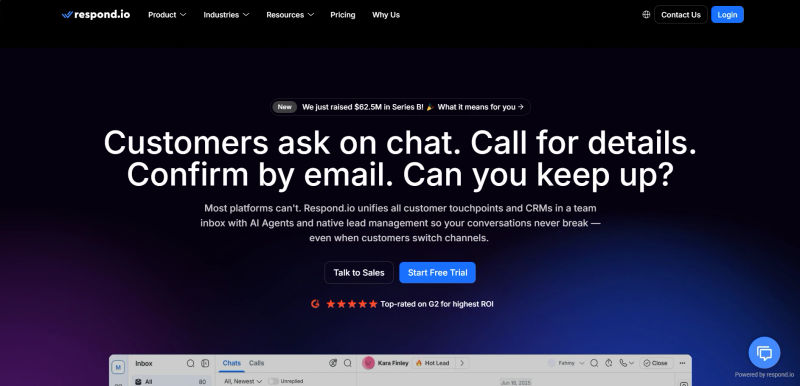
The Verdict: If your tech company relies heavily on WhatsApp for Business for closing deals in emerging markets (where Asia Pacific is the fastest-growing region), respond.io offers superior contact management and broadcast capabilities. Landbot has a WhatsApp integration, but respond.io is built around the concept of the persistent message thread. Choose Landbot for the website lead gen experience; choose respond.io if your operation is 90% instant messaging.
4. Landbot vs. Drift and Qualified: The B2B Heavyweights
Drift and Qualified are the heavyweights of the B2B Conversational Marketing world, specifically designed for Account-Based Marketing (ABM).
Sales Stack Integration: When integrating with an existing sales stack like HubSpot and Salesforce, Drift provides deep, out-of-the-box alignment for complex territory routing and automatic chat syncing. Landbot also offers native HubSpot and Salesforce integrations but relies on a modular approach; updating records is simple, but replicating Drift's advanced ABM routing requires manual mapping in Landbot's builder.
The Verdict: Drift and Qualified are significantly more expensive than Landbot (often 10x-20x the cost) but offer deep IP-based enrichment (identifying visitors before they chat) and immediate routing to sales reps based on Salesforce territory ownership.
The Trade-off: If you need deep ABM routing out of the box, Drift/Qualified are better. However, if you need a flexible, customizable builder to create unique interactive experiences (like quizzes, calculators, or product pickers) at a reasonable price point, Landbot is the more agile and cost-effective solution.


Landbot vs. Intercom, Voiceflow, and Wati
If you are evaluating Landbot and Intercom for inbound lead capture, the decision comes down to your primary use case: automated qualification versus human-driven support. For a UK B2B company that wants to qualify inbound leads without running a dedicated live chat team, Landbot is the clear winner. The practical difference is that Intercom is fundamentally a robust customer support and live chat platform, whereas Landbot is purpose-built for automated, logic-based lead qualification flows. Marketing teams can build, edit, and deploy complex routing in Landbot entirely without engineering support, avoiding the overhead of managing a full live chat product.
When deciding if Landbot or Voiceflow is better for a marketing ops team, Landbot offers a more accessible learning curve for non-technical users. While Voiceflow is a powerful, developer-friendly platform for designing complex AI agents and voice assistants, Landbot is optimized for visual, drag-and-drop flow building. This allows marketing ops to iterate on lead capture flows, adjust scoring logic, and push updates instantly without needing to involve a developer every time.
For WhatsApp-specific campaigns, comparing Landbot to Wati reveals two different approaches to the WhatsApp Business API. Wati excels as a shared team inbox for customer support and basic broadcasting. However, for automating WhatsApp lead qualification flows without writing any code, Landbot's native WhatsApp integration and visual builder provide far superior conditional logic. Marketing teams can easily design branching WhatsApp conversations that capture data, score leads, and sync directly to a CRM—all without touching a single line of code.
Implementation Strategy: Deploying Your First Interactive Bot
To ensure a successful rollout that demonstrates ROI to your VP of Marketing, follow this 30-60-90 day implementation framework.
Phase 1: The Audit and Logic Map (Days 1-30)
Don't open the builder yet. Audit your current static forms. Where is the drop-off?
Map the Conversation: Use a whiteboard tool like Miro to draft the logic. Define your qualifying questions.
Define Variables: List every data point you need (e.g.,
job_title,tech_stack,implementation_timeline).Setup Tracking: Ensure you have the Meta Pixel and Google Analytics 4 (GA4) events firing on specific block interactions. You want to know not just if they converted, but where they dropped off.
Phase 2: The Build and Integration (Days 31-60)
Build the MVP: Create the flow in Landbot. Use the "Bricks" feature to create reusable headers and footers.
Connect the Pipes: Set up the Salesforce/HubSpot integration. Map the Landbot variables to CRM fields. Crucial Step: Test the data type matches. Sending a text string to a number field in Salesforce will cause sync errors.
Webhook Validation: If you have a custom backend, set up the webhook to validate leads in real-time (e.g., checking for freemail addresses like @gmail.com to filter out non-B2B leads).
Phase 3: Optimization and Enablement (Days 61-90)
Internal Enablement: Train your SDRs on how to read the chat transcripts. Ensure they understand the context of the conversation before they reach out to the lead.
A/B Testing: Duplicate the bot. In Version A, ask for the email first. In Version B, ask for the email last. Measure the impact on Lead Velocity.
Core Web Vitals Check: Ensure the bot script isn't negatively impacting your Largest Contentful Paint (LCP). Landbot is generally performant, but heavy media files within the bot can slow load times.
Try AuthenCIO
Move to faster, smarter software evaluation with AI
Final Verdict: Is Landbot the Right Investment for Your Marketing Stack?
In 2026, Landbot remains the gold standard for visual, no-code lead qualification. It strikes the difficult balance between ease of use for the marketing team and the technical depth required by operations.
It is not a replacement for a full-service support desk like Freshchat, nor is it a dedicated messaging CRM like respond.io. However, for the specific use case of transforming passive website traffic into qualified, enriched pipeline opportunities, it offers arguably the best ROI in the market.
For the Marketing Operations Manager, Landbot solves the "engineering dependency" crisis. It allows you to own the conversion layer of your website, iterate daily, and push clean, structured data into your stack. If your goal is to build a sophisticated, data-driven engine that feels like a conversation but performs like a database, Landbot is a "Must-Have" in your 2026 toolkit.