.webp&w=64&q=75)
Introduction
The customer support landscape is currently undergoing a seismic shift, driven by the rapid maturation of Artificial Intelligence (AI). For decades, support teams have operated under a reactive model: a customer encounters an issue, submits a ticket or makes a call, and waits for a human agent to resolve it.
Streamline your software evaluation process
This linear workflow, while functional in low-volume environments, creates significant bottlenecks as businesses scale. The modern consumer, conditioned by the immediacy of digital experiences, demands instant resolution—a demand that human-only teams simply cannot meet without incurring unsustainable operational costs.
However, for many VPs of Customer Experience and Support Directors, the conversation around AI is fraught with fatigue. The market has been saturated with over-promises, leading to skepticism born from early experiences with clunky, keyword-dependent chatbots that frustrated more customers than they helped. It is crucial to acknowledge that we have moved past that era. Today, AI in customer support is not merely about replacing humans with robotic scripts; it is about architectural transformation.
This guide provides a comprehensive executive overview of the modern AI ecosystem, moving beyond the hype to explore practical applications of Natural Language Processing (NLP), predictive analytics, and agentic automation. We will examine how specific tools like Landbot, Callvu, Tidio, and Freshchat are redefining success metrics, and critically, we will address the often-overlooked foundations of data hygiene and implementation strategy required to make them work.
Key Takeaways
Agentic AI is the New Standard: Modern customer support has evolved from basic conversational chatbots to agentic automation, enabling systems to execute complex, multi-step workflows independently.
Data Hygiene Dictates Success: The effectiveness of your AI ecosystem relies entirely on a well-maintained knowledge base. Clean, structured data is your primary defense against costly AI hallucinations.
The Human-AI Hybrid Model Wins: AI does not replace human agents; it elevates them. Successful implementations shift human roles from routine task handlers to conversational architects and empathy-driven escalation specialists.
Strategic Automation Drives ROI: Integrating omnichannel automation and visual engagement tools reduces time-to-resolution while balancing operational efficiency with high customer satisfaction.
Leading Customer Support Solutions to Know
While this guide explores key industry insights, seeing these principles in action requires the right platform. Here is a snapshot of the most recognized Customer Support solutions currently shaping the market.




The Paradigm Shift: Why AI is Essential for Modern CX
The traditional support model is plagued by the "linear scaling problem." To handle 20% more tickets, you typically need 20% more agents. This correlation creates a cost structure that punishes growth. AI breaks this linearity, allowing support capacity to scale elastically independent of headcount. This is achieved primarily through high-volume ticket deflection and the automation of Tier 1 inquiries—repetitive questions regarding order status, password resets, or pricing tiers.
According to recent market analysis, the global AI customer service market was valued at $12.06 billion in 2024 and is projected to reach $47.82 billion by 2030. This explosive growth is driven by the necessity to reduce Cost-Per-Resolution while simultaneously improving availability. Yet, the goal is not just "always-on" support; it is "quality-on" support. A bad interaction at 2:00 AM is more damaging than no interaction at all. Modern AI ensures that after-hours support maintains the brand voice and accuracy expected during business hours.
From Supervisor to Architect
Furthermore, the role of the support manager is evolving from a supervisor of people to an architect of workflows. The focus is shifting toward "Agentic AI"—autonomous systems capable of reasoning, planning, and executing multi-step workflows—rather than simple response retrieval. This evolution addresses the chronic issue of agent burnout by removing the monotony of low-value tickets, allowing human agents to focus on complex, empathy-driven interactions that require high emotional intelligence (EQ).
The Foundation: Data Hygiene and the Knowledge Base
Before investing in any conversational AI platform, organizations must address "Step 0": Data Hygiene. An AI model is only as intelligent as the data it is fed. If your internal Knowledge Base (KB) is filled with outdated articles, conflicting macros, or unstructured PDFs, deploying an LLM will only result in automated confusion—often referred to as the "Garbage In, Garbage Out" principle.
Solving the Cold Start Problem
One of the most significant hurdles in AI adoption is the "Cold Start" problem—the time and effort required to train a bot before it can handle live traffic. To mitigate this, support leaders must audit their documentation structure. Content written for humans (long paragraphs, nuanced humor) is often difficult for AI to parse effectively.
Modern preparation involves:
Chunking: Breaking long articles into discrete, topic-specific blocks.
Tagging: implementing a robust taxonomy that categorizes content by intent (e.g., "Troubleshooting" vs. "Policy").
Sanitization: Removing legacy data that contradicts current SLAs.
Without this foundational work, even the most advanced customer service automation software will fail to deliver ROI, as the AI will hallucinate answers based on obsolete data points.
Embrace the future of customer support. Explore AI-powered solutions on AuthenCIO.
Deconstructing the AI Ecosystem in Support
To effectively implement AI, one must understand that it is not a monolithic entity but a convergence of several distinct technologies. Understanding the nuance between these components is critical for selecting the right tech stack.
1. Natural Language Processing (NLP) and Understanding (NLU)
At the core of modern conversational AI is NLP. For mid-market companies, NLP drives scalable customer support automation without requiring massive enterprise developer resources. Unlike early chatbots relying on rigid decision trees, NLP parses the true intent behind a query, regardless of phrasing, typos, or slang. NLU takes this further by comprehending context and sentiment. This allows an AI agent to distinguish between "I want to cancel my order" (churn risk) and "Can I cancel an order if I make a mistake?" (policy inquiry). By leveraging NLP for customer support automation, mid-market teams can accurately route complex tickets, trigger automated workflows, and resolve high-volume inquiries instantly.
2. Generative AI vs. Agentic AI
Generative AI creates human-like text and summarizes knowledge bases, but the industry is shifting to Agentic AI. While Generative AI explains how to process a refund, Agentic AI accesses APIs to process the transaction autonomously.
When evaluating key features to look for in agentic ai customer service platforms, prioritize deep API integrations, multi-step reasoning, and strict action guardrails. These elements drive true agentic ai for help desk automation (or agentic ai for helpdesk automation). Rather than just answering questions, these systems execute complex workflows to resolve end-to-end tickets without human intervention.
3. Predictive Analytics and Sentiment Analysis
The ultimate goal of AI in customer support is to move from reactive troubleshooting to proactive prevention. Predictive customer analytics utilizes machine learning algorithms to analyze historical ticket data, product usage logs, and customer behavior to identify patterns that precede a support issue.
For instance, if predictive models notice that a specific software update triggers a spike in "login error" tickets, the system can proactively email affected users with a workaround before they even encounter the bug. Similarly, sentiment analysis tools now continuously monitor the emotional tone of interactions. By analyzing syntax and keystroke speed, these systems can flag escalating frustration in real-time. This capability enables "Smart Routing," where a distressed customer is bypassed through the standard queue and immediately connected to a senior retention specialist, thereby protecting Customer Lifetime Value (LTV).
Find Perfect Software For Your Business
The Frontline: Evolution of Chatbots and Virtual Assistants
The most visible application of AI in support is the chatbot. However, the gap between a rule-based bot and an AI-driven virtual assistant is immense. Successful deployment depends on matching the tool's complexity to the business's needs.
1. Landbot: Mastering Conversational Flows
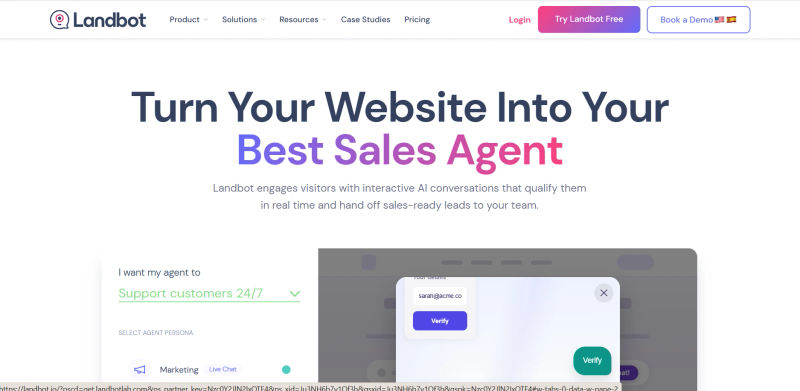
For organizations that require structured, guided interactions, Landbot serves as a prime example of how to bridge the gap between rigid rules and flexible AI. Landbot excels in creating conversational landing pages and automated flows that guide users through complex troubleshooting steps or lead qualification processes. By using a visual builder that integrates AI capabilities, Landbot allows non-technical support managers to design intricate decision trees.
Best Suited For: Teams needing strict control over the conversation flow, such as regulated industries where compliance scripts are mandatory.
Technical Prerequisites: Defined process maps and decision trees; no coding required.
2. Tidio: Accessible AI for Agility
To evaluate the customer service software industry company Tidio on agentic customer support is to examine its ability to democratize autonomous workflows for Small and Mid-sized Businesses (SMBs). When analysts evaluate the customer service software industry company Tidio on agentic customer service, they highlight its agility. Tidio integrates Lyro, an AI agent explicitly designed to learn from historical interactions and execute tasks autonomously.
Lyro ingests support content to answer questions and perform basic service actions within seconds. Unlike complex enterprise solutions, tools like Tidio combat the "Cold Start" problem. This allows teams to activate agentic AI support that effectively resolves up to 70% of customer inquiries almost immediately.
Best Suited For: SMBs and e-commerce stores needing rapid deployment and immediate ticket deflection through agentic automation.
Technical Prerequisites: A readable FAQ page or Knowledge Base for the AI to scrape.

Beyond Conversation: Intelligent Process Automation and Visual Engagement
While text-based chat is prevalent, it is not the only channel undergoing an AI revolution. Voice and visual engagement are critical frontiers, especially for industries with complex technical support needs or legacy demographic bases.
1. Callvu: Bridging the Gap with Visual IVR
Voice support is traditionally the most expensive channel. Callvu addresses this by transforming traditional voice calls into digital, visual experiences. When a customer calls a support line, Callvu’s technology can intercept the call and offer a visual interface sent via SMS or push notification. This "Visual IVR" allows the customer to navigate menus, upload photos of damaged products, or co-browse documents with an agent. AI plays a background role here by analyzing the customer's journey and predicting the most likely reason for the call, dynamically adjusting the visual menu.
Best Suited For: Telecom, Banking, and Utilities with high voice volumes and complex verification processes.
Technical Prerequisites: Integration with existing telephony infrastructure (PBX/VoIP) and CRM data.

2. Freshchat: Scaling with Omnichannel Automation
For enterprise-grade operations, the challenge is unifying data across silos. Freshchat (part of the Freshworks suite) utilizes AI to provide a unified context across email, chat, social media, and WhatsApp. Its AI engine, often branded under "Freddy AI," focuses on agent augmentation. It suggests responses, summarizes long ticket threads for agents taking over a shift, and automates automated ticket routing. By automating the administrative burden of tagging and routing tickets, Freshchat ensures that human agents spend their time solving problems rather than performing data entry.
Best Suited For: Mid-market to Enterprise teams requiring unified customer data across multiple channels.
Technical Prerequisites: Centralized customer data platform or robust CRM integration (e.g., Salesforce, HubSpot).

How to Choose a Vendor for Agentic AI Enterprise Customer Support
When deciding how to choose a vendor for agentic AI enterprise customer support, prioritize platforms that offer autonomous action execution, robust guardrails, and seamless CRM integrations. Unlike basic generative chatbots that simply summarize knowledge base articles, agentic AI must securely authenticate users, trigger backend workflows (like processing refunds or updating shipping addresses), and hand off complex edge cases to human agents with full context. Look for vendors with SOC 2 Type II compliance, transparent pricing models based on successful resolutions, and low-code orchestration layers.
To evaluate the customer service software industry company Intercom on agentic customer support, enterprise leaders should examine their flagship AI agent, Fin. Intercom has heavily pivoted from a conversational messenger to an AI-first platform, and Fin excels in agentic capabilities by integrating directly with custom APIs to take autonomous actions on behalf of the customer. However, enterprises must carefully weigh Intercom's premium pricing and per-resolution billing model against the platform's high deflection rates and rapid deployment capabilities.
To systematically evaluate potential vendors, use this core criteria:
Actionability: Can the AI execute multi-step workflows via API integrations?
Knowledge Ingestion: Does it automatically sync with your existing knowledge base without manual training?
Hallucination Controls: Are there strict deterministic guardrails to prevent the AI from making unauthorized promises?
Human-in-the-Loop (HITL): Is the escalation path to a human agent frictionless and context-rich?
Strategic Implementation: The Human-AI Hybrid Model
Implementing AI is not a "set it and forget it" initiative. It requires a strategic framework that categorizes support interactions into three buckets: Automatable, Augmentable, and Human-Only.
Automatable: These are high-volume, low-complexity queries (WISMO - "Where is my order", password resets). AI should handle 100% of these to maximize ROI.
Augmentable: These are complex queries where AI assists the human. For example, the AI might retrieve the relevant knowledge base article or draft a response for the agent to review. This is where tools like Freshchat shine.
Human-Only: These involve high-emotion scenarios, VIP clients, or novel issues that the AI has never encountered. The goal of AI is to keep the queue clear so humans can dedicate their energy here.
The Economics of AI: ROI of AI in Customer Service
To justify the investment to the C-Suite, support leaders must shift the conversation from "cost of software" to "cost of resolution." Traditional support scales linearly; adding headcount increases costs proportionally. AI introduces a high upfront effort (implementation and training) but near-zero marginal cost per additional ticket.
When calculating the ROI of AI in customer service, consider the following:
Deflection Rate: If AI deflects 30% of tickets, what is the labor savings?
Average Handling Time (AHT): If AI augmentation reduces agent research time by 2 minutes per ticket, how many FTE hours are saved annually?
Pricing Models: Be aware of the shift from per-seat pricing (common in legacy SaaS) to per-resolution or consumption-based pricing in AI tools. Ensure your volume projections align with the vendor's model.
Managing Risk: The Cost of Hallucination
Data security is paramount in this hybrid model. When training LLMs on customer data, organizations must adhere to strict SOC2 and GDPR standards. There is a real "Cost of Hallucination"—legal and reputational risk if an AI agent promises a refund policy that doesn't exist. Therefore, establishing "guardrails"—strict constraints on what the AI can and cannot say—is a critical step in the implementation roadmap.
Comparative Analysis: Traditional vs. AI-Augmented Support Models
To understand the tangible impact of AI adoption, it is helpful to compare key performance metrics between a traditional manual support model and an AI-augmented model. The following table illustrates the operational shifts that occur when solutions like Landbot, Callvu, or Tidio are integrated into the stack.
Metric | Traditional Human- Centric Model | AI-Augmented Hybrid Model | Impact on Business |
Availability | Limited to business hours or expensive shift coverage | 24/7/365 Instant Response | Increases CSAT and captures global demand |
First Response Time (FRT) | Minutes to Hours (dependent on queue depth) | Instant (< 5 seconds) | Reduces customer abandonment and frustration |
Cost Per Resolution | High ($5 - $12 per interaction) | Low ($0.50 - $1.00 per interaction) | Drastically improves margins and scalability |
Scalability | Linear (Requires hiring more staff) | Exponential (Software scales instantly) | Enables handling of peak season spikes without hiring |
Data Utilization | Siloed; manual entry required | Integrated; real-time sentiment & trend analysis | Enables proactive product improvements |
Agent Satisfaction | Low; high burnout from repetitive tasks | High; focus on complex, rewarding work | Reduces turnover and training costs |
Stop guessing. Use AuthenCIO to find the right AI-powered software for your needs.
The AI Readiness Checklist
Before signing a contract with a vendor, use this checklist to assess your organization's readiness for AI integration:
Data Audit: Is your Knowledge Base up-to-date, structured, and free of conflicting information?
Volume Analysis: Have you identified the top 5 repetitive ticket types that are prime candidates for automation?
Integration Map: Do you know how the AI tool will connect with your CRM (e.g., Salesforce, Zendesk) to read and write customer data?
Security Protocol: Have you defined what PII (Personally Identifiable Information) the AI is allowed to access?
Escalation Path: Is there a clearly defined "Graceful Handoff" workflow for when the AI fails to resolve a query?
Try AuthenCIO
Move to faster, smarter software evaluation with AI
Conclusion: Future-Proofing Your Support Stack
The integration of AI into customer support is not merely a technological upgrade; it is a strategic imperative for survival in a saturated market. The ability to offer instant, accurate, and personalized support at scale is rapidly becoming the primary differentiator between market leaders and laggards. We are moving toward a future of hyper-personalization, where AI doesn't just answer questions but anticipates needs based on a holistic view of the customer's journey.
However, success lies in the balance. The most effective support strategies will always be those that leverage AI to amplify human potential, not replace it. By utilizing conversational tools like Landbot and Tidio for deflection, visual engagement tools like Callvu for complex resolution, and omnichannel platforms like Freshchat for orchestration, businesses can build a support ecosystem that is resilient, efficient, and deeply empathetic.
As you assess your AI readiness, focus on data hygiene and workflow mapping. The tools are powerful, but they require clean data and clear strategy to function effectively. The future of customer support is here, and it is automated, intelligent, and surprisingly human.