
Introduction
Welcome to our comprehensive adcreative.ai review 2026. If you are wondering whether this AI-powered ad generation platform is worth the investment, the short answer is yes—especially for agencies and marketers needing to scale high-converting creatives quickly. In this adcreative ai review, we evaluate how the platform automates ad design, generates data-backed copy, and predicts performance before you spend a dime.
The digital advertising landscape is currently defined by the need for speed and performance. As the IAB projects US ad spend to rise by 9.5% this year, the engine driving this growth is Artificial Intelligence. For Creative Directors, manual A/B testing is rapidly being replaced by Dynamic Creative Optimization (DCO) and generative AI to dictate the pace of market entry.
Streamline your software evaluation process
However, this growth comes against a backdrop of tightening resources. While ad spend increases, operational budgets often shrink, forcing agencies to do more with less. Recent data shows that 83% of ad executives have fully deployed AI in their creative processes in 2026.
Throughout this adcreative.ai review, we will dissect the platform's latest feature set, pricing plans, and its standing against competitors like Motion, Atria, and Creative Score. Our goal is to determine if it truly delivers on the promise of scaling ad inventory, combating creative fatigue, and lowering Cost Per Acquisition (CPA) across fragmented channels.
Key Takeaways
AdCreative.ai remains a top-tier generative AI platform in 2026 for automating ad creatives, specifically tailored for performance marketers and Creative Operations (CreOps) teams. It drastically reduces design time by turning prompts and brand assets into conversion-focused ad variations.
Pros & Cons: The platform excels at rapid scaling, UGC-style video generation, and predictive analytics via its 'Creative Score.' However, it requires a learning curve for prompt engineering and may occasionally produce generic outputs without strict human-in-the-loop oversight.
Pricing: Plans are tiered for scale, starting around $29/month for basic startup needs, scaling up to $149/month for professionals, and offering custom enterprise pricing for high-volume agencies needing seamless integrations with tools like Motion and Atria.
AdCreative.ai Review — AI Ad Generation for Faster Campaigns
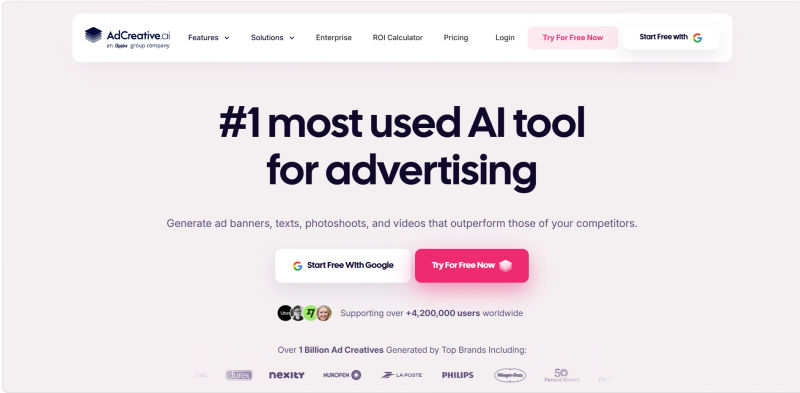
AdCreative.ai is an AI-powered advertising platform designed to help businesses create ad visuals, copy, and multiple creative variations faster. It combines AI generation with creative scoring and insights, making it particularly useful for teams running frequent digital advertising campaigns.
What Makes AdCreative.ai Stand Out
AI-powered ad creation: Quickly generates advertising creatives from product information and existing assets.
Automated copywriting: Produces headlines, descriptions, and calls to action for different campaigns.
Creative scoring: Predicts the potential performance of creatives, helping marketers identify which designs may be worth testing.
Multiple variations: Makes it easier to create several versions of an advertisement for experimentation.
Video capabilities: Supports motion-based and video advertising content in addition to static creatives.
Creative insights: Provides data-driven information that can help marketers refine their visual approach.
High-volume production: Particularly useful when teams need a large number of creatives for different campaigns, products, or audiences.
Where It Can Help Marketing Teams
The biggest advantage is speed. Instead of starting every advertisement from scratch, marketers can use AI to produce initial concepts and variations quickly.
This can be valuable for ecommerce companies, agencies, and performance marketing teams that constantly need fresh creatives for paid campaigns. It also allows marketers to spend more time on campaign strategy and testing rather than repetitive production work.
What to Watch Out For
AI designs may need editing: Some generated creatives may require adjustments before they are ready for publication.
Brand consistency: Highly distinctive brands may need additional work to ensure every creative follows their exact visual identity.
Creative quality varies: Not every AI-generated concept will be equally useful or original.
Human review is still necessary: Copy, product information, claims, and visual elements should be checked before publishing.
Higher plans can be expensive: The jump between subscription tiers may be significant for smaller businesses.
AI isn't a complete creative strategy: Strong advertising still requires good positioning, messaging, audience understanding, and campaign strategy.
Verdict: It is a strong choice for teams that want to accelerate ad production, generate creative variations, and streamline campaign testing with AI.
Best For: Digital marketers, ecommerce brands, agencies, and businesses running frequent paid advertising campaigns.
AdCreative.ai & Leading Ad Automation Alternatives
While this guide focuses on AdCreative.ai, it’s helpful to compare it against the most recognized:








Why Creative Directors are Shifting to AI-Driven Workflows
The role of the Creative Director has evolved from purely aesthetic oversight to data-driven performance management. The friction point in 2026 is "creative fatigue"—the phenomenon where ad performance degrades as audiences become desensitized to repetitive visuals. In fast-moving social auctions on platforms like TikTok, Instagram Reels, and YouTube Shorts, the shelf life of a creative asset has plummeted to mere days.
1. The Rise of Creative Operations (CreOps)
To combat this, a new discipline has emerged: Creative Operations (CreOps). This function focuses on the logistical efficiency of creative output. Agencies must now produce hundreds of variants per week, a volume that is logistically impossible and financially ruinous for traditional human design teams. This is where AI-driven workflows bridge the gap. By leveraging tools that offer 30-50% faster time-to-market, teams can shift their focus from pixel-pushing to strategy.
2. From Design to Prompt Engineering
The strategic shift for Creative Directors is profound. The job is no longer about manually adjusting kerning or masking layers in Photoshop; it is about prompt engineering and brand soul preservation. The CD's role is to ensure that the AI's output remains tethered to the brand's core identity while allowing the algorithm to optimize for Click-Through Rates (CTR) and Return on Ad Spend (ROAS).
Yet, this transition is not without its skeptics. The "uncanny valley" of AI generation and the risk of brand dilution remain top concerns. A tool must not only generate ads but do so with a strict adherence to brand guidelines and visual fidelity. As we explore AdCreative.ai, we will evaluate its capability to serve as a reliable partner in this high-stakes environment.
What is AdCreative.ai?
AdCreative.ai is an AI-powered advertising platform designed to generate high-conversion ad creatives at scale. When marketers search for a reliable ad creative ai solution, they are typically looking for this exact type of ad creative automation. Unlike standard design tools that rely on manual input for every element, AdCreative ai utilizes a massive database of high-performing ad creatives to train its machine learning models. The platform's core value proposition in 2026 is data-backed design generation.
The system operates by ingesting a brand's visual assets—logos, colors, and product imagery—and combining them with AI-generated copy and layout structures that are statistically more likely to convert. By functioning as a comprehensive ads creative ai, it targets the specific pain points of e-commerce brands, agencies, and startups that need to run multivariate tests without the bottleneck of a traditional design studio.
Technologically, adcreative.ai leverages a combination of Large Language Models (LLMs) for copywriting and proprietary computer vision algorithms for layout optimization. It understands the nuances of platform-specific requirements, automatically adjusting formats for Facebook, Google Display, LinkedIn, and Pinterest. For the marketing professional, the platform promises to be the engine that keeps the sales funnel full of fresh, optimized content.
AdCreative.ai Company Profile: Funding, Valuation, and Details
AdCreative.ai is a privately held artificial intelligence company headquartered in Paris, France, founded in 2021 by Tufan Gok. The company specializes in generative AI for advertising, providing a SaaS platform that automates the creation of ad creatives, texts, and social media posts for marketers.
Regarding the AdCreative.ai valuation and net worth, because it is a private entity, an official public market cap does not exist. However, industry estimates in 2026 place the company's valuation significantly higher than its early stages, driven by a massive surge in its global user base, high recurring revenue, and enterprise adoption.
Key AdCreative.ai company details and funding milestones include:
Founding & Leadership: Founded in 2021 and led by CEO Tufan Gok.
Funding Rounds: The company secured early seed funding to accelerate its machine learning capabilities and expand its development team. Since then, it has largely utilized its strong annual recurring revenue (ARR) to scale operations rather than relying on excessive late-stage venture capital.
Headquarters: Paris, France, supported by a globally distributed workforce.
Core Features: Unpacking the AdCreative.ai Ecosystem
A comprehensive adcreative.ai review features pricing 2026 analysis requires looking beyond marketing hype to examine actual utility. The platform now covers the entire creative lifecycle. For teams conducting an adcreative.ai features pricing review 2026, these generative tools are the primary draw. Ultimately, finalizing your adcreative.ai pricing features review 2026 means understanding how this core ecosystem directly impacts your ad operations and ROI.
1. Generative AI Ad Automation
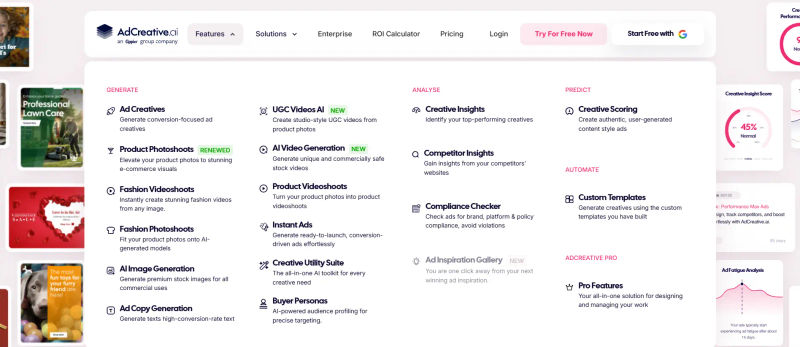
The heart of the platform is its ability to generate hundreds of ad variations in seconds. Users input their target audience, platform (e.g., Instagram Story vs. LinkedIn Feed), and upload their assets. The AI then assembles these into ready-to-publish creatives. In 2026, the visual fidelity has improved, addressing earlier concerns about low-resolution outputs. The tool now supports programmatic display formats, allowing for mass resizing and adaptation across display networks.
2. UGC-Style and Video Capabilities
A critical update for 2026 is the platform's handling of User Generated Content (UGC) styles. Recognizing that polished studio ads often underperform on TikTok and Reels, AdCreative.ai has introduced features that mimic organic content.
Static Overlays: It can take raw video footage uploaded by the user and overlay AI-optimized text hooks, stickers, and CTA buttons that mimic native platform editors.
Video Generation: While it does not generate full cinematic video from scratch (like Sora or Runway), it excels at video compositing. It can animate static product images into motion graphics and stitch together short clips with transition effects that align with current social trends. This distinction is vital: it is a remixer of video assets, not a creator of net-new footage.
3. Text Generator AI & Sales Psychology
AdCreative.ai includes a specialized text generator focused on sales psychology. Unlike generic LLMs, this feature is fine-tuned on ad copy frameworks like AIDA (Attention, Interest, Desire, Action) and PAS (Problem, Agitation, Solution). It generates headlines, punchy descriptions, and CTAs tailored to the specific sentiment of the campaign, whether it's a "hard sell" for Black Friday or a "soft nurture" for B2B lead gen.
4. Creative Insights & Analytics
For the data-obsessed marketer, the Creative Insights dashboard is crucial. It doesn't just show which ad won; it attempts to explain why. By analyzing the performance of generated creatives, the platform aggregates data to show which colors, layout styles, and call-to-action phrasings are driving the highest CTR. This feedback loop is essential for Conversion Rate Optimization (CRO), allowing teams to refine their inputs for subsequent batches.
The 'Creative Score' Feature: Predictive Performance
One of the most touted features in the 2026 update is the proprietary Creative Score. This predictive analytic tool assigns a numerical value (0-100) to every generated creative before it goes live. The scoring algorithm is based on millions of data points from successful campaigns across the platform's user base, evaluating text-to-image ratios, logo placement, contrast levels, and emotional triggers.
Case Study: The Contrast Hypothesis
To illustrate the utility of the Creative Score, consider a hypothetical scenario involving a D2C skincare brand, "GlowLabs."
Variant A (Score: 45): The AI generated a soft, pastel-on-pastel design. While aesthetically pleasing, the Creative Score flagged it for low contrast and poor headline readability on mobile screens. The predicted CTR was 0.6%.
Variant B (Score: 92): The system suggested an alternative using a high-contrast dark background with bold, white typography and a "scarcity" psychological trigger in the copy.
Instead of spending budget A/B testing Variant A, the Creative Director discarded it immediately. Variant B was launched and achieved a verified CTR of 1.8%, effectively tripling the efficiency of the ad spend. This pre-flight filtering is where the true ROI of the platform lies—saving money on losing ads before they ever launch.
Find Perfect Software For Your Business
The Human-in-the-Loop Framework: Quality Assurance in the AI Era
Despite the advanced algorithms, relying solely on AI marketing automation software without human oversight is a recipe for disaster. Hallucinations—where the AI invents facts or distorts visual elements—are still a reality in 2026. To mitigate this, agencies must implement a strict "Human-in-the-Loop" (HITL) framework.
Step 1: The Generation Phase The prompt engineer inputs the brand guidelines and campaign goals. The AI generates 50-100 variations. At this stage, quantity is the goal.
Step 2: The Brand Safety Filter A junior designer or brand manager scans the grid. They look for specific AI artifacts: distorted hands in stock photos, incorrect logo aspect ratios, or "hallucinated" product features (e.g., an ad promising a feature the software doesn't have).
Step 3: The Strategic Selection The Creative Director reviews the top 10% of designs based on the Creative Score. This is where the "soul" check happens. Does the ad feel like the brand? Is the tone correct? The CD selects the final candidates.
Step 4: The Legal Compliance Check Before export, a final check ensures no unauthorized likenesses are used (a major issue with AI-generated avatars) and that the copy complies with platform-specific policies (e.g., no "before and after" claims in certain health categories).
Seamless Integrations: Connecting with Motion and Atria
No software exists in a vacuum. In 2026, the "stack" is everything. AdCreative.ai has recognized this by opening up its API and building native integrations with key marketing tools.
1. Integrating with Motion (Analytics)
Motion is widely regarded as the gold standard for creative analytics and reporting. AdCreative.ai's integration allows for a seamless handoff.
Technical Implementation: This is a native, one-click integration. You authorize AdCreative.ai to read/write to your ad account, and Motion pulls the creative IDs automatically.
Workflow: You generate assets in AdCreative.ai, push them to Meta/Google, and then use Motion to visualize the performance data granularly. This combination allows agencies to bridge the gap between creation (AdCreative.ai) and analysis (Motion).
2. Integrating with Atria (Workflow)
Atria focuses on workflow management and creative operations. For larger teams managing hundreds of SKUs, moving assets from generation to approval can be chaotic.
Technical Implementation: Integration typically requires an API key exchange. Once connected, generated assets can be automatically routed to specific project folders in Atria.
Workflow: Agencies can automate the approval process. Generated creatives are pushed into Atria's review pipelines, where stakeholders can annotate and approve designs without logging into AdCreative.ai directly.
Comparative Landscape: AdCreative.ai vs. Industry Alternatives
Evaluating the marketing automation software company AdCreative.ai on AI alternatives to performance marketing agencies reveals a clear shift: it replaces costly agency retainers with rapid, data-backed asset generation. While distinct competitors serve different needs, AdCreative.ai empowers in-house teams to scale ad creation without traditional agency bottlenecks.
1. AdCreative.ai vs. Motion
This is the most common confusion. Motion is an analytics tool; AdCreative.ai is a generation tool.
Motion excels at telling you which of your existing ads are working and why (e.g., "Stop rate is low on video 3"). It does not create the ads for you.
AdCreative.ai builds the ads but offers lighter analytics compared to Motion's deep dive.
Verdict: They are complementary, not competitive. High-growth teams usually need both.
2. AdCreative.ai vs. Atria
Atria is a Digital Asset Management (DAM) and workflow tool. It is designed to organize thousands of assets and streamline approval flows. While Atria may have some light generative features, its core strength is organization. AdCreative.ai is pure creation engine. If your bottleneck is making ads, choose AdCreative.ai. If your bottleneck is finding and approving them, choose Atria.
3. AdCreative.ai vs. Creative Score
Creative Score (the standalone platform) focuses heavily on benchmarking against industry standards. While AdCreative.ai has an internal scoring mechanism, the standalone Creative Score tool often provides deeper competitive intelligence and broader market context. AdCreative.ai's score is best used for immediate A/B testing selection, while the standalone tool is better for long-term brand health monitoring.
AdCreative.ai Pricing Plans 2026
To evaluate the marketing automation software company adcreative.ai on pricing & plans, note its credit-based system. The adcreative.ai pricing plans 2026 use tiered models where downloads and high-res generations consume credits.
Many users search for an adcreative ai lifetime deal, but in 2026, this is a myth. Standard adcreative ai pricing relies strictly on recurring subscriptions. Whether analyzing ad creative ai pricing for startups or enterprise adcreative.ai pricing 2026, costs depend on standard adcreative.ai pricing tiers rather than one-time fees.
Plan | Price | Best For | Features |
Startup | $39 / month | Solopreneurs & Small Biz | • 10 Credits/month |
Professional | $249 / month | Freelancers & Growth Marketers | • 100 Credits/month |
Agency | $999 / month | Mid-Sized Agencies | • 500 Credits/month |
Enterprise | Custom | Large Global Brands | • Unlimited Credits |
*Note: All prices shown reflect typical monthly billing. Vendors often offer lower pricing for annual commitments, but those discounts are excluded here for easier comparison. Actual costs may vary depending on your requirements, usage volumes, and negotiated terms.

Final Verdict: Is AdCreative.ai Essential for 2026 Strategy?
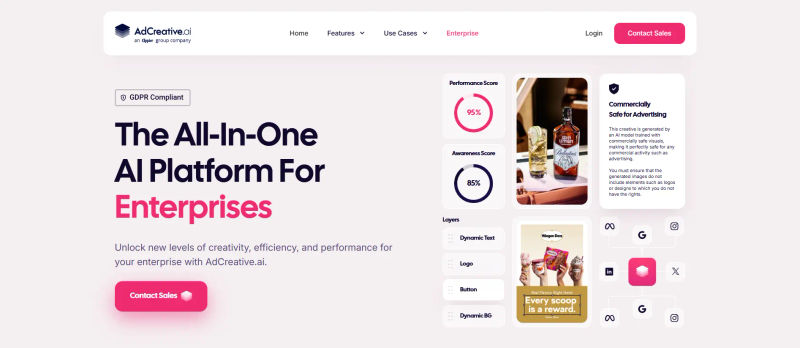
For agencies and brands handling high-volume performance marketing, AdCreative.ai has transitioned from a "nice-to-have" to a critical infrastructure component. The ability to generate, score, and iterate on creatives at speed is the only way to combat the rising costs of digital inventory.
However, it is not a replacement for a Creative Director. It is a force multiplier. It replaces the repetitive, low-level design tasks, freeing up human talent to focus on strategy, brand storytelling, and the all-important "Human-in-the-Loop" quality assurance. If your goal is to lower CPA through relentless multivariate testing, AdCreative.ai is a powerful ally. If your goal is to win a Cannes Lion for artistic excellence, you may still need the human touch.
Try AuthenCIO
Move to faster, smarter software evaluation with AI
Conclusion
The landscape of 2026 demands that marketers embrace AI not as a replacement, but as a co-pilot. AdCreative.ai offers a compelling suite of tools to automate the heavy lifting of ad production, but the smartest teams will be those who compare, test, and integrate these tools into a holistic workflow. Don't rely on hype—rely on data.