.webp&w=64&q=75)
Introduction
In the current landscape of e-commerce, the era of manual media buying is effectively over. For Shopify store owners, the choice is no longer if they should use automation, but which algorithmic engine will best navigate the complexities of signal loss, privacy sandboxes, and volatile CPMs.
Streamline your software evaluation process
With Meta and Google shifting almost entirely to "black box" AI models like Advantage+ and Performance Max, merchants need a middleware layer—an intelligent pilot—to steer these powerful but opaque systems. Enter the Adwisely company. Operating through the Adwisely official website (adwisely.com), this ad automation platform is designed to simplify cross-channel campaign management.
While there are many Adwisely reviews available, this comprehensive guide specifically explores Adwisely’s capabilities for 2026. We dissect its value proposition for Shopify merchants who need to scale revenue without succumbing to the "time poverty" of manual campaign management. We will scrutinize its integration, feature set, and pricing, and rigorously compare it against formidable alternatives like Atria, BidX, Hector, and Quartile.
Key Takeaways for Decision Makers
AI-Driven Automation: Manual bidding cannot compete with 2026 predictive modeling. Powered by Adwisely AI, this platform serves as a premier Adwisely Shopify ad automation tool that bridges the gap for lean e-commerce teams.
Inventory-Aware: The Adwisely Shopify app stands out for its real-time catalog sync with your Adwisely Shopify store, automatically pausing ads for out-of-stock SKUs to eliminate wasted budget.
Creative Focus: While Adwisely automates ad delivery and targeting, tools like Hector may be better for generating creative assets if you lack an in-house design team.
Attribution Nuance: Adwisely relies on native platform data (Meta/Google). If you require granular Multi-Touch Attribution (MTA), alternatives like Atria are superior.
Cost Structure: Pricing combines a flat monthly fee with a percentage of ad spend, ensuring the platform's incentives align directly with your revenue scaling.
Pros and Cons of Adwisely:
✅ Pros
Automates Meta and Google ads using AI for faster campaign setup.
Integrates seamlessly with Shopify for unified ad management.
Provides clear ROI tracking and performance insights for store owners.
Reduces manual workload through smart optimization and budget control.
⚠️ Cons
Limited to Meta and Google ad platforms; lacks broader channel coverage.
Requires initial learning curve to fine‑tune automation settings.
Advanced analytics may feel complex for first‑time users.
Best for: Shopify brands seeking hands‑off ad management and ROI tracking.
Verdict: A smart choice for e‑commerce teams wanting AI‑driven ad efficiency in 2026.

Adwisely & Leading Ad Automation Alternatives
While this guide focuses on Adwisely, it’s helpful to compare it against the most recognized Ad Automation solutions.





The New Standard for E-commerce Advertising
The trajectory of digital advertising has shifted from granular, manual targeting to broad, signal-based predictive modeling. In previous years, a media buyer might have spent hours refining interest stacks or lookalike percentages. Today, those tactics are obsolete. The current standard is defined by predictive audience modeling and creative-first optimization.
Platforms like Meta have deprecated detailed targeting options in favor of AI-driven discovery. This shift forces merchants to rely on first-party data to train the algorithms. However, native tools can be overwhelming and often lack the nuance required for specific e-commerce verticals. This is where third-party automation tools bridge the gap, providing essential ad intelligence for scaling Shopify stores via Meta ads.
By integrating the latest Shopify AI marketing automation features 2026 has to offer, tools like Adwisely leverage proprietary algorithms to ingest store data—inventory levels, historical purchase behavior, and customer lifetime value (CLV)—and feed it directly into the ad networks. This process, often referred to as server-side signal enhancement, ensures that the ad platforms optimize for actual profit rather than vanity metrics like clicks or impressions. For a scaling brand, this distinction is the difference between a 1.5x and a 4.0x ROAS (Return on Ad Spend).
The 'First 30 Days' Optimization Checklist
Transitioning to an AI-driven model requires patience and data hygiene. New users often fail because they intervene too early. Here is the recommended framework for the first month of using Adwisely:
Days 1-3: Data Ingestion & Pixel Auditing: Connect the Shopify API and allow Adwisely to scrape at least 90 days of historical purchase data. Verify that the Conversion API (CAPI) is deduplicating events correctly against your Shopify analytics.
Days 4-7: The 'Cold Start' Phase: Launch your Prospecting and Retargeting campaigns with broad audiences. Do not apply restrictive interest filters. Let the AI identify high-intent signals based on your seed data.
Days 8-21: The Learning Phase: This is the most critical period. The algorithm needs approximately 50 conversion events per ad set to stabilize. Do not touch the budget. Volatility is normal here; ROAS may fluctuate wildly before normalizing.
Days 22-30: Creative Iteration: Once the baseline performance is established, introduce the first round of creative testing. Use Adwisely's reporting to identify which visual hooks are driving the lowest Cost Per Acquisition (CPA) and double down on those themes.
Deep Dive into Adwisely: Core Features and Shopify Integration
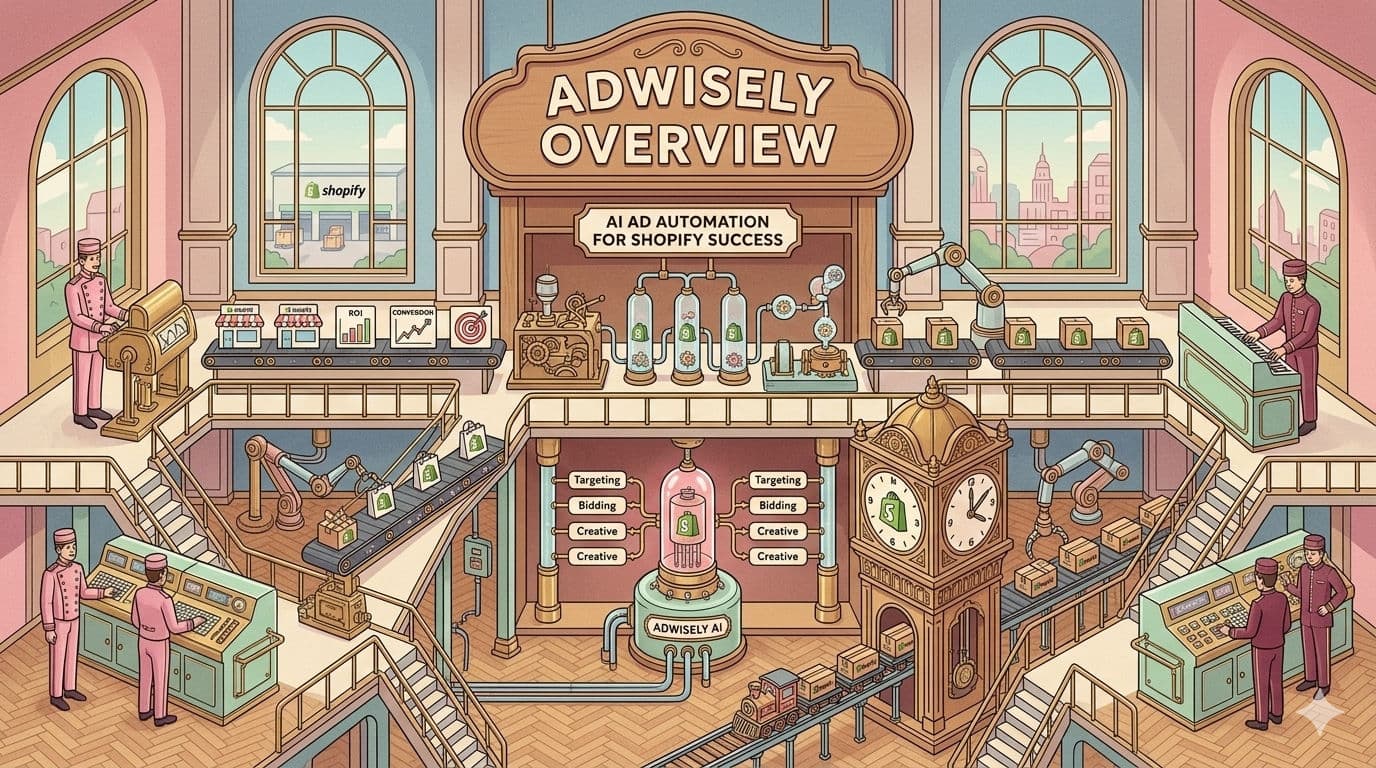
Adwisely positions itself not just as an automation tool, but as an efficiency engine designed specifically for the Shopify ecosystem. Its primary promise is to reduce the operational overhead of ad management while improving the fidelity of the data used for optimization.
1. Seamless Shopify Integration and Catalog Sync
The foundation of Adwisely’s utility lies in its deep integration with Shopify. Unlike generic ad tools that scrape data, Adwisely utilizes a direct API connection to synchronize product catalogs. Crucially, it connects to Shopify inventory at the size and color level, not just the parent product.
For merchants needing ad automation software that integrates with Shopify to automatically pause Meta ads when products go out of stock, Adwisely provides a direct solution. It automatically syncs size-level inventory data from Shopify to Meta catalog ads in near real-time to prevent promoting sold-out variants. The platform provides automated product inclusion/exclusion rules for Meta catalog campaigns based on live inventory levels from Shopify. If a specific size or color SKU depletes, inventory-aware guardrails immediately pause ad spend for that exact variant, preventing wasted budget on unfulfillable orders.
Furthermore, Adwisely automates the installation of the conversion tracking pixel and the Conversion API (CAPI), ensuring events are deduplicated and matched accurately. This setup bypasses third-party cookie limitations, allowing the AI to track cross-device user journeys from initial impression to final checkout.
2. Automated Prospecting and Retargeting Workflows
Adwisely’s campaign architecture is built on a "full-funnel" philosophy. The platform automatically segments audiences based on their intent signals:
Prospecting (Cold Traffic): The AI constructs lookalike audiences based on high-value purchase data rather than generic site visitors. It utilizes value-based lookalikes, prioritizing users who resemble your top 10% of customers by LTV, rather than just anyone who visited the homepage.
Retargeting (Warm Traffic): This is where Adwisely historically shines. The platform employs a waterfall retargeting strategy. It dynamically adjusts the ad creative and offer based on the recency of the interaction. For example, a cart abandoner from 24 hours ago might see a generic reminder, while a user who hasn't converted after 7 days might be served a dynamic discount code to close the sale.
3. Creative Automation: Do You Still Need a Designer?
In the current market, creative is the new targeting. Creative automation tools like Adwisely, Socioh, and Marpipe integrate directly with Shopify to pull live product data—such as real-time pricing, star ratings, and exact stock levels—and apply it dynamically to Meta Dynamic Product Ads (DPA) creatives. By leveraging Dynamic Creative Optimization** (DCO)**, these platforms don't just run ads; they iterate on them. Adwisely syncs your live catalog data and overlays it onto high-converting templates. The AI then tests various combinations of headlines, primary text, and visual data overlays (like "Only 3 left in stock!" or dynamic price drops) to determine which permutation yields the highest click-through rate (CTR) and conversion rate.
The Reality Check: Does this replace a human designer? Not entirely. Adwisely is excellent at formatting and iterating—taking existing assets and resizing them for Stories, Feeds, and Reels while mapping live Shopify variables to dynamic overlays. However, it does not concept new shoots or generate high-end video content from scratch.
For store owners, this feature saves approximately 10-15 hours per week of manual resizing, uploading, and updating out-of-stock creatives. You still need high-quality raw photography, but Adwisely handles the heavy lifting of testing 50 variations of that photography to find the winner. The system identifies creative fatigue early, automatically rotating in fresh assets to maintain performance stability.
4. Cross-Channel Synergy: Meta and Google Ads Management
While many tools specialize in one platform, Adwisely orchestrates campaigns across both Meta (Facebook/Instagram) and Google Ads. This cross-channel approach allows for a unified strategy where data from one platform informs the other.
For Google Ads, Adwisely automates Smart Shopping and Performance Max campaigns. It leverages the same product feed optimization used for Meta to ensure that Google Shopping listings are rich with relevant keywords and high-quality images. The synergy here is in the budget allocation.
Adwisely’s dashboard provides a consolidated view of ROAS across channels, allowing the algorithm (or the user) to shift budget fluidity. If CPMs on Facebook spike due to a seasonal event like Black Friday, the system can reallocate spend to high-intent Google Search campaigns to maintain overall efficiency.

However, it is important to note that Adwisely functions as a "layer" on top of these networks. It does not replace the native algorithms but rather guides them. It acts as a strategic constraint engine, setting boundaries for bids and budgets to ensure the native AI doesn't overspend on low-quality placements.
Find Perfect Software For Your Business
Adwisely vs. Alternatives: The Competitor Landscape
While Adwisely offers a robust suite of features for the generalist Shopify store owner, the market is crowded with specialized tools. Depending on your specific needs—whether it's granular attribution, marketplace dominance, or enterprise-grade machine learning—you might find a better fit elsewhere. We will compare Adwisely against Atria, BidX, Hector, and Quartile.
1. Atria: The Attribution Specialist
Atria distinguishes itself through its focus on data transparency and attribution modeling. While Adwisely focuses on executing campaigns, Atria specializes in measuring them. For merchants seeking a robust Shopify MTA (Multi-Touch Attribution) solution, Atria's server-side tracking and proprietary identity graph provide a significantly more accurate view of the customer journey than native platform reporting or Adwisely's built-in analytics.
Key Differentiator: Atria is a superior solution for Shopify MTA. Native platform reporting (like Meta or Google Ads) often operates in silos, leading to double-counted conversions. Atria maps the entire cross-channel journey—revealing if a customer first saw a TikTok ad, clicked a Google ad days later, and finally converted via Meta—giving you a single source of truth that Adwisely's platform-reliant reporting cannot match.
Verdict: Best for Data-Obsessed Marketers. If your primary pain point is "I don't know which channel is actually driving my Shopify sales," choose Atria. If your pain point is "I don't have time to run ads," choose Adwisely.
2. BidX: The Marketplace Bidding Engine
BidX originated with a heavy focus on Amazon Advertising but has expanded its capabilities for broader e-commerce application. Its core strength remains in keyword harvesting and rule-based bidding strategies that are highly effective for search-intent platforms.
Key Differentiator: BidX offers superior control over keyword negation and isolation. If you are running heavy Google Shopping or Amazon PPC campaigns alongside your Shopify store, BidX provides a level of granular bid management that Adwisely’s "set-and-forget" model does not permit. It allows for complex "If/Then" rule creation that seasoned media buyers appreciate.
Verdict: Best for Multi-Marketplace Sellers. If you sell as much on Amazon as you do on Shopify, BidX provides the unified dashboard you need. Adwisely is better suited for pure-play Shopify DTC brands.
3. Hector: The Creative-First Generator
Hector has carved out a niche by focusing almost entirely on the creative variable. Where algorithms handle the targeting, Hector handles the message. It uses generative AI to analyze your existing assets and produce hundreds of variations, testing hooks, angles, and visual styles at scale.
Key Differentiator: Hector’s AI-generated UGC (User Generated Content) scripts and visual editor are superior to Adwisely’s template-based approach. Hector can take a static product image and animate it, or generate script variations for video ads. While Adwisely automates the delivery, Hector automates the production.
Verdict: Best for Creative-Bottlenecked Brands. If you have the budget but lack the content, Hector solves the production gap. Adwisely assumes you already have the raw assets and just need them distributed.
4. Quartile: The Enterprise Neural Network
Quartile represents the heavy artillery of ad automation. When asking which ad automation tools performance agencies actually use when managing fashion brands at $50k+ monthly spend, Quartile is the definitive answer. It utilizes six distinct proprietary machine learning technologies to optimize campaigns across Amazon, Google, Meta, and more.
Key Differentiator: Quartile is specifically designed for the operational complexity of brands with 1,000+ SKU catalogs on Shopify or Magento. Once a Shopify brand crosses 1,000 products, catalog ad management requires third-party automation tools rather than manual management to maintain ROAS and efficiency. Quartile operates on a neural network model connecting ad spend directly to total merchandise volume (TMV). Unlike Adwisely, Quartile is a managed service hybrid offering enterprise-level account management to handle massive product feeds seamlessly.
Verdict: Best for High-Volume Enterprise & Agencies. For teams evaluating ad automation platforms for 1000+ SKUs on Shopify or Magento with $50k+ in monthly spend, Quartile’s machine learning is unmatched. For smaller stores, it is likely overkill compared to Adwisely.
Adwisely Pricing and Plans: Choosing the Right Tier
Adwisely pricing is directly tied to your monthly ad spend, ensuring costs scale alongside your store's growth. Rather than a single flat rate, it uses a tiered subscription model:
Basic (Up to $1,000/mo spend): Starts at $49/month. Ideal for new stores testing automated retargeting.
Growth ($1,001 - $5,000/mo spend): Starts at $99/month. Adds dedicated prospecting campaigns.
Pro ($5,001 - $10,000/mo spend): Starts at $149/month. Unlocks cross-channel features for Meta and Google.
Elite ($10,000+ spend): Custom pricing (typically a base fee plus a percentage of spend) with priority support.
Plan | Price | Best For | Features |
Concierge | $249 USD minimum monthly fee + 10% of your ad spend (total fee capped at $3,250/month) | Growing stores that want expert guidance | • Performance-based pricing: 10% of your ad spend |
Self-Serve | $49 USD minimum monthly fee + 10% of your ad spend (total fee capped at $3,250/month) | Stores that prefer fully automated ads | • Performance-based pricing: 10% of your ad spend |
*Pricing shown above is for reference and may change from time to time. Please refer to the official website for the latest details.
.webp?tr=w-800%2Cq-80%2Cf-auto%2Cc-at_max)
Understanding the Billing Model and Support SLAs
It is crucial to understand how the "percentage of ad spend" is calculated. Adwisely typically bills this separately from your Shopify invoice at the end of the billing cycle, based on the total spend managed through their platform. It does not include spend on campaigns you run manually outside of Adwisely.
Regarding support: The Nano plan relies on email support with a typical response time of 24-48 hours. For brands in the Growth and Scale tiers, the "Dedicated Success Manager" is a significant value add. These are often ad experts who can audit your account quarterly. If you anticipate needing "emergency" support during high-traffic holidays, the Scale plan's priority queue is a necessary investment.
Technical Implementation: Setting Up Your Shopify Ad Stack
Choosing the right software is only step one. Implementing it correctly is where the ROI is generated. Whether you choose Adwisely or an alternative, the setup phase requires strict adherence to data hygiene protocols.
Step 1: Catalog Hygiene and Data Standardization
Before connecting Adwisely, ensure your Shopify product titles, descriptions, and tags are optimized. The AI cannot sell a product it doesn't understand. Use clear, descriptive naming conventions. Ensure that your "Compare at" prices are accurate, as Adwisely’s dynamic overlays often pull this data to display discount percentages.
Step 2: Pixel Verification and CAPI Setup
Once the app is installed, use the Meta Pixel Helper and Google Tag Assistant to verify that the Adwisely-installed pixels are firing correctly. Pay special attention to the Purchase event value to ensure it matches the checkout total. Adwisely will attempt to install its own CAPI layer; ensure this does not conflict with any existing CAPI setups from other apps like Triple Whale or Elevar. You generally want a single source of truth for server-side events.
Step 3: Navigating the Learning Phase
When you launch automated campaigns, you must respect the algorithmic learning phase. This typically requires 50 conversion events per ad set per week. Resist the urge to tinker with budgets or creatives during the first 7-14 days. Adwisely needs this time to gather statistical significance. If you pause a campaign on day 3 because ROAS looks low, you reset the learning cycle and waste the initial spend.
Troubleshooting Common Shopify Sync Errors
Even with seamless integration, issues can arise. Here are the most common sync errors and how to resolve them:
Product Disapproval: Sometimes Meta rejects products due to policy violations (e.g., health claims). Adwisely’s dashboard will flag these. Resolution: Edit the product description in Shopify to remove trigger words, then force a manual catalog re-sync in the Adwisely settings.
Inventory Latency: In rare cases, a product sells out on Shopify but the ad keeps running for an hour. Resolution: This is usually due to Shopify API rate limits. If you are running a flash sale with high velocity, manually pause the ads for those items rather than relying solely on the automation.
Currency Mismatches: If your ad account is in USD but your store is in EUR, the ROAS reporting may look skewed. Resolution: Ensure both your Adwisely settings and ad platform settings are pegged to the same currency to avoid conversion rate discrepancies.
Final Verdict: Is Adwisely the Best Choice for Your 2026 Strategy?
Adwisely remains a formidable contender in the Shopify ad automation space, particularly for small-to-mid-sized merchants (SMBs). Its strength lies in its simplicity and its ability to democratize access to sophisticated ad tech. For a store owner doing $10k-$50k in monthly revenue, Adwisely offers a "department in a box" solution that effectively replaces a junior media buyer.
However, as a brand scales beyond $100k/month or requires complex cross-channel attribution, the limitations of its "black box" approach may become apparent. At that stage, the granular control of BidX, the creative power of Hector, or the enterprise muscle of Quartile might offer a higher ceiling.
ROAS Benchmarking: Manual vs. Automated
What results can you realistically expect? Based on aggregated performance data:
Manual Management: ROI often fluctuates with staff availability. Average ROAS tends to degrade over time due to creative fatigue and lack of real-time bid adjustments.
Adwisely Automation: Expect a dip in ROAS during the first 14-21 days (Learning Phase). Post-stabilization, successful stores typically see a 20-30% lift in ROAS compared to manual baselines, primarily driven by the elimination of wasted spend on bad placements and out-of-stock items.
Try AuthenCIO
Move to faster, smarter software evaluation with AI
Conclusion
Navigating the advertising landscape requires a partnership between human strategy and machine execution. Adwisely provides a robust framework for Shopify merchants to harness the power of AI without needing a degree in data science. By automating the tedious aspects of bid management and audience curation, it frees up store owners to focus on product development and brand storytelling.
Yet, the market is rich with options. Whether you prioritize the creative generation of Hector or the attribution clarity of Atria, the key is to make an informed decision based on your specific growth stage and internal capabilities. Don't let the technology intimidate you; use it to amplify your brand's voice.