
Introduction
Your 2026 marketing tech stack is overflowing. You have a tool for rank tracking, another for technical crawls, a third for competitive intelligence, and a fourth for content briefs. Each comes with its own contract, invoice, data silo, and the administrative headache of vendor security vetting. This is the reality of enterprise SEO tool sprawl—a constant battle to manage subscriptions, justify budgets to the CFO, and create a single source of truth for performance. The administrative burden is immense, and the lack of a unified data layer leads to conflicting reports and strategic misalignment.
Streamline your software evaluation process
For years, Semrush has been positioned as the solution: a powerful, all-in-one platform promising to consolidate this chaos. But is it the best enterprise SEO software for 2026, a landscape dominated by AI-driven search, massive global site footprints, and intense pressure to prove ROI? This review moves beyond surface-level feature lists to provide a critical evaluation for enterprise SEO directors. We will dissect Semrush's scalability, data governance, and total cost of ownership (TCO) to help you determine if it’s the right strategic investment to streamline your toolset and drive measurable results.
Key Takeaways for 2026
Consolidation Driver: For organizations evaluating enterprise Semrush solutions, the platform excels at unifying data for SEO, content, and PPC teams, reducing data silos and the administrative burden of managing multiple vendors.
Scale Effectiveness: Is Semrush a good choice for enterprise SEO at scale? Yes. Semrush enterprise offers robust security (SSO, RBAC), a massive keyword database (27.9B), and highly scalable tools. However, it has limitations in deep technical crawling for 10M+ page sites compared to specialists like Botify.
Company Size Suitability: What size of company uses Semrush for enterprise for SEO? It is typically adopted by mid-market to large global enterprises (1,000+ employees or $50M+ revenue) prioritizing data agility and a balanced, all-in-one platform over specialized workflow management tools like BrightEdge or Conductor.
Total Cost of Ownership (TCO): Beyond the base subscription, enterprise TCO includes API credits, user seats, and the internal 'cost of change' for migration and retraining. A full analysis is required to prove ROI.
Semrush Pros and cons
Pros
✅ All-in-one marketing platform combining SEO, content marketing, PPC research, competitor analysis, and reporting.
✅ Extensive keyword database for large-scale keyword research and market intelligence.
✅ Enterprise-ready security features including SSO, role-based permissions, and API access.
✅ Integrated content workflow from keyword research and content creation to performance tracking.
✅ Reduces tool sprawl and data silos by consolidating multiple marketing functions into one platform.
Cons
❌ Not the strongest option for advanced technical SEO on very large enterprise websites.
❌ API and custom reporting limitations may require additional BI/reporting tools.
❌ Total cost can grow significantly with add-ons, API credits, extra users, and implementation expenses.
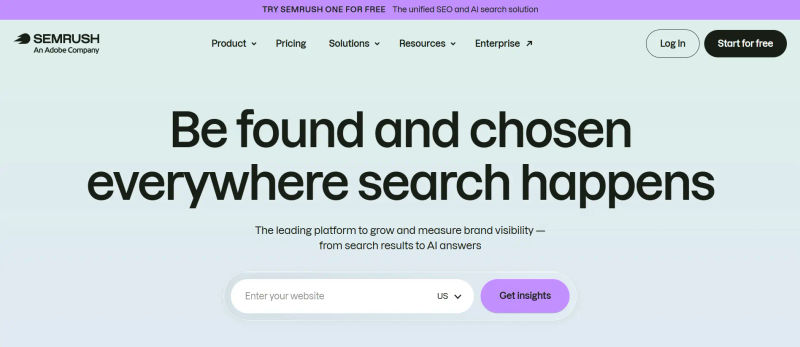
Executive Summary: 2026 Enterprise SEO Platform Comparison
For decision-makers who need the bottom line upfront, this table provides a high-level comparison of the leading Enterprise SEO Platforms in 2026.
Tool | Best For | Pricing (USD $) | Key Features | API & Data Portability | Use Cases |
Semrush | All-in-one visibility, market research, and content marketing for agile, data-driven teams. | Starts at $139.95/mo | 27.9B keyword database, .Trends competitive intelligence, App Center integrations. | Robust REST API, Google Data Studio connector, various integrations. | Market share analysis, global keyword portfolio management, integrated content workflow, PPC & SEO synergy. |
Ahrefs | Unmatched backlink intelligence and deep competitor analysis for link-focused strategies. | Starts at $129/mo | Industry-leading backlink index, Site Explorer, advanced keyword research filters. | Full-featured API, though sometimes criticized for higher credit costs. | Link building at scale, granular competitor backlink audits, content gap analysis. |
Moz | Core metrics and brand authority tracking for teams needing strong foundational tools. | Starts at $99/mo | Domain Authority (DA), Keyword Explorer, Stat SERP analysis, Local SEO. | Mozscape API provides access to link and authority metrics. | Brand authority measurement, local SEO management for multi-location businesses, foundational reporting. |
BrightEdge | High-level, automated reporting and workflow management for C-suite visibility. | Custom | Autopilot & Instant features, StoryBuilder reporting, market share forecasting. | Strong integration with enterprise stacks (Adobe, etc.); data exportable. | Executive-level performance dashboards, task automation, connecting SEO to business outcomes. |
Conductor | Enterprise-grade content strategy, workflow integration, and deep customer voice analysis. | Custom | Content guidance, workflow automation, deep integration with Adobe/Salesforce. | Excellent for integrating SEO data into other marketing platforms. | Centralizing global content operations, aligning SEO with broader marketing teams, understanding user intent. |
Botify | Deep, large-scale technical SEO crawling and log file analysis for massive websites. | Custom | Log file analyzer, JavaScript rendering, full-funnel technical SEO monitoring. | Designed for data export to BI tools like BigQuery or Snowflake. | Auditing sites with 10M+ pages, solving complex indexation issues, technical performance monitoring. |
*Note: All prices shown reflect typical monthly billing. Vendors often offer lower pricing for annual commitments, but those discounts are excluded here for easier comparison. Actual costs may vary depending on your requirements, usage volumes, and negotiated terms.
Make an informed decision on your 2026 SEO budget by using AuthenCIO's expert comparisons.
Software Covered in this Article
To help you understand Semrush Software in the right context, this article refers to a carefully curated set of key players:





The Case for Consolidation: Why Enterprise SEO Directors are Switching Tools
The drive to consolidate SEO tools in 2026 isn't just about cutting costs; it's a strategic imperative. The modern enterprise faces several critical challenges that a fragmented toolset exacerbates.
1. Eliminating Data Silos and 'Multiple Truths'
Yes, Semrush for Enterprise successfully unifies fragmented data across teams by providing a single source of truth for SEO, content, and technical departments. When teams use disparate tools, discrepancies inevitably lead to arguments over data validity rather than strategy. Semrush eliminates these silos by centralizing keyword intelligence, technical audits, and performance reporting into one shared ecosystem. This ensures all enterprise stakeholders operate on the exact same data for forecasting and decision-making.
2. Justifying High-Six-Figure Budgets to the C-Suite
CFOs are scrutinizing every marketing budget line item. Justifying a $200,000+ annual spend on a dozen different tools without a clear attribution model is a losing battle. Consolidation allows for a clearer calculation of TCO and makes it easier to tie a single, significant investment directly to business outcomes.
3. Adapting to the Pace of AI Search
With Google AI Overviews reaching 2 billion users and AI-generated content appearing in over 17% of top results, tracking visibility is no longer about simple rankings. Enterprises must monitor brand mentions in AI responses and adapt to zero-click searches. An all-in-one platform that incorporates AI search tracking provides the agility needed to manage these changes across millions of URLs.
4. Reducing Security and Compliance Overhead
Every new vendor introduces a new security risk and a lengthy procurement cycle. Managing one SOC2 Type II compliant vendor is exponentially simpler and more secure than managing five or ten smaller ones. Consolidation reduces your company's attack surface and frees up legal and IT resources from redundant vetting processes.
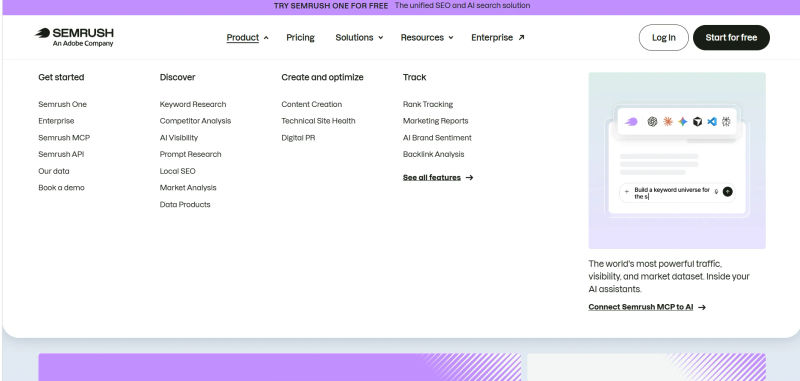
Semrush Enterprise Capabilities: A Critical Look at Scale
Is Semrush effective for large-scale SEO operations? Yes. Its 2026 enterprise-grade architecture supports global organizations effortlessly. Semrush solutions for scalable SEO management include dedicated APIs, custom data limits, and multi-user governance, ensuring the platform performs reliably under massive enterprise pressure.
1. Advanced Keyword Intelligence and Global Market Share Analysis
Semrush's foundational strength is its massive dataset, boasting over 27.9 billion keywords. For an enterprise managing a keyword portfolio in the millions, this scale is non-negotiable. The platform's tools, such as Keyword Manager and Position Tracking, handle this volume without significant performance lag. More importantly for enterprise strategy, the .Trends add-on provides market intelligence that moves the discussion from rankings to market penetration, which is invaluable for C-suite conversations.
2. Technical SEO at Scale: Auditing Millions of Pages
The Site Audit tool crawls millions of pages, reporting on over 140 technical factors and handling JavaScript rendering effectively.
To evaluate the SEO software company Semrush on log file analysis: its Log File Analyzer effectively identifies bot behavior, crawl budget waste, and response code errors. However, it relies on manual file uploads rather than real-time server integration.
Limitations: For complex enterprise sites (10M+ pages), Semrush can struggle with crawl speed and depth. Specialists like Botify maintain an advantage in granular control, automated log file analysis, and diagnosing nuanced indexation issues at massive scale.
3. Content Marketing and Competitive Intelligence Integration
This is where Semrush's 'all-in-one' promise shines, directly driving and measuring Semrush content marketing ROI. The platform seamlessly connects keyword research to content creation and revenue tracking. Enterprise teams can use the Keyword Magic Tool, build topic clusters, create briefs with the SEO Content Template, and provide real-time feedback with the SEO Writing Assistant. By tracking conversions and estimating traffic cost value against competitors, this integrated workflow proves financial impact and delivers significant efficiency gains for large-scale content operations.
Security, Governance, and Integration
Enterprise readiness requires strict security, data control, and seamless connectivity. Semrush provides essential security features like Single Sign-On (SSO) via SAML and granular role-based access control (RBAC) to maintain data integrity and compliance.
Crucially, Semrush integration with enterprise marketing stacks enables true tool consolidation. The platform's API pipes keyword and analytics data directly into internal data lakes. It offers native connectors for BI tools like Google Looker Studio, Tableau, and Power BI, eliminating manual reporting. Workflow integrations further bridge SEO and broader marketing operations by connecting directly to task management platforms (Jira, Asana) and CRMs (Salesforce, HubSpot) to align organic search data with revenue pipelines.
Find Perfect Software for Your Business
Head-to-Head: Semrush vs. The Enterprise Field
Finding the right Semrush enterprise alternative requires comparing data depth, workflow management, and technical precision. The decision to invest depends on how Semrush stacks up against alternatives for your specific requirements. Here is a breakdown of the key 2026 matchups.
1. Semrush vs. Ahrefs: Data Depth vs. Link Intelligence
In 2026, Semrush maintains its edge with a broader feature set, particularly in competitive market analysis and its integrated content marketing platform. Ahrefs, however, continues to be the undisputed leader in backlink intelligence. Its link index is renowned for its size and freshness, making it the preferred tool for enterprises engaged in aggressive, large-scale link-building campaigns.
The Verdict: Choose Semrush for a comprehensive view of digital visibility and an integrated content workflow. Choose Ahrefs if your primary strategic focus is dominating your market through superior backlink acquisition.
2. Semrush vs. BrightEdge & Conductor: All-in-One vs. Workflow Management
When evaluating Semrush for enterprise vs Conductor for enterprise search visibility, the core difference is data agility versus workflow orchestration. BrightEdge and Conductor are enterprise-native platforms focused on workflow automation, executive reporting dashboards, and integrations like Adobe Experience Manager. They excel at translating SEO data into C-suite-friendly narratives.
For teams asking, "Conductor vs Semrush Enterprise for enterprise SEO and AEO - which should we choose?", the answer depends on execution speed. For Answer Engine Optimization (AEO), Semrush offers a more extensive raw dataset. Its real-time SERP feature tracking is superior for reverse-engineering AI overviews. Conductor requires less hands-on work for reporting but lacks Semrush's granular AEO research agility.
The Verdict: Choose BrightEdge or Conductor for automated, executive-level reporting and workflow governance. Choose Semrush for data agility, deep market research, and hands-on AEO execution.
Compare Semrush with other enterprise SEO visibility tools for free on AuthenCIO.
3. Semrush vs. Botify: Technical Precision vs. Feature Breadth
To compare the technical SEO audit features of Semrush and Botify, you must weigh specialized scale against platform integration. Botify is the gold standard for massive websites, offering unparalleled log file analysis, advanced JavaScript rendering, and the capacity to audit tens of millions of URLs. Semrush’s Site Audit tool counters with a highly capable crawler handling up to 1 million pages per audit (customizable for enterprise), featuring over 140 pre-built technical checks and automated issue prioritization.
The Verdict: Choose Botify if you manage a site with over 10 million pages and technical SEO is your team's most critical function. Choose Semrush if you need a well-rounded tool that covers technical audits, content, and market research effectively.
Semrush vs. Specialized Enterprise Tools: Profound & SEOTesting
When proving ROI to leadership as discovery shifts from traditional search to answer engines (like Perplexity, ChatGPT, and Google AI Overviews), Profound is definitively better than Semrush. Profound is purpose-built to measure brand visibility, sentiment, and share of voice within generative AI responses, whereas Semrush is still adapting its traditional web index to parse LLM outputs.
Profound: Answer Engine Reporting
Pros: Purpose-built for AI answer engine tracking; provides clear metrics on brand inclusion in LLM outputs; translates AI visibility into executive-friendly ROI dashboards.
Cons: Lacks traditional search volume and backlink data; requires a separate budget alongside a traditional SEO platform.
Semrush: Answer Engine Reporting
Pros: Excellent for traditional search ROI; consolidating AI Overview tracking into existing executive reports; massive historical data baseline.
Cons: Answer engine tracking lacks the depth of specialized tools; harder to isolate pure LLM-driven ROI from traditional organic traffic.
Regarding enterprise solutions and competitive market positioning moving forward, SEOTesting and Semrush serve complementary, not competing, roles. Semrush is the definitive tool for broad competitive market positioning, offering global market share analysis, competitor keyword gaps, and macro-level industry trends. SEOTesting, conversely, is a specialized testing layer that sits on top of Google Search Console data. For enterprise teams, Semrush dictates where you position your brand in the market, while SEOTesting proves how specific page-level interventions impact that positioning through statistically significant A/B testing.
Evaluating Total Cost of Ownership (TCO) and Platform ROI
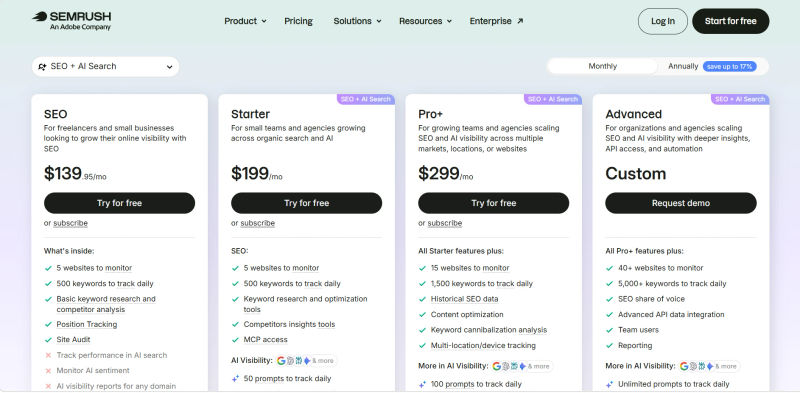
Enterprise software pricing is never simple. For Semrush enterprise pricing 2026, custom plans typically start around $10,000 annually and scale based on data limits, API access, and user seats. To budget accurately, you must evaluate the Total Cost of Ownership (TCO) beyond the base subscription fee.
Additionally, the strong Semrush SaaS valuation in 2026 ensures market stability and continuous R&D investment. However, this market dominance also gives them significant pricing power; enterprise negotiation leverage now relies more on multi-year commitments and high-volume API usage than steep base discounts.
When evaluating TCO and ROI, consider these factors:
Beyond the Base Price: TCO includes variable factors like user seats, API usage for BI tools (Tableau, Looker Studio), and specialized add-ons like .Trends, which increase your overall investment.
The Cost of Change: Factor in internal costs: project setup, migrating years of historical data from legacy tools, and retraining a team of 50+ specialists on a new platform.
Calculating the ROI of Consolidation: A key framework for calculating ROI involves:
Direct Cost Savings: Sum the annual cost of all point solutions you can cancel.
Productivity Gains: Estimate the hours saved per week by eliminating tool-switching and manual reporting. For a team of 10-15 specialists, this can translate into thousands of dollars in reclaimed productivity.
Strategic Value: Consider the value of faster decision-making and improved cross-team collaboration enabled by a unified data platform.
Implementation and Onboarding: The Enterprise Experience
Compared to platforms like BrightEdge or Conductor, reviewers describe Semrush Enterprise's support and onboarding experience as highly responsive but less consultative. The process includes a dedicated account manager, structured training, and guidance on data migration best practices.
What are real customers saying about Semrush Enterprise after a year of using it, and where does it tend to fall short? After 12 months, users praise the successful tool consolidation but frequently cite custom reporting limitations and API rate limits as primary shortcomings. Enterprise teams often outgrow native dashboards, requiring workarounds to pipe data into external BI tools. Therefore, it's crucial to negotiate support SLAs and assess the quality of their professional services layer early, as this relationship significantly impacts long-term value.
Try AuthenCIO
Move to faster, smarter software evaluation with AI
Final Verdict: Is Semrush the Right Investment for Your 2026 Roadmap?
After a thorough analysis, it's clear that Semrush is a top-tier enterprise SEO platform in 2026. However, it is not a universal solution. The decision to invest hinges on your organization's specific priorities.
You should choose Semrush in 2026 if:
Your primary goal is tool consolidation and team efficiency. You want a single source of truth to unite your SEO, content, and PPC teams.
Your organization values data agility and practitioner empowerment. Your team is hands-on and needs flexibility to dive deep into data without restrictive templates.
You need a balanced, all-in-one platform that is very good across all major SEO functions, even if it's not the absolute best-in-class in every niche category.
You should consider an alternative if:
Your primary need is automated, C-suite-level reporting. A platform like BrightEdge or Conductor might be a better fit.
Your strategy is overwhelmingly focused on a single discipline, such as deep technical crawling (Botify) or best-in-class backlink acquisition (Ahrefs).
Risk Assessment
The primary risk of adopting any all-in-one platform is dependency. By consolidating onto Semrush, you are betting on their continued data accuracy, feature innovation, and a stable pricing model. A sudden price hike in 2027 or a dip in data quality could have a significant impact, making it crucial to have clear terms in your enterprise agreement.
Ultimately, Semrush represents a powerful and versatile SEO Tool Consolidation Strategy for the modern enterprise. It empowers teams with world-class data and integrated workflows, making it a formidable contender for your 2026 SEO budget.