
Introduction
If you are among the growing wave of ai-first seo specialists in 2026, you know the developer bottleneck remains the biggest roadblock to executing impactful changes. You diagnose issues on a 50,000-page site, file the Jira tickets, and wait. While your perfectly optimized title tags and schema markup languish in a backlog, opportunities are lost.
Streamline your software evaluation process
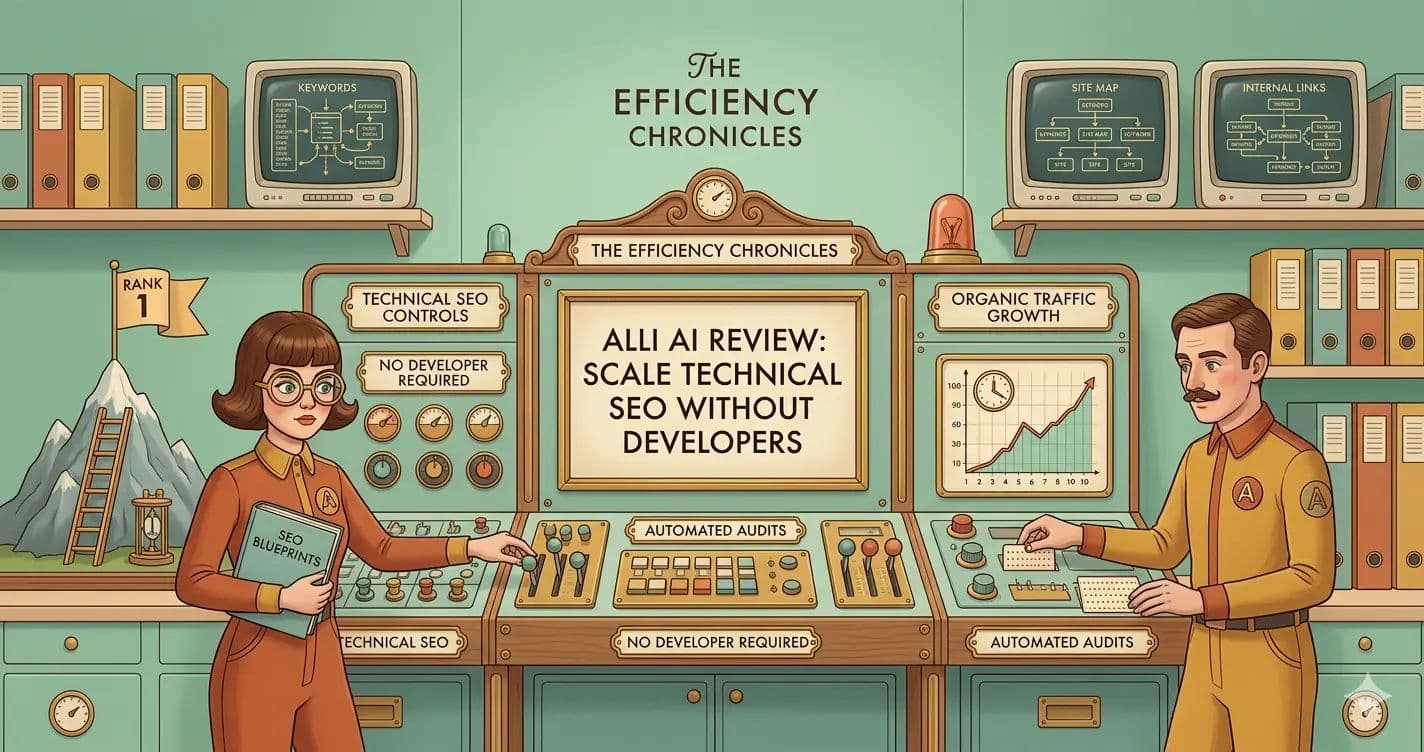
This is where the promise of SEO automation comes in. Alli AI (sometimes searched as alliai or allii.ai) is a prominent player in this space, promising not just to find your SEO problems but to actively fix them—without writing code. But with so much hype, can this alli ai seo tool really deliver for mid-sized agencies? In this comprehensive alli ai review, we answer exactly that.
This is not another promotional overview; it is a definitive alli ai seo review 2026. We will dissect its core features, benchmark it against the tools you already use, and give you a clear verdict based on our testing and aggregated alli ai reviews. Whether you need a focused alli ai seo review, a broader alli ai seo automation review 2026, or a deep-dive alli ai seo tool review 2026, this guide covers it all. We explore its bulk optimization capabilities, its approach to schema, and critically, how alli ai seo deployment works in practice.
Tools | Best For | Pricing | Key Features |
Alli AI | Bypassing developer queues for on-page & technical fixes at scale. | Starts at $299/month | JS snippet deployment, live code editor, bulk meta & schema rules, real-time technical fixes, CMS-agnostic implementation. |
All-in-one SEO visibility and competitive intelligence. | Starts at $140/month | Site audits, keyword research, backlink analysis, rank tracking, content and competitive intelligence suite. | |
Screaming Frog | Deep, granular technical SEO auditing and data extraction. | $279/year | Desktop crawler, advanced filters, custom extraction (XPath, Regex), log file analysis, bulk exports for technical SEO audits |
AI-driven content optimization and brief generation. | Starts at about $119/month. | NLP-based content editor, keyword research, SERP analyzer, content audits, outline/brief generation. | |
Tracking and improving brand visibility in AI answers (AEO). | Starts at $49/month | AI visibility tracking across major LLMs, prompt-level scoring, competitor benchmarking, schema-oriented recommendations, AEO-focused content workflows. | |
Lumar | Enterprise technical SEO observability and website health monitoring. | Custom Pricing | Cloud-based crawling, ongoing site health monitoring, technical SEO, performance, and accessibility insights with dashboards for big organizations. |
Sitebulb | Visual, exploratory technical SEO crawling for consultants and agencies. | Starts at $18/month | Visual crawl maps, issue prioritization, in-depth audit reports, strong explanations aimed at consultants and in-house SEO teams. |
Cloudflare Workers | Flexible edge-level code execution for custom SEO and performance rules. | Custom Pricing | Run JavaScript at the CDN edge, rewrite HTML, headers, and redirects, implement custom SEO and routing logic with developer-built scripts. |
SearchPilot | Enterprise edge SEO testing and controlled experiments. | Custom Pricing | SEO split-testing on the edge, bulk page variant testing, measurement of organic impact, designed for experiment-driven SEO at scale. |
*Note: All prices shown reflect typical monthly billing. Vendors often offer lower pricing for annual commitments, but those discounts are excluded here for easier comparison. Actual costs may vary depending on your requirements, usage volumes, and negotiated terms.
Key Takeaways
Alli AI remains a powerhouse in 2026 for mid-sized agencies and SEO teams looking to bypass developer bottlenecks. It excels at deploying real-time technical fixes and bulk on-page optimizations directly to any CMS without altering the backend code.
Pros: Instant deployment of schema markup and meta tags, CMS-agnostic integration via a simple JavaScript snippet, and massive time savings for technical SEO implementation.
Cons: The premium pricing model can be steep for solo consultants, and automated content adjustments still require human oversight to maintain brand voice and accuracy.
Bottom Line: If your agency struggles with slow developer queues, Alli AI pays for itself by allowing SEO specialists to implement critical technical changes instantly.
Pros and Cons of Alli AI
Pros
Deploys SEO fixes instantly without developer involvement.
CMS-agnostic setup via a simple JavaScript snippet.
Bulk optimization of meta tags, schema, and on-page elements.
Enables rapid technical SEO updates across thousands of pages.
Strong time savings and efficiency for large-scale SEO operations.
Cons
Expensive for solo consultants and small businesses.
Poorly configured rules can create site-wide SEO errors.
Changes disappear if the subscription and script are removed.
Best For
Mid-sized agencies and technical SEO teams needing fast, large-scale SEO implementation without waiting for developers.
Verdict
Powerful SEO automation platform that removes implementation bottlenecks, but requires technical expertise, careful QA, and sufficient budget.

Software Covered in this Article
To help you evaluate Alli AI in the right context, this article compares it against a carefully curated set of competitors:








What is Alli AI? (And Why SEO Specialists Use It)
Unlike traditional SEO platforms that diagnose problems and leave the implementation to you, Alli AI is built on a fundamentally different premise: execution. Originating as an innovative software solution (details and history can be found on the Alli AI startup official website), it is an on-page automation platform that provides technical SEO automation** at scale** via a single JavaScript snippet installed on your website. This is its key differentiator. Instead of permanently altering your site's source code, it acts as an optimization layer, deploying changes in real-time as the page is rendered for users and search engine bots.
This CMS-agnostic approach means it can work with virtually any setup—WordPress, a headless CMS, or a complex custom stack—without needing deep backend access. For e-commerce brands, it allows teams to instantly deploy the SEO best practices Shopify environments typically require custom theme development to achieve. The primary reason an SEO specialist turns to a tool like Alli AI is to break free from the developer queue. It's designed to address common pain points like:
The Developer Bottleneck: Implementing hundreds of meta description updates or schema changes that would otherwise take weeks of dev time.
Scaling Technical Fixes: Pushing out a critical fix, like a canonical tag rule, across thousands of pages instantly.
Maintaining Consistency: Enforcing SEO best practices across a site with multiple contributors and no centralized control.
Agile SEO Testing: Rapidly A/B testing title tags or on-page content without a complex engineering setup.
For mid-sized firms using Content Delivery Networks (CDNs), Alli AI's snippet works in tandem with services like Cloudflare. The script executes on the client-side after the page is delivered from the CDN cache, meaning it can apply dynamic SEO fixes without interfering with your edge caching strategy.
Core Features Tested: From Bulk Edits to Live Deployment
When evaluating Alli AI SEO automation features, the platform excels at bypassing traditional developer bottlenecks. We tested its most critical components—from bulk on-page edits to live deployment—to see how this automated implementation performs in real-world scenarios for mid-sized agencies and in-house teams.

1. Automated Meta Tag & Content Optimization
This is Alli AI's bread and butter. The platform allows you to create rules to modify title tags, meta descriptions, H1s, and even body content in bulk. You can use variables (like product name or category) to generate unique tags across thousands of pages. For an e-commerce site with a massive SKU count, this is a high-efficiency solution.
Workflow: The process is straightforward. You define a page segment (e.g., all URLs containing
/product/), create a rule for the element you want to change, and use dynamic variables or static text. The 'Live Editor' feature lets you see a visual preview of your changes before deploying them.Performance: The bulk implementation is incredibly fast. Changes can be pushed live across an entire site in minutes. However, the AI-generation for meta descriptions, while functional, lacks the nuance of a human writer or more advanced generative tools. It's best for programmatic application where a templated-but-unique description is better than a missing or duplicated one. Accuracy rates for AI-generated descriptions are generally high for product pages but can miss the mark on capturing complex user intent for informational content.
Critique: The power here is also a risk. A poorly constructed rule can instantly deploy incorrect or nonsensical title tags across your entire site. This feature requires a 'measure twice, cut once' approach and is not for beginners. The lack of a robust, multi-stage approval workflow within the platform means agencies must build their own manual sign-off process. A key 'Safety First' checklist item should be: Always test new rules on a staging environment or a small, non-critical page segment before full deployment.
2. Schema Markup Automation at Scale
Manually implementing and validating schema, especially custom types, is tedious. Alli AI aims to automate this by allowing you to create and deploy JSON-LD markup using rules, similar to its meta tag feature. It supports standard schema types like Product, Article, and FAQ out of the box.
Workflow: You select the schema type, map page elements (e.g., pull the product price from the
<span>with classprice) to the required schema properties, and set the deployment rules. This is particularly powerful for sites that weren't built with proper schema from the ground up.Performance: For standard schema, the automation is highly effective. It correctly injects the markup without interfering with existing code. The real test is with custom schema types. While Alli AI allows for custom JSON-LD input, it requires the user to be proficient in writing the code themselves. The tool facilitates the deployment of custom schema, but not its creation.
Critique: A significant drawback is how the tool handles 'SEO conflict'. If you have an existing, hard-coded schema on a page and deploy a conflicting rule via Alli AI, it can lead to validation errors in Google Search Console. The platform doesn't have a sophisticated conflict resolution system; it simply injects its code. Careful auditing is required to ensure you're not creating duplicate or conflicting structured data.
3. Real-time Technical Fixes Without a Developer
Using the Live Editor, you can inject or modify code directly on the page. This could mean adding canonical tags, noindex tags, implementing hreflang, or even fixing broken internal links on the fly. The editor provides the precision technical SEOs need, allowing changes to be targeted using robust CSS selectors rather than just visual clicking.
Workflow: The editor allows you to select page elements via selectors and modify the HTML or inject scripts into the
<head>or<body>. For example, you can create a rule to add arel="canonical"tag to all paginated pages pointing to the root category page.Performance: This is arguably the most powerful feature for bypassing development cycles. In 2026 benchmarks, such tools can reduce the deployment time for critical technical fixes from weeks to minutes. The ability to instantly patch a widespread issue, like incorrect canonicalization after a site update, is invaluable. We tested this by modifying image alt tags and adding internal links, and the changes were reflected immediately.
Critique: While powerful, this feature demands caution. Direct code injection carries inherent risks, and a flawed rule could impact site rendering or functionality. It's crucial to have a strong understanding of HTML and the DOM to use this feature safely.
Find Perfect Software For Your Business
Performance Analysis: Efficiency vs. Control for Mid-Sized Firms
For a mid-sized firm, the value proposition of Alli AI hinges on a single question: does the efficiency gain outweigh the potential loss of granular control and the inherent risks?
The Efficiency Gain: The ROI is most clearly measured in hours saved. Consider a task like updating 5,000 product meta descriptions. Manually, this is a week's work. With Alli AI, a rule can be configured and deployed in under an hour. The platform effectively eliminates the 'developer bottleneck' for a specific subset of SEO tasks. This frees up the technical SEO specialist to focus on higher-level strategy, such as analyzing log files, planning site architecture, or conducting deeper competitive analysis. Leading AI SEO agents report saving marketing teams over 50 hours per week through similar autonomous workflows.
The Loss of Control & Inherent Risks: The trade-off is control. When you hard-code a change, it's permanent and version-controlled. Changes made through Alli AI exist within its ecosystem. If you ever deactivate the tool, all your fixes vanish. This vendor lock-in is a significant strategic consideration. Furthermore, the risk of deploying an error at scale is magnified. A typo in a rule doesn't just affect one page; it affects thousands. This necessitates a rigorous internal QA process.
Impact on Core Web Vitals and Page Speed
A primary concern for any technical SEO is the performance impact of third-party scripts. Because Alli AI operates via JavaScript injection, the risk of 'code bloat' is real. Every rule you add increases the complexity and potentially the execution time of that script. Our tests on page load speed showed a negligible impact with a handful of rules. However, a site with hundreds of complex rules could see a performance degradation, potentially affecting Core Web Vitals like Largest Contentful Paint (LCP) if the script delays main content rendering, or Cumulative Layout Shift (CLS) if it modifies content after the initial paint. It's crucial to monitor Core Web Vitals closely in Search Console and use tools like PageSpeed Insights to benchmark performance before and after implementing a large set of rules.
Evaluate Alli AI and other technical SEO platforms on the free AuthenCIO engine.
Alli AI vs. The Competition: Which Tool Wins in 2026?
Alli AI doesn't exist in a vacuum. To understand its true value, you must compare it to the specialized tools already in your arsenal. It's not about which tool is 'best,' but which tool is right for the job.
1. Alli AI vs. Surfer & Rank Prompt (Content Automation)
This comparison is about recommendations versus execution. Surfer and Rank Prompt primarily help you research, write, and optimize content. While Surfer includes a post-publication Audit feature to analyze live pages for missing NLP terms and structural gaps, it only provides a checklist of recommendations that you must manually apply.
Alli AI is a post-publication execution tool that modifies existing pages on the fly. You could use a Surfer audit to identify content gaps, then use Alli AI to automatically inject terms or A/B test title tags at scale. If your bottleneck is creating optimized content or semantic analysis, Surfer is the clear winner. If your bottleneck is implementing on-page changes to thousands of existing pages without developers, Alli AI is the solution.
2. Alli AI vs. Screaming Frog, Sitebulb & Lumar.io (Technical Auditing)
This is the most critical comparison for technical SEOs. Screaming Frog, Sitebulb, and Lumar.io are the industry standards for diagnostics. They are deep crawlers that provide an exhaustive, granular view of your site's technical health. Alli AI is not a deep crawler. Its auditing capabilities are surface-level at best. It is a tool for implementation. The ideal workflow involves using Screaming Frog to identify 10,000 pages with missing meta descriptions, then using that data to build a bulk optimization rule in Alli AI. These tools are complementary, not competitive.
3. Alli AI vs. Edge SEO (e.g., Cloudflare Workers, SearchPilot)
This is a direct comparison for bypassing CMS limitations. Edge SEO platforms like SearchPilot or custom Cloudflare Workers also allow real-time code modification without touching the source code. The key difference is the execution layer and primary use case.
Edge SEO tools make changes at the CDN level before the page is delivered to the user. Platforms like SearchPilot specifically excel at rigorous SEO testing, allowing teams to run statistical A/B tests on technical changes before a full rollout.
Conversely, Alli AI operates on the client-side (in the browser). While it lacks the advanced A/B SEO testing capabilities of SearchPilot, it is designed for rapid deployment via a user interface. Edge SEO requires development knowledge, whereas Alli AI offers an accessible path to similar outcomes for teams without engineering support.
Pricing and Value for Mid-Sized SEO Agencies
When evaluating Alli AI's pricing structure, the focus is squarely on agency scalability and reducing developer bottlenecks. For those researching alli ai pricing 2026, the entry-level Business plan starts at $299/month. This tier covers up to 5 sites and 1,250 pages, including multiple user seats for team collaboration. If you are looking specifically at alli ai seo pricing 2026 for larger operations, costs scale up to custom Enterprise plans designed for managing over 50 sites and 20,000+ pages. A 10-day free trial remains available and is essential for testing compatibility with your existing tech stack.

Is the investment worth it? The value calculation for a mid-sized firm is straightforward: you must weigh the subscription cost against the billable hours saved on manual implementation. If your technical SEO specialists spend 20 hours a month on tasks that Alli AI can automate in two, the ROI is immediate. Compared to a broader all-in-one platform like Semrush, Alli AI acts as a specialized, premium investment. It is a scalpel rather than a Swiss Army knife, offering immense value if your agency struggles with developer bottlenecks.
Try AuthenCIO
Move to faster, smarter software evaluation with AI
The Verdict: Is Alli AI the Best SEO Automation for Agencies in 2026?
After extensive testing and analysis, our verdict is that Alli AI is a powerful, specialized tool that delivers on its core promise: automating the implementation of on-page and technical SEO changes at scale. It is one of the most effective solutions on the market for any mid-sized firm consistently hampered by the developer bottleneck.
However, it is not a 'set-it-and-forget-it' platform or a replacement for your core SEO toolkit. Its value is directly proportional to the expertise of the user. In the hands of a seasoned technical SEO, it can dramatically increase efficiency. In the hands of a novice, it carries the risk of deploying site-wide errors with a single click.
You should seriously consider investing in Alli AI in 2026 if:
Your SEO recommendations consistently get stuck in a development backlog for weeks or months.
You manage large, complex websites (especially e-commerce) and need to make bulk on-page changes regularly.
Your team has strong technical SEO expertise but lacks dedicated developer resources for implementation.
You want to rapidly A/B test on-page elements like titles and metas without engineering support.
You should probably stick with your current toolkit if:
Your primary needs are deep technical auditing, keyword research, or all-in-one site management (stick with Screaming Frog and Semrush).
You work on smaller sites where manual implementation is manageable.
Your team lacks the technical confidence to manage a tool that directly modifies site code, even via a script.
A Final Note on Security: Giving a third-party script the ability to modify your production website is a significant security consideration. Before committing, your organization must conduct a thorough security review of Alli AI's practices and ensure it complies with your data and privacy policies. Ultimately, the shift in 2026 is from AI assistants to autonomous agents. Alli AI is a firm step in that direction, but it still requires a skilled pilot.