Introduction
If you are evaluating cloud communications software alternatives to Calilio, you need platforms that go beyond basic VoIP to offer advanced AI routing, seamless CRM integrations, and global scalability. While Calilio provides a reliable baseline for cloud telephony, growing support and sales teams often outgrow its feature set, leading to throttled efficiency, inflated Average Handle Time (AHT), and agent burnout.
Streamline your software evaluation process
The shift toward AI-driven business telephony is an immediate operational reality. However, the best cloud communications software alternatives differentiate themselves not through generic features, but through measurable ROI in real-time coaching, automated transcription, and specialized workflow automation. Decision-makers must evaluate how these platforms align with their unique workflows, agent onboarding processes, and regional coverage needs.
To help you navigate this complex market, we have analyzed the top 12 AI cloud dialers for 2027. This guide bypasses marketing fluff, focusing entirely on decision-making criteria, total cost of ownership, and the specific use cases where each platform excels.
Key Takeaways
Top Recommendations: If you are searching for the best cloud communications software alternatives to Calilio in 2027, CloudTalk and KrispCall lead the market for high-volume sales and global remote support, respectively.
Pricing Expectations: Expect to pay between $15 and $30 per user per month for entry-level AI cloud dialers. Advanced enterprise tiers offering real-time AI coaching and unified omni-channel features typically range from $50 to over $100 per user monthly.
Core Advantages: Modern support and sales leaders are migrating to these platforms to leverage deeper CRM integrations, automated speed-to-lead workflows, and real-time AI transcription that legacy systems struggle to provide.
Top Calilio Alternatives
Nextiva — best for all-in-one business communications and customer experience management
RingCentral — best for enterprise-grade unified communications and scalability
Dialpad — best for AI-powered voice intelligence and team collaboration
Zoom Phone — best for businesses already using the Zoom ecosystem
Talkdesk — best for cloud contact centers and customer support teams
8x8 — best for global businesses needing international VoIP coverage
Aircall — best for sales and support teams requiring CRM integrations
CloudTalk — best for call centers handling high-volume inbound and outbound calls
Kixie — best for sales teams focused on power dialing and revenue acceleration
Vonage — best for businesses needing customizable communications and APIs
KrispCall — best for remote teams managing multiple virtual phone numbers
CallHippo — best for startups and small businesses seeking easy-to-deploy VoIP solutions
At a Glance: Calilio Alternatives Comparison Table
Tool | Best For | Pricing (USD $) | Key Features | Primary AI Strength | Avg. Setup Time |
CloudTalk | High-Volume Outbound Sales Teams | Starts at $25/user/month | Predictive dialing, local presence, workflow automation | Smart Outbound Automation | 1-3 Days |
KrispCall | Global Remote Support Teams | Starts at $15/user/month | Unified callbox, global numbers in 100+ countries | Global Routing Intelligence | Under 24 Hours |
CallHippo | Mid-Market Scalability | Starts at $20/user/month | Rapid agent onboarding, global connect, call cascading | Intelligent Call Cascading | 1-2 Days |
Kixie | CRM Automation and Speed-to-Lead | Starts at $35/user/month | Bi-directional CRM sync, automated SMS triggers | Speed-to-Lead Routing | 2-4 Days |
Nextiva | Unified Omni-Channel Communication | Starts at $30/user/month | Threaded conversations, unified inbox, automated surveys | Real-Time Sentiment Analysis | 1-2 Weeks |
Dialpad | Real-Time AI Transcription and Coaching | Starts at $23/user/month | Live agent assist, real-time QA scoring, AI playbooks | Live Agent Coaching | 3-5 Days |
RingCentral | Enterprise-Grade Reliability | Starts at $30/user/month | 99.999% uptime, complex PBX routing, advanced analytics | Predictive Network Routing | 2-4 Weeks |
Zoom Phone | Integrated Video and Voice Workflows | Starts at $15/user/month | Native UCaaS consolidation, seamless video handoff | Conversational Intelligence | 3-7 Days |
Aircall | Seamless Helpdesk Integrations | Starts at $30/user/month | Native Zendesk/Intercom sync, intuitive admin UI | Contextual Insight Cards | 1-2 Days |
Talkdesk | AI-First Contact Center Innovation | Starts at $85/user/month | Autonomous voice agents, deep AI analytics | Predictive Intent Routing | 3-6 Weeks |
8x8 | Global Compliance and Security | Starts at $24/user/month | SOC2/GDPR compliance, data residency controls | Secure Data Processing | 2-4 Weeks |
Vonage | Customizable API-Driven Solutions | Starts at $20/user/month | Programmable voice, CPaaS integration, custom logic | Programmable Voice APIs | Varies by Build |
Note: All prices shown reflect typical monthly billing. Vendors often offer lower pricing for annual commitments, but those discounts are excluded here for easier comparison. Actual costs may vary depending on your requirements, usage volumes, and negotiated terms.
Software covered in this article
To help you understand AI Cloud Call Center Software in the right context, this article refers to a carefully curated set of key players:








Why Support Leaders are Moving Beyond Calilio
The decision to migrate away from Calilio rarely stems from a single system failure; rather, it is driven by the compounding inefficiencies of outgrowing a basic platform. As customer expectations evolve, support leaders are actively evaluating broader cloud communications software alternatives that offer proactive, context-aware, and highly integrated ecosystems.
The Cost of Technical Debt and Integration Gaps While Calilio offers standard integrations, modern support teams require bi-directional, real-time synchronization across their entire tech stack. When evaluating cloud communications software alternatives, leaders prioritize platforms that eliminate siloed communication data to provide a unified view of the customer journey. The technical debt incurred by staying on a platform with integration gaps directly impacts resolution rates and inflates the high cost of manual call logging.
The Rise of Autonomous Voice Agents and UCaaS Convergence Industry benchmarks reveal that while many enterprise cloud contact centers incorporate some form of AI, only a fraction consider their deployments mature. Support leaders are migrating to platforms that offer more than just post-call summaries. The best cloud communications software alternatives deliver real-time human-AI orchestration and UCaaS (Unified Communications as a Service) convergence. This allows for the deployment of autonomous voice agents capable of handling multi-turn conversations, drastically reducing tier-1 ticket volume.
Agent Experience and Burnout For distributed teams, poor call quality and disjointed interfaces lead to customer frustration and agent burnout. Platform stagnation forces agents to toggle between screens, manually enter data, and guess customer context. Top-tier cloud communications software alternatives embed directly into CRMs like Salesforce, HubSpot, or Zendesk without requiring manual API configuration, winning the market by prioritizing seamless agent experiences.
Top 12 Calilio Alternatives for AI-Driven Operations
When evaluating these 12 platforms, the most critical question is not "Which tool has the most features?" but rather "Which tool is built for my specific operational model?" Below is an in-depth analysis of the top competitors, categorized by their primary strengths.
1. CloudTalk: Best for High-Volume Outbound Sales Teams
Who is this best for? Sales managers and outbound operations leaders who need to maximize agent talk time and connection rates through intelligent automation.
Platform Overview: CloudTalk has positioned itself as a powerhouse for outbound operations.
Overcoming the limitations of basic dialers, CloudTalk excels in eliminating the dead time between calls.
Its architecture is built around workflow automation, ensuring that agents spend their time speaking with qualified leads rather than navigating administrative interfaces.
When evaluating Calilio vs CloudTalk, the latter offers a more aggressive focus on outbound volume and sales productivity.
Key AI & Operational Features:
Smart Predictive Dialing: Utilizes AI to predict agent availability and automatically dials multiple numbers, connecting the agent only when a live human answers, which drastically reduces idle time.
AI Local Presence: Automatically matches the outbound caller ID to the area code of the lead, significantly boosting answer rates and building immediate trust with prospects.
Automated Workflows: Allows administrators to build custom rules. For example, if a call goes to voicemail, the system can automatically send a pre-written SMS and schedule a follow-up task in the CRM.
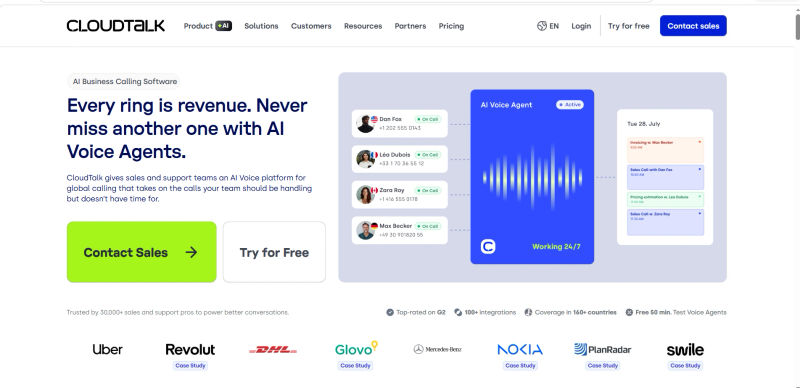
Why Choose It Over Calilio: If your team's primary metric is outbound connection rate, CloudTalk's predictive dialer and local presence features provide an immediate, measurable ROI that standard cloud dialers struggle to match.
Furthermore, their dedicated migration support ensures your existing numbers are ported quickly without disrupting daily sales quotas.
Quick Verdict: The top choice for sales teams prioritizing connection rates, automated dialing, and seamless outbound workflows over complex inbound routing.
Find Perfect Software for Your Business
2. KrispCall: Best for Global Remote Support Teams
Who is this best for? Support managers overseeing distributed, remote agents who require a unified, highly intuitive interface without complex onboarding.
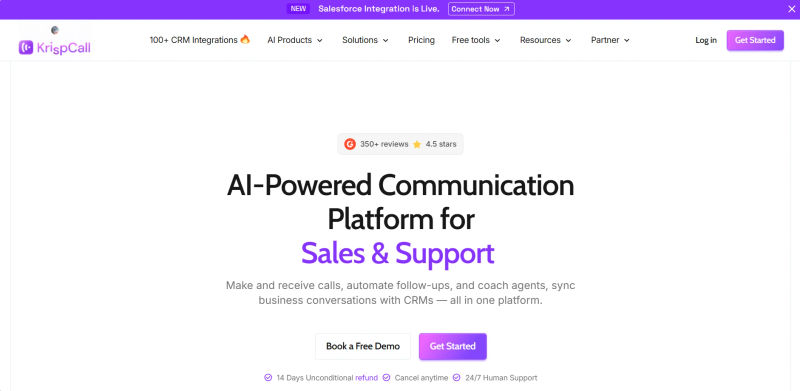
Platform Overview: KrispCall simplifies the complexity of managing a global workforce.
It focuses heavily on the user experience for the agent, providing a "Unified Callbox" that consolidates voice, SMS, and internal team communications into a single pane of glass.
When comparing Calilio vs KrispCall, KrispCall provides a much faster deployment model for teams scattered across multiple time zones.
Key AI & Operational Features:
Unified Callbox: A centralized dashboard that prevents agents from toggling between multiple applications to view customer history, reducing cognitive load.
Global Number Availability: Instant access to local, mobile, and toll-free numbers in over 100 countries, bypassing complex regional regulatory hurdles.
Shared Workspaces: Allows multiple remote agents to manage a single high-priority client number collaboratively, ensuring zero missed inbound requests.
Why Choose It Over Calilio: KrispCall drastically reduces the time required for agent onboarding.
Its interface is highly intuitive, making it the superior choice for support leaders who need to rapidly scale remote teams across different time zones without sacrificing visibility or incurring massive training costs.
Quick Verdict: The ideal lightweight, globally accessible dialer for remote teams that need to spin up international numbers instantly.
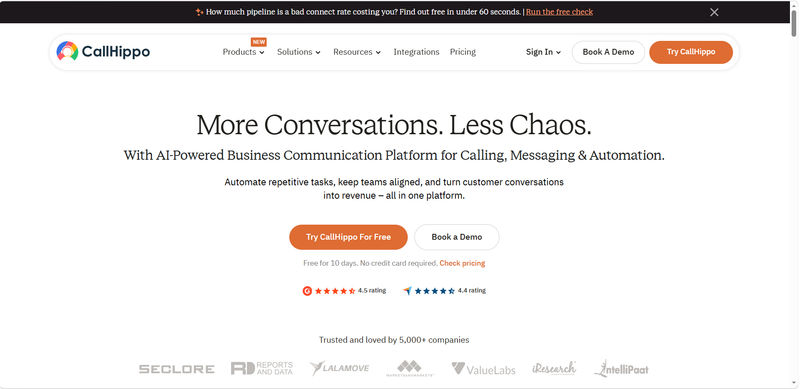
3. CallHippo: Best for Mid-Market Scalability
Who is this best for? Operations leaders at rapidly growing mid-market companies who need a flexible, cost-effective solution that scales seamlessly as call volumes spike.
Platform Overview: CallHippo bridges the gap between lightweight small-business dialers and heavy enterprise contact centers.
It provides a robust set of features at a competitive price point, ensuring that mid-market teams do not overpay for enterprise modules they do not yet need.
In a Calilio vs CallHippo matchup, CallHippo offers far more granular control over inbound routing as your team expands.
Key AI & Operational Features:
Call Cascading: Intelligently routes inbound calls through a predefined sequence of agents based on skill level and availability, ensuring priority clients are handled by senior staff.
Global Connect: AI-driven time zone detection that alerts agents if they are attempting to call a lead outside of appropriate business hours, protecting brand reputation.
Post-Call Analytics: Automated generation of performance reports focusing on agent occupancy and call abandonment rates, giving managers actionable data.
Why Choose It Over Calilio: CallHippo offers superior pricing flexibility and scalability.
It allows growing teams to add advanced routing and analytics features modularly, providing a more controlled Total Cost of Ownership (TCO) as the business expands, backed by solid migration assistance.
Quick Verdict: A highly scalable, modular solution perfect for mid-market teams that need advanced routing without enterprise-level pricing.
4. Kixie: Best for CRM Automation and Speed-to-Lead
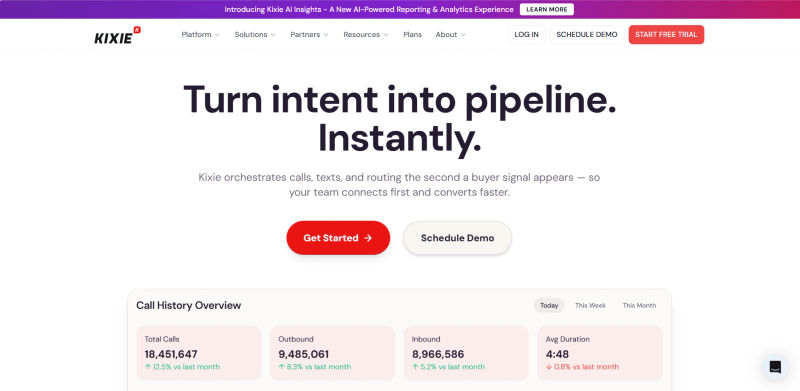
Who is this best for? Revenue operations and support leaders who treat their CRM (Salesforce, HubSpot, Pipedrive) as the ultimate source of truth and require zero-latency data synchronization.
Platform Overview: Kixie is engineered specifically for CRM-centric workflows.
It functions less as a standalone phone system and more as a powerful voice extension of your existing CRM.
Its primary goal is to automate the manual data entry that leads to agent burnout.
When looking at Calilio vs Kixie, Kixie's bi-directional sync is significantly more robust and instantaneous.
Key AI & Operational Features:
Bi-Directional CRM Sync: Every call, voicemail, and SMS is instantly logged into the CRM with zero manual input required from the agent, ensuring perfect data hygiene.
Speed-to-Lead Routing: AI triggers that automatically initiate an outbound call to an agent the second a high-value lead submits a web form, maximizing conversion rates.
Event-Based Automation: Triggers custom CRM workflows based on call dispositions (e.g., tagging a call as "Technical Issue" automatically opens a high-priority support ticket).
Why Choose It Over Calilio: Kixie's integration depth is unmatched.
If your team suffers from siloed communication data or poor CRM hygiene, Kixie forces compliance through automation, ensuring a truly unified view of the customer journey and eliminating manual logging.
Quick Verdict: The ultimate choice for organizations that want their telephony system to live and breathe entirely within their CRM environment.
5. Nextiva: Best for Unified Omni-Channel Communication
Who is this best for? Customer experience leaders who need to manage voice, email, SMS, and social media interactions within a single, threaded conversational view.
Platform Overview: Nextiva has evolved into a comprehensive customer experience management platform.
It recognizes that a customer might start an interaction via a website chatbot, escalate to an email, and finally call support.
Nextiva ties these touchpoints together. In a Calilio vs Nextiva comparison, Nextiva offers a much broader omnichannel scope.
Key AI & Operational Features:
Threaded Conversations: Merges all communication channels into a single timeline, giving the agent full context before they even say "Hello," which drastically reduces AHT.
AI Sentiment Analysis: Scans emails and voice transcripts in real-time to gauge customer frustration, automatically escalating at-risk accounts to senior managers.
Automated Surveys: Triggers dynamic CSAT and NPS surveys immediately after a call, tying feedback directly to specific agent performance for better QA.
Why Choose It Over Calilio: Nextiva is the superior alternative for teams struggling with fragmented communication channels.
It eliminates the blind spots that occur when voice data is kept separate from email and text interactions, providing a holistic view of the customer.
Quick Verdict: Best for support teams that need to break down silos between voice, email, and chat to deliver a seamless customer experience.

6. Dialpad: Best for Real-Time AI Transcription and Coaching
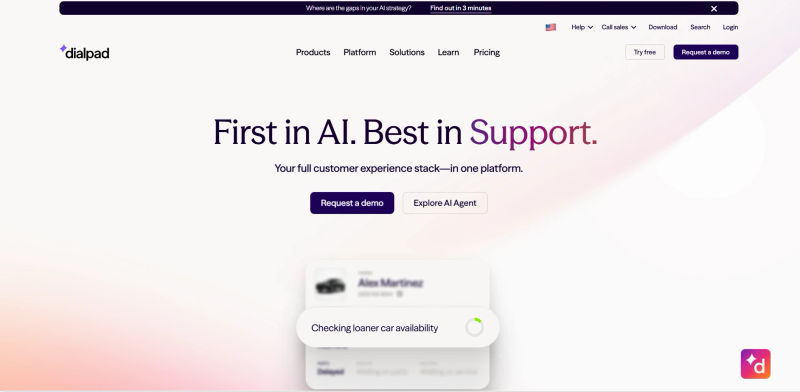
Who is this best for? Support managers who prioritize live agent training, real-time quality assurance, and immediate in-call assistance.
Platform Overview: Dialpad is built natively on its own proprietary AI engine, known as Dialpad Ai.
Rather than bolting on third-party AI tools, Dialpad processes voice data in real-time, focusing heavily on augmenting the agent's capabilities while the call is active.
When evaluating Calilio vs Dialpad, Dialpad's live coaching capabilities are vastly superior.
Skip the sales pitch and run a side-by-side competitor comparison on AuthenCIO.
Key AI & Operational Features:
Live Agent Assist: If a customer mentions a specific competitor or a complex technical issue, the AI instantly pops a customized battle card or knowledge base article onto the agent's screen.
Real-Time QA Scoring: Evaluates agent performance on predefined criteria (e.g., greeting compliance, empathy) during the call, rather than waiting for manual post-call reviews.
Automated Post-Call Summaries: Generates highly accurate, formatted summaries of the conversation, complete with action items, saving agents minutes of wrap-up time per call.
Why Choose It Over Calilio: For coaching remote or distributed support teams without real-time visibility, Dialpad is the gold standard. It transforms the manager's role from retroactive reviewer to proactive coach.
However, support managers should account for a moderate learning curve; agents will need dedicated training to effectively utilize live battle cards without getting distracted mid-call.
Quick Verdict: The premier platform for real-time agent enablement and live QA, provided your team is willing to invest time in training.
7. RingCentral: Best for Enterprise-Grade Reliability
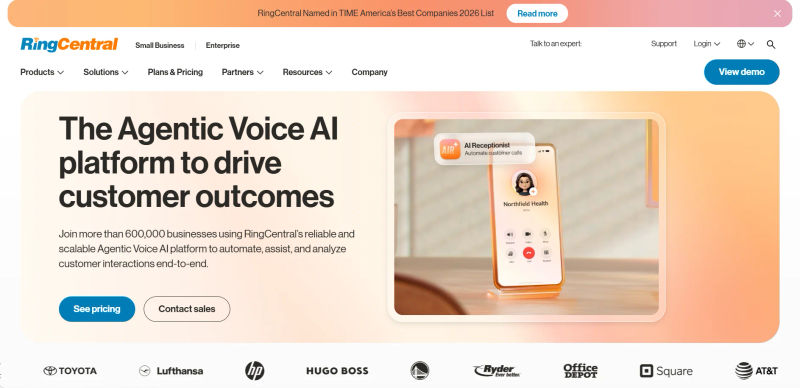
Who is this best for? IT and operations executives at large enterprises who require absolute stability, complex PBX configurations, and strict compliance standards.
Platform Overview: RingCentral remains a titan in the Unified Communications as a Service (UCaaS) space.
It is designed for massive scale, offering the infrastructure necessary to support thousands of concurrent global users without degradation in call quality.
In the Calilio vs RingCentral debate, RingCentral wins on pure infrastructural resilience.
Key AI & Operational Features:
99.999% Uptime SLA: Financially backed guarantees of reliability, utilizing geo-redundant data centers to prevent localized outages from affecting global operations.
Advanced IVR and Routing: Allows for highly complex, multi-layered routing trees based on time of day, agent skill, and real-time queue capacity.
Deep Analytics: Enterprise-grade reporting dashboards that provide granular visibility into network latency, jitter, and overall system health.
Why Choose It Over Calilio: When downtime translates to thousands of dollars in lost revenue or severe SLA breaches, RingCentral provides the institutional stability and complex routing logic that enterprise organizations demand.
Their migration teams are also equipped to handle massive, multi-site deployments.
Quick Verdict: The safest, most reliable choice for large enterprises that cannot afford a single minute of unexpected downtime.
8. Zoom Phone: Best for Integrated Video and Voice Workflows
Who is this best for? Organizations already heavily invested in the Zoom ecosystem that want to consolidate their communication stack and reduce software bloat.
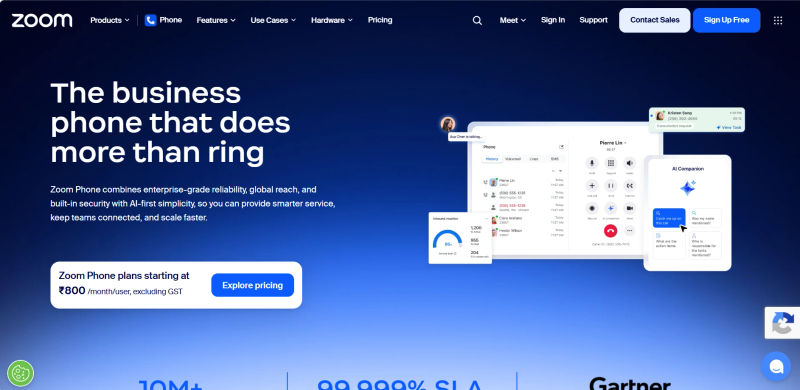
Platform Overview: Zoom Phone leverages the familiar Zoom interface, adding robust enterprise cloud PBX capabilities.
It is designed for teams that frequently transition between internal video collaboration and external voice communication.
Comparing Calilio vs Zoom Phone, Zoom offers a massive advantage in vendor consolidation.
Key AI & Operational Features:
Seamless Handoff: Allows users to elevate a standard voice call to a full Zoom video meeting with screen sharing with a single click, without dropping the connection.
Zoom AI Companion: Integrates meeting summaries, action item extraction, and conversational intelligence directly into the voice workflow.
Hardware Ecosystem: Deep native integrations with a vast array of physical desk phones, conference room systems, and headsets.
Why Choose It Over Calilio: If your company already uses Zoom for video, adopting Zoom Phone drastically reduces administrative overhead and agent training time.
It offers a path to vendor consolidation that Calilio cannot match, streamlining procurement and IT management.
Quick Verdict: The most logical upgrade for teams already utilizing Zoom for video conferencing, offering seamless UCaaS consolidation.
9. Aircall: Best for Seamless Helpdesk Integrations
Who is this best for? Inbound customer support teams utilizing platforms like Zendesk, Intercom, or Front, who need a telephony system that lives entirely within their helpdesk.
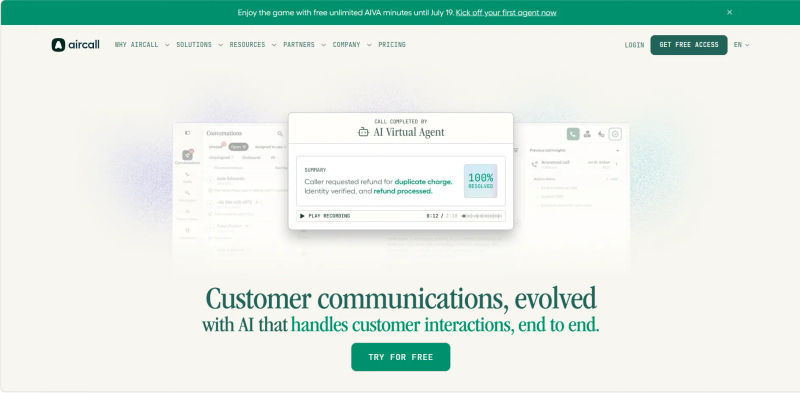
Platform Overview: Aircall is famous for its "one-click" integration ecosystem.
It does not try to be a CRM or a helpdesk; instead, it aims to be the best possible voice layer sitting on top of the tools your support team already uses every day.
In a Calilio vs Aircall scenario, Aircall's setup speed and helpdesk synergy are unparalleled.
Key AI & Operational Features:
Native Helpdesk CTI: The Aircall dialer embeds directly into the Zendesk or Intercom interface, utilizing screen pops to show customer history on incoming calls.
Insight Cards: Pulls custom data fields from the helpdesk and displays them on the dialer, ensuring agents know exactly who is calling and their current ticket status.
Collaborative Call Routing: Easy-to-configure routing rules that allow teams to share the burden of high call volumes dynamically.
Why Choose It Over Calilio: Aircall's administrative interface is remarkably user-friendly.
Support managers can spin up new numbers, build routing trees, and integrate with their helpdesk in minutes, without requiring IT intervention. It is the definition of a plug-and-play solution.
Quick Verdict: The absolute best option for support teams that want their phone system embedded directly into Zendesk or Intercom.
10. Talkdesk: Best for AI-First Contact Center Innovation
Who is this best for? Forward-thinking contact center leaders who want to deploy autonomous voice agents and predictive intent routing to deflect low-level inquiries.
Platform Overview: Talkdesk represents the cutting edge of contact center technology.
It is built for operations that want to push the boundaries of what AI can handle, moving beyond agent assistance into true autonomous issue resolution.
When assessing Calilio vs Talkdesk, Talkdesk is a significantly heavier, more advanced enterprise platform.
Key AI & Operational Features:
Autonomous Voice Agents: Highly advanced conversational AI that can handle complex, multi-turn customer interactions (e.g., processing returns, troubleshooting basic tech issues) without human intervention.
Predictive Intent Routing: Analyzes the customer's recent web behavior and historical data to predict the reason for their call, routing them to the exact specialist equipped to handle it.
AI Data Analytics: Deep neural network analysis of 100% of customer interactions to identify emerging product issues or shifts in customer sentiment before they become widespread problems.
Why Choose It Over Calilio: Talkdesk is significantly more expensive and complex than Calilio, but it offers the highest ceiling for operational efficiency.
Deploying autonomous voice agents requires significant upfront mapping of customer intents, meaning the learning curve for administrators is steep.
However, the long-term deflection of tier-1 tickets justifies the initial setup time.
Quick Verdict: An enterprise-grade powerhouse for organizations ready to invest heavily in autonomous AI and ticket deflection.

11. 8x8: Best for Global Compliance and Security
Who is this best for? Support operations in highly regulated industries (healthcare, finance, government) that require strict data residency controls and compliance certifications.
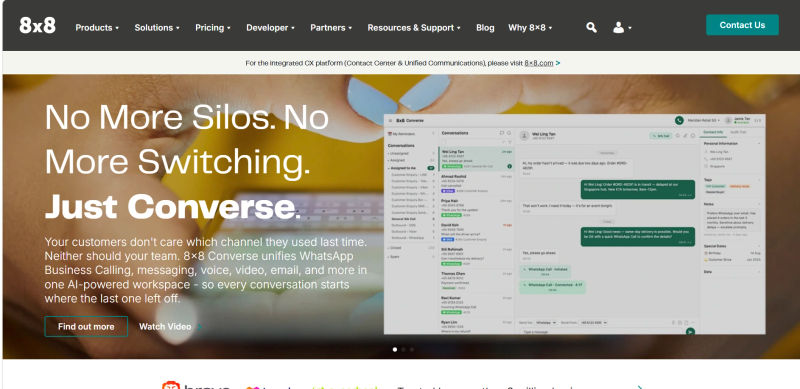
Platform Overview: 8x8 focuses heavily on the governance and security aspects of cloud communications.
While it offers a robust suite of AI and UCaaS features, its primary differentiator is its commitment to protecting sensitive voice data across international borders.
Comparing Calilio vs 8x8, 8x8 provides a much stronger security posture.
Key AI & Operational Features:
Strict Regulatory Compliance: Out-of-the-box compliance with SOC2, GDPR, HIPAA, and PCI-DSS, with detailed audit logs for every interaction.
Data Residency Controls: Allows administrators to dictate exactly which regional servers process and store call recordings and AI transcripts, ensuring compliance with local data sovereignty laws.
Global PSTN Replacement: Full PSTN replacement in over 50 countries, providing enterprise-grade voice quality without relying on third-party local carriers.
Why Choose It Over Calilio: Trust and governance are non-negotiable in regulated sectors.
8x8 provides the security infrastructure and compliance reporting that Calilio and many other lightweight dialers lack, protecting the organization from severe regulatory fines and data breaches.
Quick Verdict: The mandatory choice for healthcare, finance, and government sectors where data sovereignty and compliance are paramount.
12. Vonage: Best for Customizable API-Driven Solutions
Who is this best for? Technical operations teams and developers who want to build highly customized, programmable voice workflows directly into their proprietary applications.

Platform Overview: Vonage operates both as a standard UCaaS provider and a powerful Communications Platform as a Service (CPaaS).
It is designed for organizations that find off-the-shelf software too restrictive and possess the technical resources to build bespoke solutions.
In a Calilio vs Vonage evaluation, Vonage wins on pure developer flexibility.
Key AI & Operational Features:
Programmable Voice APIs: Allows developers to embed voice and video calling directly into custom mobile apps or proprietary internal software.
Custom AI Integrations: Flexibility to route voice data through proprietary or third-party AI models for specialized transcription, translation, or sentiment analysis.
Dynamic Routing Logic: Build routing rules based on complex database queries that standard drag-and-drop IVR builders cannot accommodate.
Why Choose It Over Calilio: If your customer experience relies on a proprietary application and you need voice capabilities embedded natively within that ecosystem, Vonage provides the API flexibility that closed-system dialers like Calilio cannot offer.
Their technical support during migration is tailored toward developers.
Quick Verdict: The best platform for engineering-heavy teams that want to build bespoke telephony workflows from the ground up.

Key Factors When Evaluating AI Cloud Dialers
Selecting the right telephony platform requires a structured evaluation process. As you compare these 12 alternatives against Calilio, ensure your Internal Requirements Document (IRD) prioritizes the following criteria:
Proven AI Maturity Over Feature Checklists Every vendor claims to have AI. However, there is a massive difference between a platform that uses a generic API for basic transcription and one that utilizes proprietary models for real-time, low-latency agent coaching.
During demos, demand to see AI features working live in a production environment. Ask specifically about the AI's accuracy rates regarding industry-specific jargon and its ability to handle regional accents.
Total Cost of Ownership (TCO) and Hidden Fees Transparent pricing remains a challenge in the cloud dialer market. The headline per-user cost rarely reflects the final invoice.
When calculating ROI to justify the software to executive leadership, you must account for hidden costs.
Look closely at API access fees, per-minute international surcharges, costs for storing call recordings beyond 30 days, and premium charges for advanced AI modules.
AI Data Transparency and Governance AI-processed voice data introduces new security vulnerabilities. You must know exactly how the vendor uses your customer data to train their models.
If a platform uses generative AI to summarize calls, evaluate their consent management tools, call-recording notices, and opt-out handling.
Ensure the vendor offers strict data residency controls and guarantees that your proprietary conversations are not used to train public AI models.
The Migration and Handoff Process Switching from Calilio should not result in operational downtime. Evaluate the prospective vendor's post-implementation support and SLA guarantees.
Ask for a comprehensive migration checklist during the sales process. How quickly can they port your existing numbers? What is the failover plan if the porting process is delayed?
The best vendors provide a dedicated implementation manager to ensure a seamless transition.
Try AuthenCIO
Move to faster, smarter software evaluation with AI
Conclusion and Migration Next Steps
Moving away from Calilio is a strategic opportunity to align your communications infrastructure with the specific needs of your support operations. There is no universal "best" tool—only the best tool for your unique use case.
If your priority is automating high-volume outbound sales, CloudTalk and Kixie offer unmatched speed-to-lead capabilities.
For support teams that live inside Zendesk or Salesforce, Aircall and Nextiva provide the deep, threaded integrations necessary to reduce manual logging.
Meanwhile, enterprise leaders requiring absolute stability and regulatory compliance should look toward RingCentral and 8x8, and those ready to embrace autonomous voice agents will find Talkdesk leading the charge.
Migration Next Steps Checklist:
Audit Current Numbers: Document all local, toll-free, and international numbers currently hosted on Calilio to prepare for porting.
Verify CRM API Compatibility: Ensure your chosen alternative has a native, bi-directional integration with your specific CRM version.
Request a Sandbox: Before signing a contract, demand a sandbox environment to test call latency and AI transcription accuracy with your actual agents.
Define Success Metrics: Establish baseline metrics for AHT, CSAT, and connection rates to measure the ROI of the new platform post-launch.
Do not rely on vendor marketing to make your final decision. Define your must-have features, calculate your true Total Cost of Ownership, and leverage objective data to validate your choice.