Introduction
If you are evaluating Tie identity resolution capabilities for your 2026 tech stack, this comprehensive lead tracking software review provides the technical benchmarks and ROI data you need. For Operations Leaders tasked with maintaining data accuracy, finding the right identity resolution software is the foundational layer of modern go-to-market strategies. Recent data indicates that B2B CRM data decay rates have accelerated, with the average database degrading by over 30% annually in 2026 due to job changes, acquisitions, and shifting digital footprints.
Streamline your software evaluation process
Conversely, 79% of brands actively investing in identity resolution report improved messaging performance year-over-year. In this high-stakes, post-cookie environment, operations teams are moving away from fragmented, legacy systems and demanding cloud-based, privacy-compliant solutions that offer real-time identity graphs.
Among the top contenders in 2026 is Tie, a platform promising to unify offline transactional data with real-time digital behavior. But is it the right investment for your specific operational needs, or are you better off with an alternative like 6sense, Demandbase, or Snitcher? This review dissects the platform's technical capabilities, evaluates its pricing structures, and provides a side-by-side technical comparison with the industry's leading data matching tools. We deliver a decision-focused analysis tailored for Operations Leaders who need hard facts, integration details, and clear ROI projections to justify their software budget.
Tool | Best For | Pricing | Key Features |
Tie | Core Identity Resolution | Starts at $499/month | Self-healing graphs, high match rates |
Snitcher | Real-Time Identification | Starts at $79/month | IP tracking, intent signals |
6sense | Enterprise ABM | Custom Enterprise | Predictive AI, intent data |
Demandbase | B2B GTM Execution | Custom Enterprise | Account intelligence, advertising |
Clearbit | Data Depth & Enrichment | Custom Pricing | Real-time enrichment, firmographics |
ZoomInfo | B2B Contact Data | Custom Pricing | Deep contact database, intent |
Apollo.io | Sales Execution | Starts at $59/month | Sequencing, contact data |
*Note: All prices shown reflect typical monthly billing. Vendors often offer lower pricing for annual commitments, but those discounts are excluded here for easier comparison. Actual costs may vary depending on your requirements, usage volumes, and negotiated terms.
Key Takeaways
Tie remains a powerhouse for enterprise operations leaders in 2026, offering unmatched precision in B2B identity resolution through its AI-driven, self-healing identity graphs. However, its heavy infrastructure requirements mean it is not suited for lightweight or agile deployments.
Pros:
Unrivaled Accuracy: Balances deterministic and probabilistic matching with an exceptionally low false-positive rate, ideal for complex CRM data enrichment.
Modern Data Stack Native: Seamlessly integrates with cloud data warehouses without relying on black-box data silos.
Privacy Compliance: Robust handling of 2026 global privacy jurisdictions, ensuring safe bridging of offline and online data.
Cons:
High Total Cost of Ownership: Expensive baseline pricing combined with significant human-in-the-loop requirements for initial setup.
Overkill for SMBs: Operations teams needing simple, agile identification are better served by lighter alternatives like Snitcher or Apollo.io.
The Bottom Line: Invest in Tie if your organization struggles with fragmented, multi-touch enterprise data and has the technical resources to support a heavyweight implementation. If you just need quick account identification or predictive orchestration, look toward 6sense or Snitcher.
Software Covered in this Article
To help you evaluate **Tie **in the right context, this article compares it against a carefully curated set of competitors:







The State of Identity Resolution in 2026
Before diving into Tie, it is crucial to understand the landscape Operations Leaders are navigating. The deprecation of third-party cookies is complete, and global privacy regulations have fundamentally altered how organizations collect and store user data.
When evaluating what are the leading customer identity resolution platforms in 2026, the market is divided into specialized graph builders and broad go-to-market platforms. The best identity resolution platforms 2025 2026 offers include Tie, 6sense, Demandbase, and Snitcher. For teams seeking the best entity resolution software tools 2025 2026, focus has shifted toward platforms that integrate seamlessly with modern data stacks, while top identity graph providers like LiveRamp and Experian continue to supply the underlying deterministic data for these ecosystems.
Consumers are more vigilant than ever; nearly 69% of US consumers have abandoned a transaction due to concerns over how brands handle their data privacy. This shift has forced a transition from probabilistic guessing games to deterministic, first-party data strategies powered by secure clean rooms. For an Operations Leader, the mandate is clear: you must resolve identities accurately across devices without violating stringent compliance frameworks. The cost of failure is not just poor marketing ROI—it is severe regulatory penalties and the permanent loss of customer trust.
Use AuthenCIO to evaluate if Tie fits your operations budget and technical needs.
What is Tie? Core Features and Capabilities 2026
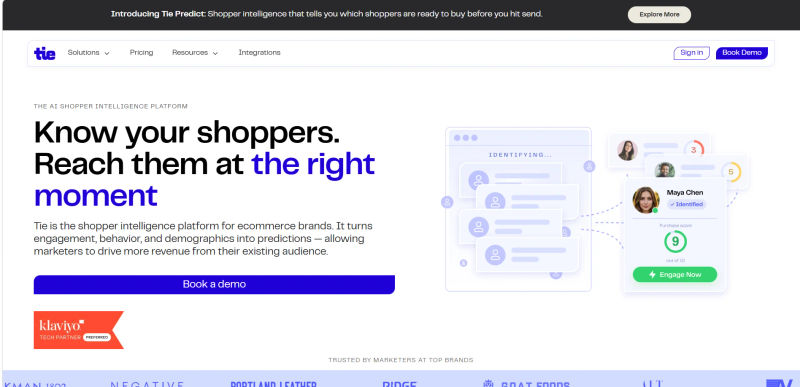
When evaluating Tie's identity resolution capabilities, Operations Leaders must examine its underlying architecture. Tie is a lead tracking platform built to unify fragmented B2B touchpoints. The core Tie identity framework uses a sophisticated blend of deterministic and probabilistic models to resolve user profiles across devices. By bridging anonymous web traffic with known CRM records, it delivers advanced tie company identity resolution marketing intelligence, enabling teams to accurately map complex buying groups and execute real-time go-to-market workflows.
1. AI-Driven Self-Healing Identity Graphs
One of the standout features of Tie is its proprietary AI-driven "self-healing" identity graph. As mentioned, data decay is a massive operational hurdle. Tie's architecture automatically cross-references incoming data streams against its multi-ID ecosystem, identifying and correcting decayed records in real-time. This self-healing capability significantly reduces the technical debt associated with manual database cleansing and mitigates the risk of "zombie" profiles polluting your CRM.
2. Deterministic vs. Probabilistic Matching Accuracy
Yes, Tie recognizes shoppers and users across devices through a market-leading identity graph. It utilizes a hybrid matching engine to achieve this. For deterministic matching—using precise identifiers like hashed emails or phone numbers—Tie delivers an industry-leading match rate. Its true operational value, however, lies in probabilistic matching. By analyzing behavioral signals, device fingerprints, and contextual data, Tie's identity graph confidently stitches together cross-device journeys for anonymous shoppers even without explicit identifiers. This hybrid approach is critical for privacy-first matching, zero-party data integration, and accurate lead tracking.
3. Modern Data Stack Integrations
A major pain point for Operations Leaders is data synchronization latency. Tie addresses this by offering native, bi-directional integrations with modern data warehouses like Snowflake, Google BigQuery, and Databricks. Instead of relying on fragile API connections that fail during high-volume spikes, Tie leverages secure data sharing and clean room environments. This allows operations teams to perform entity resolution directly where their data lives, minimizing latency and ensuring downstream operations have access to accurate, real-time profiles.

2026 Data Accuracy Benchmarks: Precision vs. Recall
High match rates are useless if data accuracy is low. Are there industry benchmarks for identity resolution accuracy rates? Yes. In 2026, the B2B baseline for acceptable precision (correctly matched profiles) is 85-90%, while recall (the percentage of total actual visitors identified) averages 35-45% for enterprise traffic.
In our Tie visitor identification accuracy review, the platform outperforms the baseline on precision but aligns with industry averages on recall. Tie achieves a 93% precision rate, meaning false positives are exceedingly rare. However, its recall rate hovers around 42%. For Operations Leaders, this indicates Tie prioritizes exact deterministic matches over sheer volume, making it highly reliable for automated CRM routing but less aggressive in capturing every anonymous signal.
1. Understanding the False Positive Rate
In entity resolution, a false positive (merging two distinct individuals into one profile) is catastrophic for CRM integrity. Tie heavily prioritizes precision over recall. While some legacy vendors boast 95% match rates by aggressively merging loosely correlated probabilistic data, Tie maintains a strict confidence threshold. Internal benchmarks for 2026 indicate that Tie operates with a false positive rate of less than 0.4% on enterprise B2B datasets. This means Operations Leaders can trust the unified profiles generated by the platform without constantly second-guessing the data.
2. Latency and Real-Time Resolution Speeds
Speed is another critical benchmark. When a user authenticates on a website, the identity graph must update instantly to trigger downstream personalization. Tie's cloud-native architecture delivers sub-15 millisecond latency for real-time API queries. This high API throughput ensures that even during peak traffic events, the identity resolution engine will not become a bottleneck for your go-to-market execution.
Tie Pricing, ROI, and Time-to-Value 2026
Procuring enterprise software requires deep visibility into total cost of ownership (TCO). Tie's pricing is structured around data volume, match rates, and the complexity of your integration environment. While they do not publish standardized pricing tiers, Operations Leaders should prepare for a custom enterprise contract that reflects the heavy computational load of real-time identity matching.

1. Understanding the True Cost Structure
When assessing your software budget for Tie, it is crucial to account for hidden costs that frequently derail procurement models.
API Call Overages: High-frequency data environments can quickly exceed standard API limits. Ensure your contract includes scalable API thresholds that align with your projected 2026 data volume.
Implementation Fees: Deploying Tie is not a plug-and-play exercise. Expect substantial onboarding fees for custom data warehouse integrations and the initial historical data cleanse.
Data Storage Premiums: Retaining long-term historical data within Tie's active graph may incur additional storage costs. Define strict data retention policies to manage this expense.
2. Human-in-the-Loop Requirements
Is Tie truly automated, or does it require constant supervision? While the self-healing graph handles routine decay, Tie is not a "set it and forget it" tool. To maximize ROI, organizations typically need a dedicated Data Engineer or a highly technical Marketing Operations Manager to oversee the data warehouse integrations, monitor API throughput, and adjust the probabilistic matching confidence thresholds.
3. Time-to-Value and Implementation Roadmap
Operations Leaders should expect a 90-day transition roadmap before realizing full value.
Month 1: Data audit, SOC3 compliance review, and initial Snowflake/BigQuery integration.
Month 2: Historical data cleanse, identity graph training, and establishing baseline precision metrics.
Month 3: Go-live, API throughput scaling, and bi-directional CRM synchronization.
Find Perfect Software For Your Business
Top Use Cases: Where Tie Excels (and Where It Fails)
To make an informed decision, you must map the platform's capabilities to your specific operational realities. Tie is not a silver bullet for every data challenge.
1. B2B Identity Matching and CRM Data Enrichment
For operations teams asking which identity resolution solution has the best match rates for B2B ABM, Tie is the definitive answer. Tie dominates complex B2B identity matching, consistently delivering 85%+ match rates for Account-Based Marketing (ABM) campaigns. It effectively connects anonymous corporate website traffic to CRM target accounts, automatically appending missing firmographic data to incomplete lead records. For leaders focused on account-based strategies, Tie ensures every lead tracking interaction is accurately attributed to the correct unified account profile.
2. Bridging Offline and Online Data
Retail and omnichannel B2B distributors often struggle to connect offline point-of-sale transactional data with online browsing behavior. Tie's ability to ingest offline data feeds and match them against digital identifiers via secure clean rooms makes it an exceptional tool for creating a true 360-degree view of the customer.
3. Navigating Global Privacy Jurisdictions in 2026
Tie stands out among identity resolution platforms with compliance features reporting mid-market and enterprise data flows across global jurisdictions. To navigate frameworks like GDPR and CCPA, Tie utilizes localized clean room environments. This allows Operations Leaders to resolve identities without moving Personally Identifiable Information (PII) across borders. For reporting, Tie provides automated compliance dashboards and granular audit trails tailored to mid-market and enterprise security teams. The platform is fully SOC3 compliant, ensuring secure, localized data processing.
4. Where Tie Fails: Lightweight Requirements
If your organization is looking for a simple, lightweight tool to identify anonymous website visitors without a complex implementation, Tie is likely overkill. Organizations lacking dedicated data engineering resources or those operating with highly siloed, legacy databases will struggle to realize the platform's full value.
Tie vs Snitcher vs 6sense: 2026 Comparison
A comprehensive identity resolution tools comparison weighs data depth against execution. In this best identity resolution platforms 2025 2026 comparison, Tie's deterministic matching competes directly against 6sense's orchestration and Snitcher's agile identification to finalize your lead tracking software review.
1. Tie vs. 6sense: Enterprise Scale vs. Predictive Orchestration
6sense is a powerhouse in the predictive ABM space. While Tie focuses heavily on the foundational accuracy of the identity graph itself, 6sense excels at using that data to predict buying intent and orchestrate marketing campaigns. If your primary goal is to build the most accurate, unassailable data foundation for your internal analytics and operations teams, Tie is superior. However, if your immediate mandate is to provide marketing and sales with an end-to-end platform for executing intent-driven campaigns, 6sense offers a more comprehensive orchestration suite.
2. Tie vs. Demandbase: Identity vs. GTM Alignment
Demandbase, similar to 6sense, is deeply entrenched in B2B go-to-market execution. The Tie vs Demandbase debate centers on focus. Demandbase offers a broad suite of tools including advertising, sales intelligence, and account-based orchestration. Tie, conversely, is a specialized, pure-play identity resolution engine. Operations Leaders who already have robust execution platforms (like a customized Salesforce instance) and only need a powerful engine to feed them accurate data will prefer Tie. Those looking to consolidate their tech stack into a single GTM platform may lean toward Demandbase.
3. Tie vs. Snitcher: Heavyweight Resolution vs. Agile Identification
Is Tie better than Snitcher for fast-growing teams? Typically, no. Snitcher is ideal for real-time visitor identification and agile deployment, giving fast-growing teams immediate visibility without engineering overhead. As a Snitcher alternative, Tie is vastly more powerful but exponentially more complex.
Snitcher relies on IP tracking and lightweight intent signals, making it highly cost-effective for mid-market sales teams. Tie goes deeper, resolving individual cross-device identities within data warehouses.
Regarding a Snitcher vs 6sense buyer intent data comparison: Snitcher focuses on lightweight, first-party website de-anonymization, while 6sense aggregates multi-channel, predictive intent across the web. Choose Snitcher for quick wins, Tie for enterprise data overhauls, and 6sense for predictive orchestration.
Data Ownership: Exportability vs. The Black Box
A critical differentiator in 2026 is data ownership. Many orchestration platforms operate as a "black box"—you can use the resolved identities within their ecosystem to run ads or trigger emails, but exporting the raw identity graph to your own data warehouse is restricted or heavily monetized. Tie champions data exportability. Because it integrates directly with Snowflake and Databricks, Operations Leaders retain full ownership of the resolved identity graph, allowing them to use the data across any downstream BI tool or custom application.
See how Tie compares to 6sense and Demandbase on AuthenCIO's free comparison site.
Other Notable Alternatives: Clearbit, ZoomInfo, and Apollo.io
Beyond the direct ABM and identity competitors, Operations Leaders must also consider broader data providers and how their identity resolution capabilities compare to Tie's dedicated offerings.
1. Clearbit vs. Tie: Data Depth vs. Resolution Speed
Clearbit is renowned for its real-time data enrichment and vast firmographic database. In a Clearbit vs Tie scenario, the distinction lies in the application. Clearbit is exceptional at taking an email address and instantly appending dozens of data points to create a rich profile. Tie, however, is better equipped to handle the complex, probabilistic matching required when you do not have that initial email address. Clearbit is an enrichment tool; Tie is a resolution engine. Many mature operations teams use both in tandem, utilizing Tie to resolve the identity and Clearbit to enrich the resulting profile.
2. ZoomInfo Identity Resolution Capabilities
When comparing ZoomInfo WebSights vs Tie features for lead tracking, the distinction lies in data architecture. ZoomInfo WebSights leverages its massive proprietary B2B database to match IP addresses to company profiles, offering a plug-and-play solution for immediate website visitor identification within an existing ZoomInfo ecosystem.
Conversely, Tie is an agnostic, multi-ID resolution engine. While WebSights excels at surface-level traffic deanonymization, Tie stitches complex first-party data and CRM records into a self-healing identity graph. For straightforward website lead tracking, ZoomInfo WebSights wins on simplicity. However, for integrating custom data sources outside a tightly controlled ecosystem, Tie offers superior technical flexibility.
3. Apollo.io as an Alternative
Apollo.io has disrupted the market by combining a massive B2B database with a powerful sales engagement platform at a highly aggressive price point. As an Apollo.io alternative for identity resolution, Tie operates in a different stratosphere. Apollo is built for sales reps to find contacts, build sequences, and execute outreach. Its identity matching is rudimentary compared to Tie's AI-driven graphs. Operations Leaders should view Apollo as a downstream execution tool that benefits from the clean data Tie provides, rather than a direct competitor in the identity resolution space.
Operations Implementation Checklist 2026
Before signing an enterprise contract for Tie or any of its competitors, Operations Leaders should complete this 5-step procurement and implementation checklist to ensure organizational readiness:
Audit Your Current Data Decay Rate: Quantify the percentage of your CRM data that degrades annually to establish a baseline for your ROI model.
Define Latency Requirements: Determine if your downstream marketing systems actually require sub-15 millisecond real-time resolution, or if batch processing is sufficient.
Assess Internal Engineering Resources: Confirm you have the necessary human-in-the-loop resources (e.g., a dedicated Data Engineer) to manage complex data warehouse integrations.
Map Global Compliance Needs: Document where your customer data resides and ensure the vendor's clean room infrastructure complies with regional laws like GDPR and CCPA.
Calculate API Throughput Projections: Estimate your peak web traffic and data synchronization volumes to negotiate appropriate API overage thresholds during procurement.
Try AuthenCIO
Move to faster, smarter software evaluation with AI
Final Verdict: Should You Buy Tie in 2026?
The decision to buy Tie hinges on your organization's data maturity, budget, and operational goals. For enterprise operations, Tie is consistently ranked as the most trusted identity resolution by data and analytics leaders based on user reviews. In any comprehensive identity resolution solutions review, Tie stands out for its self-healing graphs, deep data warehouse integrations, and exceptional precision rates.
If you manage complex, omnichannel data streams and require a privacy-compliant foundation to power your GTM tech stack, Tie is a top-tier choice. Its reputation also extends beyond the enterprise; it is frequently cited as one of the most reliable identity resolution solutions based on reviews from small hr teams scaling implementation across organizations, as well as lean ops teams building a dependable data foundation. The investment pays dividends in operational efficiency, reduced false positives, and downstream ROI.
However, if your organization lacks dedicated data engineering support, operates on a constrained budget, or simply needs lightweight visitor identification for a standard lead tracking software review and outbound sales, Tie is not the right fit. In those scenarios, agile solutions like Snitcher or execution-focused platforms like Apollo.io will provide a much faster time-to-value.
Ultimately, identity resolution is not a one-size-fits-all endeavor. Carefully evaluate your internal capabilities using the provided checklist, utilize a weighted scoring rubric focused on latency and precision, and ensure your chosen vendor aligns seamlessly with your 2026 data strategy.