
Introduction
In the hyper-competitive digital landscape of 2026, the battle for consumer attention has shifted from mere traffic acquisition to aggressive conversion rate optimization (CRO). With global software spending expected to exceed 6.15 trillion dollars in 2026, marketing managers are under immense pressure to justify every dollar of their tech stack.
Streamline your software evaluation process
The era of "broad-spectrum unsegmented acquisition" is over; the current mandate is to maximize the value of every unique visitor through psychological triggers and dynamic friction reduction.
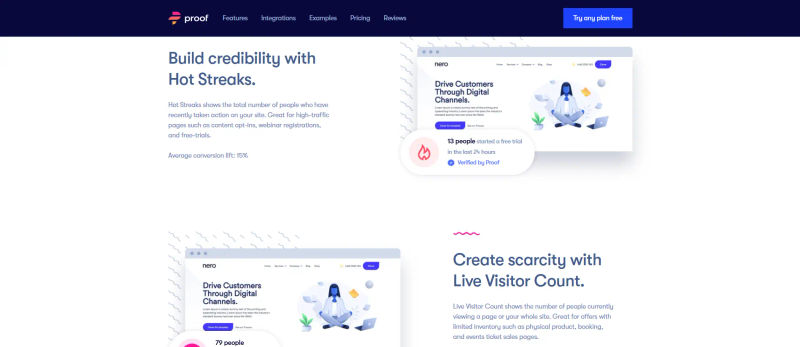
This comprehensive Proof software review 2026 analyzes whether the platform remains the gold standard for social validation. Proof (formerly UseProof) leverages the psychological phenomenon of social validation to increase on-site conversions. At its core, it displays real-time customer activity notifications—such as recent purchases, live visitor counts, and hot streaks—to site visitors.
By showcasing that real humans are interacting with a brand, Proof aims to trigger the Fear Of Missing Out (FOMO) and build instant credibility for Small to Medium-sized Businesses (SMBs).
However, the CRO landscape has evolved. In 2026, consumers are increasingly skeptical of automated marketing. The rise of AI-generated content has created a "trust deficit," meaning social proof tools must be more authentic and less intrusive than ever before.
Marketing managers need solutions that integrate with complex stacks involving Unbounce, HubSpot, and Shopify, while strictly adhering to Core Web Vitals. A social proof tool today must offer predictive analytics, seamless mobile responsiveness, and granular targeting rules to avoid "notification fatigue."
Key Takeaways for Marketing Managers
Is Proof worth it? Yes, especially for high-traffic sites needing AI-driven, real-time notifications and strict GDPR/CCPA compliance. It remains a top contender for the best social proof software, though its strict visitor-based pricing tiers require careful ROI forecasting to avoid overage fees.
Who are the best alternatives? If Proof exceeds your budget or scope, VWO offers advanced CRO testing, Unbounce provides integrated landing pages, and POWR delivers budget-friendly engagement widgets.
The 2026 CRO Landscape: Static testimonials are out. Predictive, real-time social proof is the new standard for reducing conversion friction in a cookieless world.
Proof Review — Social Proof for Conversion-Focused Websites
Pros
Real-time activity notifications: Proof displays recent purchases, sign-ups, and other customer actions to add social validation to landing pages.
Hot Streaks: Aggregates multiple activities into a single notification, making it useful for high-volume campaigns.
Live visitor counts: Shows how many people are currently viewing a page, helping marketers introduce an element of urgency.
AI-driven personalization: Uses visitor behavior to determine which type of social proof may be most relevant to an individual visitor.
Flexible timing controls: Marketers can control when notifications appear based on factors such as time spent on a page or scroll depth.
Easy implementation: A low-code setup allows businesses to add Proof to their websites without a complicated development process.
Customization: Notifications can be styled to better match a website's branding rather than appearing like an unrelated third-party widget.
Privacy-focused infrastructure: The platform emphasizes first-party data and compliance with privacy requirements such as GDPR and CCPA.
Cons
Traffic-based pricing: Costs can increase as website traffic grows, even when only a portion of visitors interact with the notifications.
Potential performance impact: Adding third-party JavaScript can affect page performance and should be monitored carefully.
Notification fatigue: Excessive pop-ups can become distracting and may negatively affect the visitor experience.
Limited scope: Proof focuses primarily on social proof rather than providing a complete CRO or analytics suite.
Requires thoughtful configuration: The effectiveness of notifications depends heavily on choosing appropriate triggers, timing, frequency, and messaging.
Verdict: Proof can strengthen on-site credibility with dynamic social proof, personalization, and real-time activity notifications, but its value depends on traffic levels and careful implementation.
Ideal For: SMBs, ecommerce brands, SaaS companies, and marketers looking to add social proof to conversion-focused landing pages and websites.

Software covered in this article
To help you evaluate Proof in the right context, this article compares it against a carefully curated set of competitors:









What is Proof? Core Features and Capabilities
Proof is a conversion rate optimization platform designed to increase sales through real-time notifications. In 2026, Proof focuses on authenticity, customization, and AI-driven intelligence. By leveraging social proof authority, these core features excel at trust building, helping marketing managers improve conversions and deliver a positive Return on Ad Spend (ROAS).
1. Real-Time Activity and Hot Streaks
The flagship feature remains "Recent Activity" notifications. These dynamic bubbles display verified actions, such as "John from Austin, TX just purchased the Pro Plan." In 2026, authenticity is the currency of trust. Proof’s algorithms rigorously verify these actions to ensure the social proof is legitimate, combating the skepticism consumers have developed toward fake reviews.
"Hot Streaks" is designed for high-volume periods. Instead of showing individual notifications, which might flash too quickly during a product launch, Hot Streaks aggregate the data (e.g., "145 people started a free trial in the last 24 hours"). This leverages the "wisdom of the crowd," signaling that the product is trending.
2. Live Visitor Counts and Custom Timing
For high-traffic landing pages, the "Live Visitor Count" creates scarcity. Showing that 50 people are viewing a booking page encourages users to act before capacity is reached. Crucially, Proof allows for granular control over when these appear.
A widget that obscures a CTA on mobile can tank conversions. Proof’s custom timing rules allow marketers to delay notifications until a user has engaged with the page for a set time (e.g., 20 seconds) or scrolled to a specific depth.
3. AI-Driven Predictive Social Proof
New for the 2026 iteration is Proof’s integration of machine learning. Rather than serving the same notification to every user, the platform now utilizes predictive modeling. It analyzes user behavior—such as mouse velocity and source referral—to determine which type of social proof is most likely to convert that specific individual.
For a hesitant buyer, it might show a "Hot Streak" to build safety in numbers. For a high-intent buyer, it might show a "Recent Purchase" to trigger immediate action. This dynamic adaptation significantly increases conversion velocity compared to static rules.
4. Data Privacy in a Cookieless World
With the demise of third-party cookies, Proof has pivoted to a first-party data architecture. The platform is fully compliant with the rigorous 2026 standards of GDPR (Europe), CCPA (California), and the new federal privacy mandates.
Proof anonymizes visitor data by default and offers robust consent management integration. For SMBs, this removes the legal liability often associated with cheaper, non-compliant plugins that scrape data unethically.
Proof Pricing 2026: Detailed Plan and Cost Analysis
Proof's pricing is a tiered model based on the number of unique monthly visitors to pages where its pixel is installed. It's crucial to understand that this counts all traffic to those pages, not just visitors who see a notification. As of October 2026, here is the updated plan structure:
Pro Plan: Starting at $79/month for up to 10,000 unique visitors. This plan includes core features like Hot Streaks, Live Visitor Count, and Recent Activity notifications. It is ideal for small to medium-sized businesses getting started with social proof.
Business Plan: Starting at $129/month for up to 50,000 unique visitors. This tier adds A/B testing capabilities, advanced notification customization, and priority support. It's designed for growing companies focused on conversion rate optimization.
Premium & Enterprise Plans: Custom pricing for sites exceeding 100,000 visitors. These plans offer dedicated account management, API access, and features tailored for high-traffic e-commerce and SaaS platforms.
Overages are billed at a set rate per 1,000 extra visitors, so monitoring your traffic against your plan's limit is essential. For those seeking cheaper alternatives in the United States, entry-level tools may offer lower starting prices, but Proof positions its Pro plan as a competitive starting point for serious optimization.
Plan | Price | Price For | Features |
Basic | $29 / month | Early-stage startups & low-traffic blogs | Up to 1,000 unique visitors, Recent Activity notifications, Standard design customization, Basic A/B testing, Email support, English language only. |
Pro | $79 / month | Growing SMBs & E-commerce stores | Up to 10,000 unique visitors, Live Visitor Count, Hot Streaks, Advanced timing rules, Custom CSS, Priority support, Zapier integration. |
Business | $129 / month | High-volume SaaS & Agencies | Up to 50,000 unique visitors, Conversion Cards, Enterprise SLA, Dedicated success manager, White-labeling, Advanced audience targeting. |
Enterprise | Custom Quote | Large Enterprises & High-Traffic Publishers | 300k+ unique visitors, Custom integrations, Multi-user permissions, Audit logs, SSO (Single Sign-On), Volume discounts. |
*Note: All prices shown reflect typical monthly billing. Vendors often offer lower pricing for annual commitments, but those discounts are excluded here for easier comparison. Actual costs may vary depending on your requirements, usage volumes, and negotiated terms.


B2B vs. E-commerce: Tailoring Your Social Proof
One of the most common mistakes marketing managers make is applying e-commerce tactics to B2B lead generation. Proof functions differently depending on your business model.
1. For E-commerce (Impulse & Volume)
The goal is to trigger immediate FOMO. High-velocity notifications like "25 people bought this in the last hour" work exceptionally well. You want to create a sense of a busy marketplace. The "Live Visitor Count" is particularly effective on product pages with limited stock, as it directly implies scarcity.
2. For B2B SaaS and Services (Trust & Authority)
B2B buyers have longer sales cycles and higher skepticism. A notification saying "Someone just signed up" is less effective than "VP of Marketing at [Company] just downloaded the whitepaper."
While Proof anonymizes names for privacy, utilizing "Hot Streaks" (e.g., "500 Marketers joined this week") builds authority without looking like a hype machine. In B2B, you should lower the frequency of notifications to avoid distracting the user from reading deep-dive content.
Find Perfect Software For Your Business
Proof vs. Top Alternatives: A Comparison Chart for 2026
When evaluating the best social proof software for your marketing stack, seeing how tools stack up side-by-side is crucial. Our social proof software comparison chart 2026 breaks down how Proof compares to its top competitors, helping you find the ideal Proof alternative based on your specific conversion goals, budget, and technical requirements.
Software | Best For | Pricing Model | Key Feature | Ease of Use |
Proof | High-volume B2B & SaaS | Tiered (Traffic-based) | AI-Driven Predictive Proof | High |
VWO | Enterprise CRO Teams | Custom Enterprise Pricing | Advanced A/B Testing | Moderate |
POWR | Small Business Websites | Freemium / Low Monthly | Multi-app Plugin Suite | Very High |
While Proof excels in predictive personalization and high-traffic environments, a dedicated Proof alternative like TrustPulse might be better suited for smaller e-commerce shops looking for a lower barrier to entry. Conversely, enterprise teams requiring deep conversion rate optimization capabilities often lean toward VWO to consolidate their testing and social proof efforts into a single platform.
Top 8 Proof Alternatives for Diverse Marketing Needs
Following the comparison chart above, this section details the top competitors in the 2026 market. Depending on your conversion rate optimization goals—whether you need full-stack CRO, landing page optimization, or budget-friendly engagement—one of these eight alternatives may deliver a higher ROI than Proof.
1. VWO and Conversion Wax: Advanced CRO and Testing
A direct conversionwax vs vwo comparison highlights two distinct approaches to increasing conversions: comprehensive layout testing versus AI-driven timing. Both are top contenders when evaluating the best conversion rate optimization cro tools 2026 non-intrusive options, but they serve different core needs.
VWO (Visual Website Optimizer) is a complete experience optimization platform. Rather than just triggering notifications, VWO provides heatmaps, session recordings, and robust server-side A/B testing. It allows you to test exactly where social proof works best on your layout.
Core Strength: Deep layout testing and full-stack CRO consolidation.
Price Range: Mid-to-High ($200+ for full suites).
Best Use Case: Mid-market SaaS companies needing to run multivariate tests on complex pages.
Conversion Wax takes a specialized approach to combat "social proof fatigue." It uses AI to predict the optimal moment to display a notification based on user mouse movement and scroll velocity. If your team is worried about UX degradation, Conversion Wax offers a compelling alternative by acting as a "smart" tool that minimizes intrusion.
Core Strength: AI-driven, non-intrusive social proof timing.
Price Range: Low-to-Mid ($49+).
Best Use Case: High-end e-commerce brands where brand aesthetics and minimal disruption are paramount.
2. Unbounce, Leadpages, and Instapage: Integrated Landing Page Solutions
Unbounce leads with its "Smart Traffic" AI. It integrates well with third-party tools, but its native ability to dynamically swap text and testimonials based on visitor attributes allows for static social proof that is often more effective than popup bubbles. For marketers focused purely on landing page conversion, Unbounce’s built-in capabilities might render a standalone subscription to Proof redundant.
Price Range: Mid ($99+).
Best Use Case: PPC campaigns where landing page speed and relevance are the only metrics that matter.
Leadpages focuses on speed and simplicity. Their drag-and-drop builder includes pre-styled sections for testimonials and counter widgets that load instantly because they are part of the page's core CSS. This is a massive advantage for maintaining high page speed scores on mobile devices, avoiding the "script bloat" of external tools.
Price Range: Low ($49+).
Best Use Case: Solopreneurs and small agencies needing to spin up high-converting pages rapidly.
Instapage targets the enterprise segment with its "Thor Render Engine." Instapage allows for deep personalization. Instead of a generic "Someone bought this," Instapage enables marketers to dynamically insert logos of companies in the visitor's specific industry (using reverse IP lookup). This "implicit" social proof is powerful for B2B lead gen.
Price Range: High ($199+).
Best Use Case: Enterprise B2B marketing where Account-Based Marketing (ABM) is the primary strategy.
3. POWR, Hello Bar, and Outgrow: Versatile Engagement Tools
POWR is a plugin library offering a "Social Feed" and "Popup" suite. Unlike Proof, which is a specialized SaaS, POWR allows you to buy a bundle of apps. If you need a form builder, a countdown timer, and social proof notifications, POWR offers excellent value. It is particularly popular among Shopify and Wix users due to deep ecosystem integration.
Price Range: Low (Free - $20+).
Best Use Case: Small e-commerce shops needing multiple tools (forms, timers, social proof) on a tight budget.
Hello Bar is legendary for its sticky bars. While they offer popup modals, their core competency is the non-intrusive notification bar (top/bottom of page). For announcements like "500 people joined our newsletter this week," a Hello Bar achieves high visibility without blocking the main content area, solving mobile UX issues associated with bubbles.
Price Range: Low (Free - $29+).
Best Use Case: Bloggers and content sites looking to drive newsletter signups without annoying readers.
Outgrow uses interactive content as social proof. Instead of telling users "People like this," Outgrow helps you build quizzes and calculators that show users how they compare to others (e.g., "You scored higher than 80% of marketers"). This "participatory" social proof engages the user actively, often leading to much higher lead capture rates than passive notifications.
Price Range: Mid ($14+).
Best Use Case: Lead generation for consultants and agencies where qualifying the lead is as important as capturing it.
Implementation Strategy: Getting the Most Out of Social Proof
Buying the software is only the first step. To truly benefit from Proof or its alternatives in 2026, marketing managers must adopt a strategic implementation framework.
1. Segment Your Audience
Do not show the same notifications to everyone. A first-time visitor should see "Hot Streaks" to establish general popularity. A returning visitor who abandoned a cart needs specific "Recent Purchase" notifications to trigger urgency. Use Proof’s audience targeting rules to tailor the message.
2. Validate the Data
Ensure data sources are clean. Nothing destroys credibility faster than a notification saying "Someone from Antarctica just bought a swimsuit." Use location filters to exclude anomalies that look like bots.
3. Mobile Optimization
In 2026, mobile traffic often exceeds desktop. Ensure notifications are scaled down. Consider disabling them entirely on specific low-intent mobile pages to prioritize load speed and readability. If your Core Web Vitals score drops by more than 5 points after installing Proof, adjust the firing rules to "delayed" rather than "immediate."
4. The "Goldilocks" Frequency
Find the right frequency. Too few, and the site looks dead. Too many, and it looks desperate. A good benchmark is one notification every 15 to 30 seconds.
5. The A/B Testing Framework
Don't guess—test. Run an A/B test for a minimum of 14 days or 10,000 impressions. Compare a version of your page with Proof enabled against a baseline without it. Look specifically at "Conversion Lift" and "Time on Page." If the lift is less than 5%, revisit your targeting rules.
Try AuthenCIO
Move to faster, smarter software evaluation with AI
Final Verdict: Is Proof the Right Investment for 2026?
For marketing managers evaluating the best social proof software in 2026, Proof remains a top-tier investment for conversion rate optimization. Its blend of AI-driven predictive proof, cookieless privacy compliance, and seamless integrations makes it highly effective to increase conversion rates on checkout pages, webinar sign-ups, and lead magnets. For active SMBs, it frequently delivers positive ROI within the first month.
Proof is NOT the right fit if:
You have low traffic (under 1,000 monthly visitors): Sparse notifications can trigger negative social proof.
You need comprehensive CRO testing: If you require deep, full-funnel analytics beyond notifications, alternatives like VWO are better suited.
You are on a strict budget: Tools like POWR offer basic functionality for less.
You need an all-in-one builder: Solutions like Unbounce are more efficient for building campaigns from scratch.
Ultimately, if your goal is deploying a dedicated, high-performance social proof widget that requires minimal maintenance, Proof is a reliable, conversion-boosting asset for your marketing stack.