Introduction
For years, 800.com has been a recognizable name for small businesses seeking toll-free numbers and basic virtual phone services. However, as we navigate through 2027, the telephony landscape has evolved dramatically.
Streamline your software evaluation process
Today's business owners and startup founders require more than just a simple forwarding number; they need comprehensive cloud communications software alternatives. These modern competitors frame themselves as full-suite cloud solutions, offering AI-driven unified communications that integrate seamlessly with your existing workflows—without eating into your profit margins.
High monthly recurring costs, limited advanced features, and the complexity of managing toll-free and local numbers in a single dashboard have led many decision-makers to look for better options. Furthermore, the strict enforcement of 2027 A2P 10DLC (Application-to-Person 10-Digit Long Code) regulations has made outbound SMS compliance a nightmare for small businesses using legacy systems. Founders need cloud-based providers that handle this regulatory red tape automatically.
The goal of this guide is to help you choose the right tool, not just learn about what is out there. Every alternative excels at a specific use case, meaning the "best" platform depends entirely on whether you are a bootstrapping solopreneur, a rapidly scaling startup, or a complex enterprise operation.
Key Takeaways:
Comprehensive Cloud Solutions: The best cloud communications software alternatives replace legacy forwarding with full-suite platforms featuring voice, video, SMS, and deep CRM integrations.
Cost Efficiency: Modern alternatives offer significantly lower Total Cost of Ownership (TCO) by bundling minutes, SMS, and advanced cloud features into a single subscription.
AI and Automation: Platforms in 2027 leverage AI for real-time call summaries, sentiment analysis, and smart routing.
Regulatory Compliance: Top competitors automatically handle A2P 10DLC registration to ensure your business texts are not blocked by carriers.
Use-Case Specific: There is no "one size fits all." Your choice should be dictated by your need for CRM integrations, international scaling, or hardware compatibility.
Tool | Best For | Pricing (USD $) | Contract Term | Key Features |
Unitel Voice | Growing Startups | Starts at $9.99/mo | Monthly | Auto-attendant, mobile app, voicemail-to-email |
Quo | AI-Driven Call Routing | Starts at $14.00/mo | Monthly or Annual | Smart routing, AI summaries, automated tagging |
Nextiva | Scalable Unified Comms | Starts at $21.00/mo | Annual (Discounted) | CRM integration, call pop, unlimited domestic calling |
Weave | Service-Based Businesses | Custom (~$399/office) | Annual | Appointment reminders, payment processing, 2-way text |
RingCentral | Global Enterprise Features | Starts at $20.00/mo | Annual (Discounted) | 100+ countries, 300+ integrations, 99.999% uptime |
Grasshopper | Solo Entrepreneurs | Starts at $14.00/mo | Monthly or Annual | Desktop/mobile app, virtual fax, business texting |
Phone.com | Low-Volume Budget Users | Starts at $12.99/mo | Monthly | Mix-and-match users, HIPAA compliance, video meetings |
Dialpad | AI-Powered Analytics | Starts at $15.00/mo | Annual (Discounted) | Voice Intelligence, real-time coaching, sentiment analysis |
GoTo Connect | Integrated Video Meetings | Starts at $27.00/mo | Monthly or Annual | Cloud PBX, softphone, international calling bundles |
Ooma | Easy Hardware Setup | Starts at $19.95/mo | Monthly | Desk phone compatibility, virtual receptionist, ring groups |
Zoom Phone | Existing Zoom Users | Starts at $10.00/mo | Monthly or Annual | Elevate call to video, centralized admin, seamless UI |
Vonage | Custom API Integrations | Starts at $19.99/mo | Monthly or Annual | CPaaS capabilities, flexible APIs, robust app ecosystem |
*Note: All prices shown reflect typical monthly billing. Vendors often offer lower pricing for annual commitments, but those discounts are excluded here for easier comparison. Actual costs may vary depending on your requirements, usage volumes, and negotiated terms.
Top 800.com Alternatives:
Nextiva — best for all-in-one business communications and customer engagement
RingCentral — best for enterprise-grade unified communications
Dialpad — best for AI-powered business calling and meetings
Zoom Phone — best for organizations already using Zoom
GoTo Connect — best for businesses needing voice, video, and contact center tools
Vonage — best for customizable communications and API integrations
Ooma — best for small businesses seeking affordable VoIP service
Weave — best for healthcare and local service businesses managing customer communication
Grasshopper — best for solopreneurs and small teams needing a virtual phone system
Phone.com — best for budget-conscious businesses with basic phone needs
Unitel Voice — best for startups and remote teams wanting a professional business number
Quo — best for businesses seeking a simple cloud phone solution and team collaboration features
Software Covered in this Article
The following articles break down the key aspects of Cloud Communications Software, featuring a carefully curated set of key players:










Why Switch to Cloud Communications Software Alternatives?
Switching to cloud communications software alternatives offers businesses far more than just a memorable toll-free number. While legacy providers like 800.com excel at basic inbound call routing, modern cloud platforms unify voice, SMS, video conferencing, and team chat into a single, scalable application.
Upgrading to a comprehensive unified communications as a service (UCaaS) solution provides several distinct advantages for growing teams:
Advanced Call Routing: Move beyond basic forwarding with AI-powered interactive voice response (IVR), skills-based routing, and automated call distribution.
Seamless CRM Integrations: Modern cloud communications software alternatives natively sync with tools like Salesforce, HubSpot, and Zendesk, automatically logging calls and pulling up customer records instantly.
Omnichannel Capabilities: Manage SMS marketing, internal team messaging, and customer support tickets from the same dashboard you use to make outbound calls.
Cost Consolidation: Instead of paying separately for a toll-free number provider, a video conferencing tool, and team chat software, you roll everything into one predictable monthly subscription.
By migrating to a robust cloud alternative, you future-proof your business communications, ensuring your team can collaborate and support customers from anywhere without being bottlenecked by limited legacy telecom features.
Best Budget-Friendly 800.com Alternatives
For small business owners and solopreneurs, managing overhead is critical.
If your primary frustration with 800.com is the high monthly recurring costs that eat into your margins, these four budget-friendly alternatives offer reliable local and toll-free numbers without the premium price tag.
1. Unitel Voice
Unitel Voice has built a strong reputation as a founder-friendly virtual phone system.
It is designed specifically to give small teams a professional image without requiring complex technical setups or expensive hardware.
Who is this best for? Unitel Voice is best for bootstrapped startups and small business owners who need a highly affordable, professional toll-free number with straightforward call forwarding.
Key Features:
Easy-to-configure auto-attendants and custom greetings.
High-quality mobile application for managing calls on the go.
Voicemail-to-email transcription for quick message scanning.
Free setup and no hidden porting fees.
Pricing: Plans start at an incredibly competitive $9.99 per month. Importantly, this is not just a platform fee; the base tier includes a generous bundle of 500 inbound minutes, making it highly cost-effective for early-stage companies.
Why it beats 800.com: Unitel Voice strips away the bloat.
If you simply need to route customer calls to your cell phone while maintaining a professional corporate image, Unitel Voice offers a much lower Total Cost of Ownership (TCO) than 800.com.
The transparent inclusion of 500 minutes in the base price prevents the "bill shock" often associated with legacy metered plans.

2. Quo
Quo is a newer entrant that has rapidly gained market share by democratizing AI telephony features for smaller budgets.
It bridges the gap between basic forwarding and advanced call center analytics.
Who is this best for? Quo is best for tech-savvy small businesses that want AI-driven call routing and automated call summaries without paying enterprise-level software prices.
Key Features:
AI-powered smart routing based on caller intent and history.
Automated call summaries generated immediately after hang-up.
Sentiment analysis to gauge customer satisfaction on the fly.
Simple, intuitive dashboard for managing multiple local numbers.
Pricing: Starts at roughly $14.00 per month per user.
Why it beats 800.com: While 800.com relies on traditional IVR (Interactive Voice Response) menus, Quo leverages 2027 AI standards to route calls more intelligently.

This reduces caller frustration and saves your team time by eliminating manual note-taking, a feature set 800.com simply cannot match at this price point.
3. Grasshopper
Grasshopper is a legacy player that has successfully modernized its platform for 2027.
It focuses heavily on keeping personal and business communications separate on a single device.
Who is this best for? Grasshopper is best for solo entrepreneurs and independent contractors who want to run their entire business from their personal smartphone without carrying two devices.
Key Features:
Distinct business caller ID to separate work from personal calls.
Robust business texting (SMS/MMS) from your toll-free or local number.
Virtual fax capabilities included in standard plans.
Custom professional greetings and extensions.
Pricing: Plans start at $14.00 per month for one number and three extensions.
Why it beats 800.com: Grasshopper's mobile app is consistently rated higher for usability and reliability.
A common complaint with VoIP apps is severe mobile battery drain; Grasshopper has heavily optimized its 2027 mobile application to run efficiently in the background without killing your smartphone's battery.
It is purpose-built for the "on-the-go" solopreneur, offering a superior mobile experience compared to 800.com.

4. Phone.com
Phone.com stands out for its highly flexible pricing model, catering to businesses that have fluctuating call volumes or part-time staff.
Who is this best for? Phone.com is best for low-volume users on a strict budget and healthcare startups that require out-of-the-box HIPAA compliance.
Key Features:
Mix-and-match pricing (combine pay-per-minute and unlimited users).
Included basic video conferencing capabilities.
HIPAA-compliant voice and messaging options.
Over 50 standard communication features including call queuing.
Pricing: Starts at $12.99 per month for metered plans, allowing you to pay only for the minutes you actually use.
Why it beats 800.com: The ability to mix metered and unlimited users on the same account provides unparalleled financial flexibility.
Furthermore, 800.com cannot compete with Phone.com's built-in HIPAA compliance and integrated video meeting tools at this price point, making it a much safer choice for medical, dental, and wellness startups.

Best 800.com Alternatives for Scaling Startups
As your startup grows from 1 line to 20 lines, basic call forwarding is no longer sufficient.
You need platforms that offer deep CRM integrations, analytics, and team collaboration tools.
These three alternatives are built to scale seamlessly with your operations.
5. Nextiva
Nextiva has evolved into a powerhouse of unified communications, focusing on reliability and deep integrations with the tools your sales and support teams already use.
Who is this best for? Nextiva is best for scalable startups that need a highly reliable unified communications platform with deep integrations into CRMs like HubSpot, Salesforce, and Zoho.
Key Features:
Threaded conversations that combine voice, email, and SMS history.
"Call Pop" feature that displays caller CRM data before you answer.
99.999% historically proven uptime with minimal jitter or latency.
Advanced call routing and multi-level auto-attendants.
Pricing: Starts at $21.00 per user per month.
Why it beats 800.com: Nextiva transforms your phone system from a simple utility into a core piece of your revenue engine.
The CRM integrations ensure that your team has full context for every call, a feature that 800.com's basic dashboard simply cannot match.
Additionally, Nextiva is renowned for its premium, 24/7 human customer support, boasting average response times of under two minutes—a critical safety net for founders who cannot afford downtime.

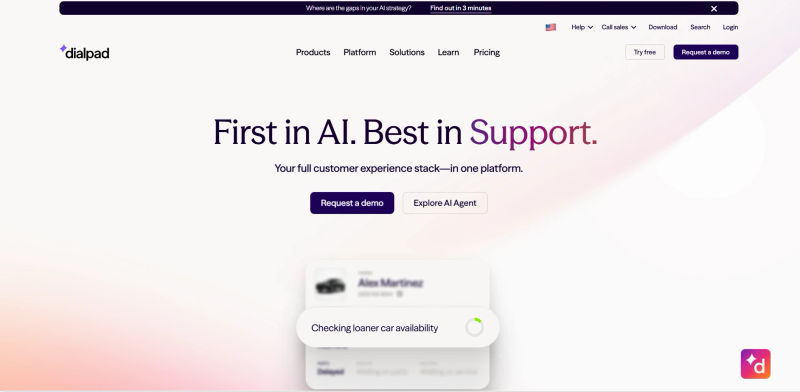
6. Dialpad
Dialpad was built from the ground up on the Google Cloud Platform, making it one of the most modern, AI-forward telephony solutions on the market in 2027.
Who is this best for? Dialpad is best for sales and support teams that rely on AI-powered analytics, real-time coaching, and live transcription to improve performance.
Key Features:
Proprietary Voice Intelligence (Vi) for real-time call transcription.
Live sentiment analysis and automated post-call action items.
Real-time coaching cards that pop up to help reps handle objections.
Seamless scaling from a single user to thousands of seats instantly.
Pricing: Starts at $15.00 per user per month.
Why it beats 800.com: If you are a decision-maker looking to optimize team performance, Dialpad's AI features are lightyears ahead of 800.com.
Instead of just connecting calls, Dialpad actively helps your team close deals and resolve tickets faster through real-time AI assistance.
Their desktop and mobile applications are also incredibly lightweight, ensuring crisp call quality even on weaker Wi-Fi networks.
7. Ooma
Ooma (specifically Ooma Office) offers a unique hybrid approach, bridging the gap between traditional desk phones and modern cloud software.
Who is this best for? Ooma is best for startups and small businesses that have a physical office presence and want an easy hardware setup alongside their cloud features.
Key Features:
Plug-and-play compatibility with a wide range of IP desk phones.
Virtual receptionist to route calls professionally.
Ring groups to ensure inbound calls are always answered by available staff.
Support for legacy analog devices like traditional fax machines.
Pricing: Starts at $19.95 per user per month.
Why it beats 800.com: Not every startup is 100% remote.
If you have a physical office, retail space, or warehouse, Ooma provides the easiest transition from traditional landlines to VoIP.
It offers superior hardware support compared to 800.com's purely virtual approach, allowing you to seamlessly blend physical desk phones with modern cloud routing.

Best Omnichannel & Enterprise Competitors
For businesses with complex needs, global footprints, or specific industry requirements, a basic toll-free number provider won't cut it.
These five platforms offer robust Unified Communications as a Service (UCaaS) and omnichannel capabilities.
Find Perfect Software for Your Business
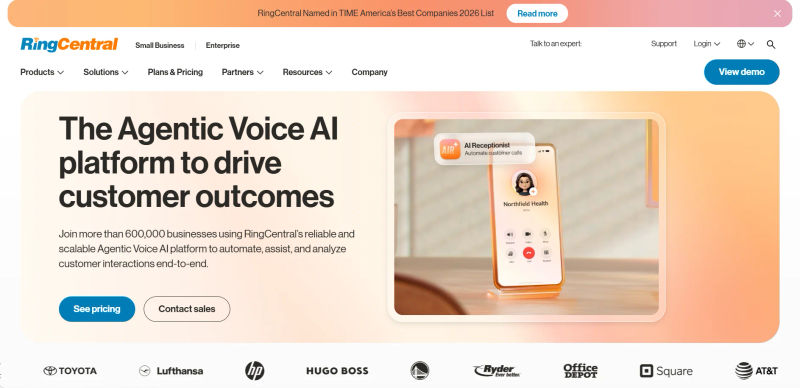
8. RingCentral
RingCentral is the undisputed heavyweight in the UCaaS space, offering an exhaustive feature set designed for maximum scalability and global reach.
Who is this best for? RingCentral is best for businesses that require global enterprise features, extensive third-party integrations, and the ability to deploy local and toll-free numbers internationally.
Key Features:
Over 300 out-of-the-box integrations with enterprise software.
Global presence with local numbers available in over 100 countries.
Advanced AI insights, call recording, and compliance archiving.
Unified app for message, video, and phone (MVP).
Pricing: Starts at $20.00 per user per month.
Why it beats 800.com: RingCentral is built for scale.
If your startup is expanding internationally, RingCentral offers International Toll-Free Service (ITFS) numbers in dozens of countries with predictable, flat-rate routing.
800.com's international capabilities are highly limited in comparison.
Furthermore, RingCentral provides dedicated account managers and 24/7 priority human support for its enterprise tiers, ensuring your global operations never miss a beat.
9. Zoom Phone
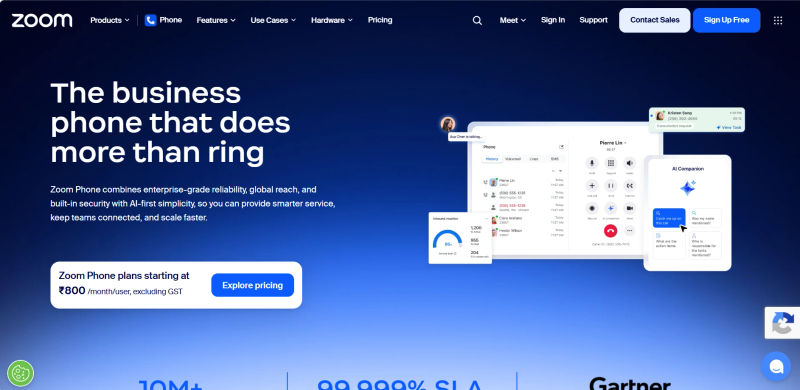
Leveraging its massive footprint in video conferencing, Zoom has built a highly competitive cloud phone system that integrates directly into its existing architecture.
Who is this best for? Zoom Phone is best for teams that already use Zoom for video meetings and want a seamless, unified interface for all internal and external communications.
Key Features:
Ability to elevate a voice call to a Zoom video meeting with one click.
Centralized admin portal for managing both video and voice licenses.
Familiar, highly intuitive user interface.
Robust call delegation and shared line appearance.
Pricing: Starts at $10.00 per user per month as an add-on to existing plans.
Why it beats 800.com: Consolidation is a major trend in 2027.
By choosing Zoom Phone, you eliminate the need for a separate telephony app like 800.com, reducing context switching for your employees and simplifying IT management.
Zoom Phone also offers excellent international toll-free add-ons, making it incredibly easy to spin up global numbers directly from the admin dashboard you already use.
10. Vonage
Vonage offers a unique blend of standard UCaaS features and powerful Communications Platform as a Service (CPaaS) APIs.
Who is this best for? Vonage is best for tech-heavy startups and developers who need customizable API integrations to embed voice and SMS directly into their own proprietary apps.
Key Features:
Vonage Business Communications (VBC) unified app.
Extensive API library for custom SMS, voice, and video routing.
Deep integration with Salesforce, Microsoft Teams, and G Suite.
Visual voicemail and advanced call screening.
Pricing: Starts at $19.99 per user per month.
Why it beats 800.com: 800.com is a closed system.
Vonage allows you to build custom communication workflows.
If you want to trigger an automated SMS from your business number when a user completes an action in your custom software, Vonage's APIs make it possible, offering a level of technical flexibility that legacy providers simply cannot match.

11. Weave
Weave takes a highly specialized approach, focusing entirely on the needs of local, service-based businesses rather than traditional office-based startups.
Who is this best for? Weave is best for service-based small businesses (like dental offices, optometry clinics, plumbing services, and salons) that need to combine telephony with client management.
Key Features:
Automated appointment reminders via two-way texting.
Integrated payment processing (Text-to-Pay).
Customer profiles that pop up on screen when they call.
Review management to automatically request Google reviews post-appointment.
Pricing: Custom pricing, typically around $399 per month per office location (includes multiple users).
Why it beats 800.com: Weave is an all-in-one growth platform for local businesses.
While 800.com provides a phone number, Weave provides a comprehensive system that reduces no-shows, collects payments faster, and drives online reviews.
For a local clinic or service provider, Weave directly impacts the bottom line in ways a standard toll-free number cannot.

12. GoTo Connect
Formerly known as Jive, GoTo Connect combines a robust cloud PBX system with the reliable video conferencing capabilities of GoTo Meeting.
Who is this best for? GoTo Connect is best for businesses that want a deeply integrated bundle of cloud telephony and reliable video meetings managed from a single, easy-to-use admin portal.
Key Features:
Visual dial plan editor for incredibly easy call routing setup.
Bundled international calling to over 50 countries.
High-quality softphone application for desktop and mobile.
Integrated GoTo Meeting licenses for all users.
Pricing: Starts at $27.00 per user per month.
Why it beats 800.com: GoTo Connect's visual dial plan editor is a game-changer for non-technical founders, allowing you to literally drag and drop your call routing flows on a digital canvas.
Combined with bundled international calling, it offers significantly more value and ease of use than 800.com for distributed teams.

How to Choose the Right Virtual Phone System for Your Business
Migrating from 800.com means upgrading to comprehensive cloud communications software. To avoid service interruptions and hidden costs, you must evaluate these cloud communications software alternatives based on more than just basic calling features.
When reviewing the 12 alternatives above, follow a structured approach to select the right cloud communications platform for your 2027 operations.
Join over 10,000+ businesses that made smarter software choices using AuthenCIO.
1. Calculate the Total Cost of Ownership (TCO)
Do not just look at the advertised monthly rate. To compare TCO over a 12-month period, build a template that includes:
Base Subscription: Monthly cost per user.
Usage Fees: Charges for exceeding minute or SMS limits.
Hidden Fees: Porting fees, setup costs, and regulatory compliance fees.
Add-ons: Costs for premium features like AI summaries, CRM integrations, or toll-free number rentals.
Many businesses find that a $20/month unlimited plan (like Nextiva) is ultimately cheaper than a $10/month metered plan once hidden SMS and minute overages are factored in.
2. Verify Call Quality and Mobile App Reliability
In 2027, poor call quality is unacceptable.
During your free trial period, test the platform's latency and jitter. Make test calls on cellular data, home Wi-Fi, and office networks.
Look for providers that boast a 99.999% uptime Service Level Agreement (SLA).
Additionally, monitor the mobile app's battery drain.
A common pitfall of cheaper VoIP providers is a poorly optimized app that kills your smartphone battery by mid-day. Providers like Grasshopper and Dialpad have specifically optimized their apps to prevent this.
3. Audit Your CRM and Workflow Integrations
A phone system should not exist in a silo.
Ensure the alternative you choose integrates natively with your existing tech stack.
If you use HubSpot, Salesforce, or Zoho, platforms like RingCentral, Dialpad, and Nextiva will automatically log calls, sync recordings, and pull up customer records instantly via "Call Pop" features.
This eliminates manual data entry and drastically improves team productivity.
4. Follow a 5-Step Migration Checklist
To migrate your business number from 800.com without dropping calls, follow this checklist:
Do not cancel 800.com yet: Your number must be active to port it.
Sign up for the new provider: Secure your new account and request a temporary number.
Submit a Letter of Authorization (LOA): Provide your new carrier with your 800.com account details and PIN to initiate the porting process.
Set up your new routing: Configure your auto-attendants, voicemail, and user extensions on the new platform using the temporary number.
Test and Cutover: Once the port completes (usually 3-10 days), test inbound and outbound calls. Only then should you officially cancel your 800.com account.
5. Navigate 2027 A2P 10DLC Regulatory Compliance
In 2027, the telecommunications industry strictly enforces A2P (Application-to-Person) 10DLC (10-Digit Long Code) regulations.
This means small businesses can no longer send outbound SMS messages from a virtual number without registering their brand and campaign with The Campaign Registry.
If you fail to register, major carriers (like AT&T and Verizon) will block your business texts, and you may face heavy fines.
When choosing an 800.com alternative, you must select a provider that simplifies this process.
Platforms like RingCentral, Phone.com, and Nextiva have built-in compliance wizards that guide you through A2P 10DLC registration directly within their admin dashboards, ensuring your marketing and transactional texts reach your customers without interruption.
Try AuthenCIO
Move to faster, smarter software evaluation with AI
Conclusion: Which 800.com Competitors Win in 2027?
Transitioning from legacy systems to modern cloud communications software provides businesses with better value, advanced AI tools, and seamless workflow integrations. While 800.com offers basic toll-free routing, the top 2027 alternatives deliver comprehensive unified communications at a lower total cost of ownership.
To summarize the top cloud communications software alternatives for different business stages:
For Solo Entrepreneurs: Grasshopper wins for its battery-optimized mobile app and clear separation of business and personal calls.
For Scaling Startups: Nextiva is the top choice due to its deep CRM integrations, reliable "Call Pop" features, and lightning-fast human customer support.
For Global Enterprises: RingCentral dominates with its unparalleled international toll-free availability and extensive 300+ app integration ecosystem.
Replacing outdated telephony with a robust cloud communications platform transforms your phone lines from a basic utility into a scalable, revenue-generating engine. Take the time to calculate your TCO, test mobile app reliability, and verify CRM integrations before migrating.